组成图示
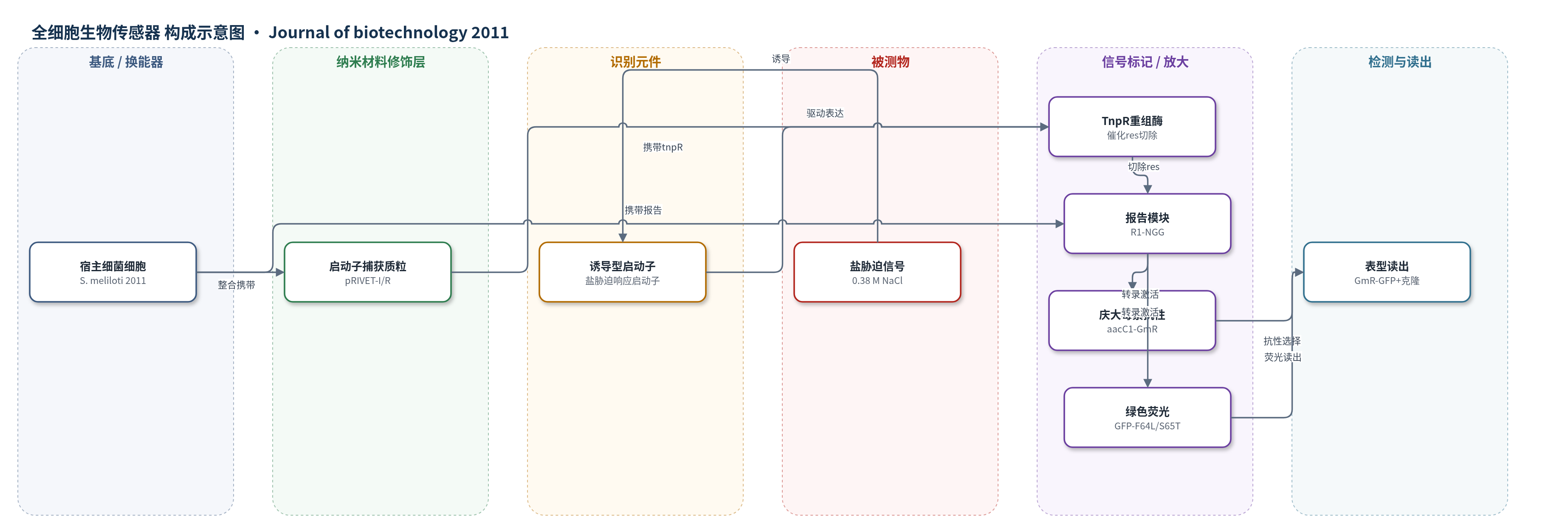
点击图片查看大图 · 依据论文自动绘制
传感器类型
全细胞生物传感器
检测对象
诱导启动子(induced promoters)、盐胁迫/氯化钠(NaCl, 0.38 M);样品基质:Sinorhizobium meliloti 2011 细菌培养物(TY 培养基/平板)。
检测原理
该全细胞遗传生物传感器以 S. meliloti 2011 为传感细胞。环境刺激(如 0.38 M NaCl 盐胁迫)激活宿主基因组或质粒插入片段中的诱导型启动子,驱动无启动子 tnpR-lacZ 融合转录,产生 Tn5 TnpR 重组酶。TnpR 识别报告模块 R-NGG/R1-NGG 中 res/res1 位点,催化切除 res 侧翼的 ΔNm/Km(nptII)抗性盒。切除后,原本被 nptII 盒中断的 nptII 启动子得以连续转录下游无启动子 aacC1-gfp 融合,使细胞获得庆大霉素抗性(GmR)并表达 GFP-F64L/S65T。诱导启动子活性越强或暴露时间越长,发生不可逆切除的克隆比例越高,最终通过 Gm 平板选择或蓝光荧光计数读出 GmR-GFP+ 克隆。
检测灵敏度
原文未报告 LOD、线性范围、灵敏度斜率或 R^2。
效应效果
系统在 S. meliloti 2011 中实现清晰正选择表型转换:NmR-GmS-GFP- 转为 NmS-GmR-GFP+,无 nptII-tnpR 融合质粒对照无变化,切除前荧光背景低。构建约 1.2×10^4 个 pRIVET-I 克隆,筛选去除自发切除率≥1% 克隆后保留约 6400 个,自发切除率由 2.5% 降至 0.22±0.08%,约降低十倍。0.38 M NaCl 胁迫下切除率 0.91±0.22%,对照 0.21±0.05%,p=0.005,约四倍增加;约 75% GmR 克隆对应盐诱导基因型。测序 3/15 为 Smc04182 下游 tnpR 融合,回接验证高盐切除率 13.5±1.8% 对 6.1±1.1%。作者认为该 sacB 独立正选择工具适用于构建重组生物传感器和发现复杂环境/宿主中诱导的细菌标记物。
传感器的构成
- 基底/换能器:Sinorhizobium meliloti 2011 宿主细菌细胞,作为全细胞传感平台并承载遗传模块。
- 修饰/捕获层:pRIVET-I(窄宿主范围整合型)或 pRIVET-R(广宿主范围复制型)质粒,携带无启动子 tnpR-lacZ 融合和 BglII 克隆位点。
- 识别元件:宿主基因组或质粒插入片段中的诱导型启动子(如盐胁迫响应启动子、Smc04182 下游区域),识别环境信号并驱动 tnpR 转录。
- 重组酶元件:Tn5 TnpR 解旋酶/重组酶(tnpR),由诱导启动子表达,催化 res/res1 位点特异性切除。
- 报告/选择模块:R-NGG 或 R1-NGG,含 nptII 启动子、res/res1 侧翼的 ΔNm/Km 抗性盒、无启动子 aacC1 和 gfp-F64L/S65T。
- 信号标记物:GFP-F64L/S65T 绿色荧光蛋白与 aacC1 庆大霉素抗性基因,切除后共同转录激活,产生 GmR-GFP+ 表型。
- 读出层:含庆大霉素(Gm)的 TY 平板选择与蓝光激发绿色荧光观察,用于计数 GmR-GFP+ 克隆。
中文摘要
RIVET(重组介导的体内表达技术)是一种用于鉴定复杂生物生态位中诱导基因的遗传工具,也可与调控蛋白和转录调控因子结合开发高灵敏生物传感器。RIVET 通常包括启动子捕获盒(产生 tnpR 基因组转录融合)和报告盒(携带 res 侧翼选择标记,tnpR 表达后切除,产生不可逆可遗传表型变化)。本文构建并验证一套新的正选择 RIVET 系统,启动子捕获模块诱导后激活抗生素抗性和绿色荧光表型。构建两类启动子捕获工具:基于窄宿主范围质粒 pRIVET-I(可在多种革兰氏阴性菌整合)和广宿主范围质粒 pRIVET-R。在模式土壤菌 Sinorhizobium meliloti 中评估,tnpR 表达后发生 NmR-GmS-GFP- 到 NmS-GmR-GFP+ 的清晰表型转换。构建 pRIVET-I 整合型 RIVET 文库,外界条件变化(如盐胁迫)显著增加 GmR-GFP+(切除)克隆出现。所描述的独立于 sacB 的正选择 RIVET 系统为构建新重组生物传感器和寻找微生物定殖/侵入复杂环境与真核宿主时诱导的细菌标记物提供基础工具。
英文摘要
RIVET (Recombination Based in vivo Expression Technology) is a powerful genetic tool originally conceived for the identification of genes induced in complex biological niches where conventional transcriptomics is difficult to use. With a broader application, genetic recombination-based technologies have also been used, in combination with regulatory proteins and specific transcriptional regulators, for the development of highly sensitive biosensor systems. RIVET systems generally comprise two modules: a promoter-trap cassette generating genomic transcriptional fusions to the tnpR gene encoding the Tn-γδ TnpR resolvase, and a reporter cassette carrying res-flanked selection markers that are excised upon expression of tnpR to produce an irreversible, inheritable phenotypic change. We report here the construction and validation of a new set of positive-selection RIVET systems that, upon induction of the promoter-trap module, generate the transcriptional activation of an antibiotic-resistant and a green-fluorescent phenotype. Two classes of promoter-trap tools were constructed to generate transcriptional fusions to tnpR: one based on the use of a narrow-host-range plasmid (pRIVET-I), integrative in several Gram-negative bacteria, and the other based on the use of a broad-host-range plasmid (pRIVET-R). The system was evaluated in the model soil bacterium Sinorhizobium meliloti, where a clear-cut phenotypic transition from Nm(R)-Gm(S)-GFP(-) to Nm(S)-Gm(R)-GFP(+) occurred upon expression of tnpR. A S. meliloti integrative RIVET library was constructed in pRIVET-I and, as expected, changes in the extracellular conditions (e.g., salt stress) triggered a significant increase in the appearance of Gm(R)-GFP(+) (excised) clones. The sacB-independent positive-selection RIVET systems here described provide suitable basic tools both for the construction of new recombination-based biosensors and for the search of bacterial markers induced when microorganisms colonize and invade complex environments and eukaryotic hosts.