组成图示
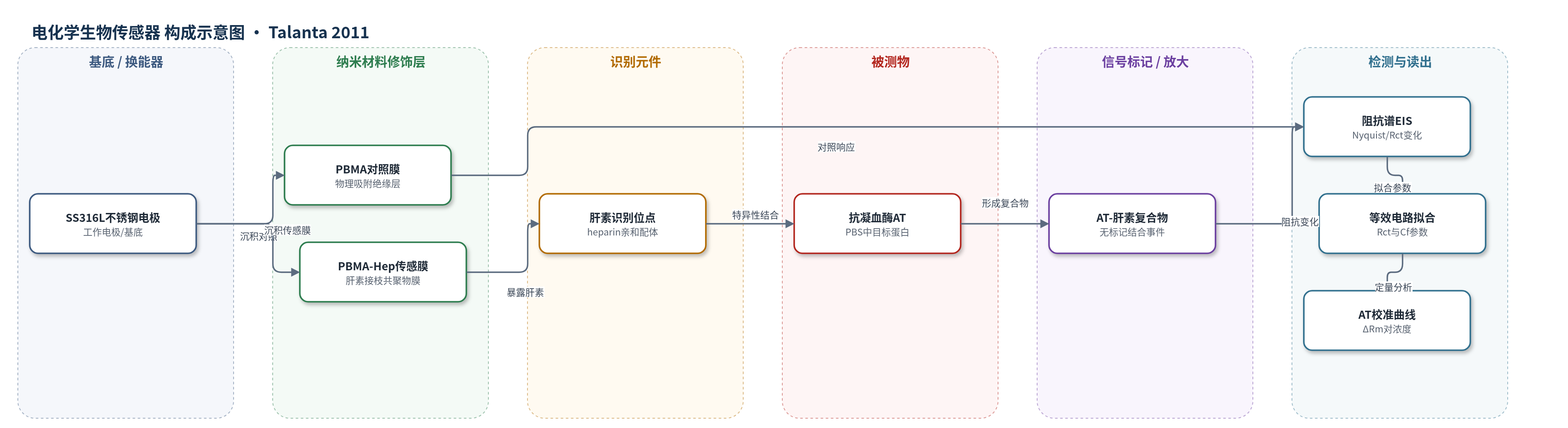
点击图片查看大图 · 依据论文自动绘制
传感器类型
电化学生物传感器
检测对象
抗凝血酶(antithrombin, AT/ATIII);样品基质:PBS缓冲液(pH 7.4)
检测原理
传感器以SS316L不锈钢为工作电极,表面物理吸附PBMA-Hep共聚物薄膜,其中肝素作为识别元件。PBS中AT与肝素特异性结合形成AT-肝素复合物,使蛋白质嵌入或吸附于聚合物膜内,增加膜厚度并改变界面介电常数。由于蛋白质和聚合物膜具有绝缘性,电子转移受到阻碍,电荷转移电阻Rct增大,膜电容Cf按Cf=εε0A/df下降。EIS在-290 mV、10 mV扰动、10 mHz–100 kHz下记录Nyquist谱,半圆直径随AT浓度增加而增大,0.15–0.25 U/ml呈线性,0.3 U/ml接近饱和。该过程为无标记检测,未使用酶催化或核酸放大。
检测灵敏度
LOD: 0.46 μmol/l;线性范围: 0.15 U/ml–0.25 U/ml(0.3 U/ml接近饱和)
效应效果
作者将EIS测量至少重复3次,表明涂层在测量过程中化学稳定、响应可重复且稳定,AT-肝素复合物自组装稳定。PBMA对照膜对AT无显著响应,而PBMA-Hep膜在0.15–0.25 U/ml呈线性,0.3 U/ml接近饱和,显示良好选择性,结论称具有优异特异性。与文献中纳米金修饰QCM传感器最低可检测浓度7.35×10^-7 mol/l以及酶免疫法测得肝素化表面结合AT约1 μmol/l相比,本文以0.46 μmol/l作为低检测限,作者认为方法简单且更灵敏。文中未报告实际样品加标回收率、RSD或抗干扰实验。
传感器的构成
- 基底电极:SS316L不锈钢片,机械抛光与超声清洗,作为EIS工作电极
- 聚合物修饰层:PBMA-Hep共聚物薄膜,THF/H2O溶液沉积并物理吸附,厚度约35 μm
- 识别元件:heparin(肝素)接枝于PBMA形成PBMA-Hep,作为亲和配体捕获AT
- 被测物:antithrombin(AT/ATIII),在PBS pH 7.4中逐步加入
- 电化学测量体系:PBS pH 7.4电解质、SCE参比电极与铂箔对电极,用于阻抗谱测量
中文摘要
本文报道了一种用于检测抗凝血酶(antithrombin,AT)的新型生物传感器。作者以肝素作为亲和识别配体,采用硝酸铈铵作为氧化还原引发剂,在硝酸水溶液中使丙烯酸酯单体丁基甲基丙烯酸酯聚合并接枝到肝素多糖上,得到肝素接枝聚丁基甲基丙烯酸酯(PBMA-Hep)共聚物。将该共聚物以薄膜形式沉积在不锈钢316L(SS316L)电极表面,形成传感界面。采用傅里叶变换红外光谱(FTIR)和差示扫描量热法(DSC)对聚合物结构进行表征,并通过电化学阻抗谱(EIS)、接触角测量和原子力显微镜(AFM)分析薄膜性质。EIS 用于研究传感器对 AT 的亲和结合以及修饰电极功能化生长与传感响应之间的关系。结果表明,该方案简单、灵敏,并与现有抗凝血酶检测方法具有相关性。
英文摘要
Specific recognition between two biological partners is widely exploited in biosensors nowadays. To explore this avenue, a novel biosensor for antithrombin (AT) detection was constructed. Heparin was used as the affinity ligand. A well-known acrylic monomer (butyl methacrylate) was polymerized and grafted onto the heparin polysaccharide by the use of ceric ammonium nitrate as a redox initiator in aqueous nitric acid medium. Polymers were deposited as a thin layer onto surface of stainless steel electrode (SS316L). The obtained polymers were studied by Fourier transform infrared spectroscopy (FTIR) and analyzed by differential scanning calorimetry (DSC). Moreover, the films were characterized by electrochemical impedance spectroscopy (EIS), contact-angle measurements and AFM. EIS was used to study the biosensor affinity to AT and the relationship between functionalization growth of modified electrode and the response of the sensor. The proposed approach appears to be simple, sensitive and correlated with methods that analyse the detection of antithrombin.