组成图示
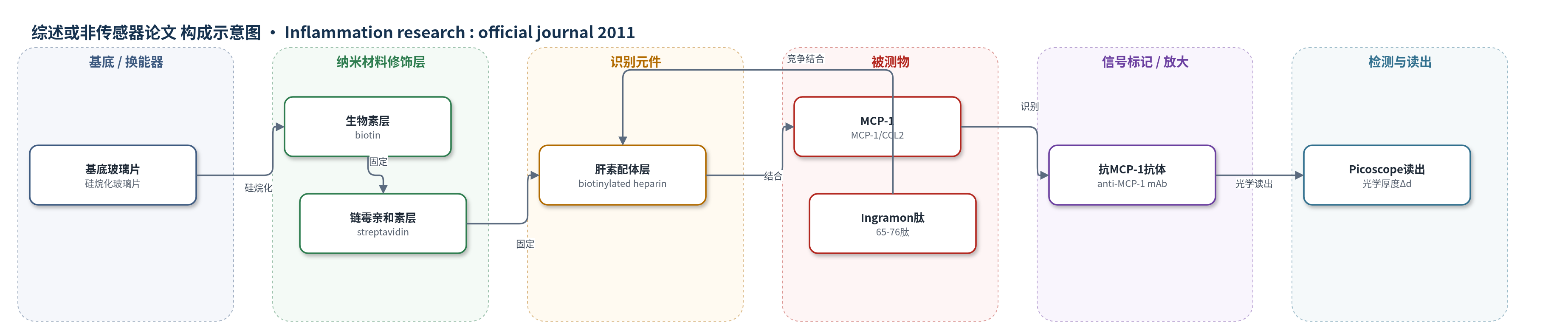
点击图片查看大图 · 依据论文自动绘制
传感器类型
综述或非传感器论文
检测对象
MCP-1(monocyte chemotactic protein-1,CCL2)、IL-8(interleukin-8);样品基质:重组蛋白溶液(PBS+0.15% BSA)、患者血浆/血清
检测原理
Picoscope以硅烷化玻璃片为基底,经生物素—链霉亲和素固定生物素化肝素。MCP-1通过C端碱性氨基酸与肝素结合,抗MCP-1抗体再结合MCP-1,使分子层厚度增加。Picoscope记录平均光学厚度n×Δd的皮米级变化,MCP-1浓度越高,Δd越大。Ingramon与肝素结合位点竞争,减少MCP-1固定和抗体结合,降低Δd。ELISA中肝素固定于96孔板,MCP-1结合后经抗MCP-1抗体和HRP二抗识别,OPD/H2O2显色,492 nm吸光度随结合量变化;Ingramon竞争抑制使吸光度下降。
检测灵敏度
—
效应效果
Ingramon组33例较对照组34例,支架术后第1、2、7天hsCRP和纤维蛋白原升高较低,血浆MCP-1第1、2天下降,无副作用。机制上,Ingramon不影响MCP-1诱导THP-1细胞Ca2+流、单核细胞Mac-1外化及MCP-1二聚化。Picoscope测得MCP-1—肝素KD为0.44 μM;100 μg/ml Ingramon使Δd降至约0.15 nm。ELISA中150 μg/ml抑制MCP-1—肝素结合最强,并较弱抑制IL-8—肝素结合。作者认为其可竞争阻断趋化因子与糖胺聚糖结合,具抗炎和支架后再狭窄防治潜力。
传感器的构成
- 基底/换能器:显微玻璃片(microscopic glass slips),硅烷化后作为Picoscope无标记生物传感器芯片,用于光学厚度检测
- 固定层:生物素(biotin)覆盖硅烷化玻璃表面,提供链霉亲和素固定位点
- 亲和素层:链霉亲和素(streptavidin,50 μg/ml),固定生物素化肝素
- 识别/配体层:生物素化肝素(biotinylated heparin,100 μg/ml),作为MCP-1结合的糖胺聚糖配体
- 被测物:MCP-1(monocyte chemotactic protein-1,CCL2),在含0.15% BSA的PBS中流过芯片
- 信号标记:抗MCP-1单克隆抗体(anti-MCP-1 mAb,clone 5D3-F7,20 μg/ml),结合已固定MCP-1以确认结合
- 读出:Picoscope无标记生物传感器,记录分子层平均光学厚度(n×Δd)的皮米级变化
中文摘要
目的:MCP-1 C端肽Ingramon可抑制单核细胞迁移并在炎症及支架后再狭窄动物模型中显示抗炎活性。本研究评估其用于冠脉支架术后患者对急性期反应物和趋化因子的影响及机制。对象:87例缺血性心脏病患者行冠脉造影,67例植入支架,其中33例加用Ingramon,20例仅造影。方法:检测hsCRP和纤维蛋白原;血浆趋化因子用ELISA或流式珠阵免疫分析;流式细胞术检测细胞内Ca2+和整合素暴露;SDS-PAGE分析MCP-1二聚化;生物传感器和ELISA检测MCP-1与肝素结合。结果:Ingramon组术后hsCRP和纤维蛋白原升高幅度较低,血浆MCP-1下降;不影响MCP-1受体结合或二聚化,但抑制MCP-1与肝素结合。结论:其抗炎作用可能通过削弱趋化因子与糖胺聚糖相互作用介导。
英文摘要
OBJECTIVE AND DESIGN: The peptide from C-terminal domain of MCP-1 (Ingramon) has been shown to inhibit monocyte migration and possess anti-inflammatory activity in animal models of inflammation and post-angioplasty restenosis. Here, we investigate the effect of Ingramon treatment on blood levels of acute-phase reactants and chemokines in patients after coronary stenting and the mechanisms of Ingramon anti-inflammatory activity.
SUBJECTS: Eighty-seven patients with ischemic heart disease (IHD) who faced the necessity of coronary angiography (CA) were enrolled. In 67 patients, one-stage coronary stenting was performed; 33 of them were treated with Ingramon in addition to standard therapy. Twenty patients underwent CA only.
METHODS: High-sensitivity C-reactive protein (hsCRP) and fibrinogen blood levels were detected routinely. The chemokine concentration in plasma was measured by enzyme-linked immunosorbent assay (ELISA) or cytometric bead array-based immunoassay. Intracellular Ca(2+) levels and cell surface integrin exposure were assayed by flow cytometry. MCP-1 dimerization was studied by sodium dodecyl sulfate polyacrylamide gel electrophoresis (SDS-PAGE). MCP-1-heparin binding was assessed with a biosensor and ELISA.
RESULTS AND CONCLUSIONS: Ingramon treatment was accompanied by less pronounced elevation of hsCRP and fibrinogen levels and decreased MCP-1 concentration in plasma in patients after coronary stenting. Ingramon had no effect on MCP-1 interaction with cell receptors or MCP-1 dimerization, but inhibited MCP-1 binding to heparin. The anti-inflammatory activity of the peptide may be mediated by an impaired chemokine interaction with glycosaminoglycans.