组成图示
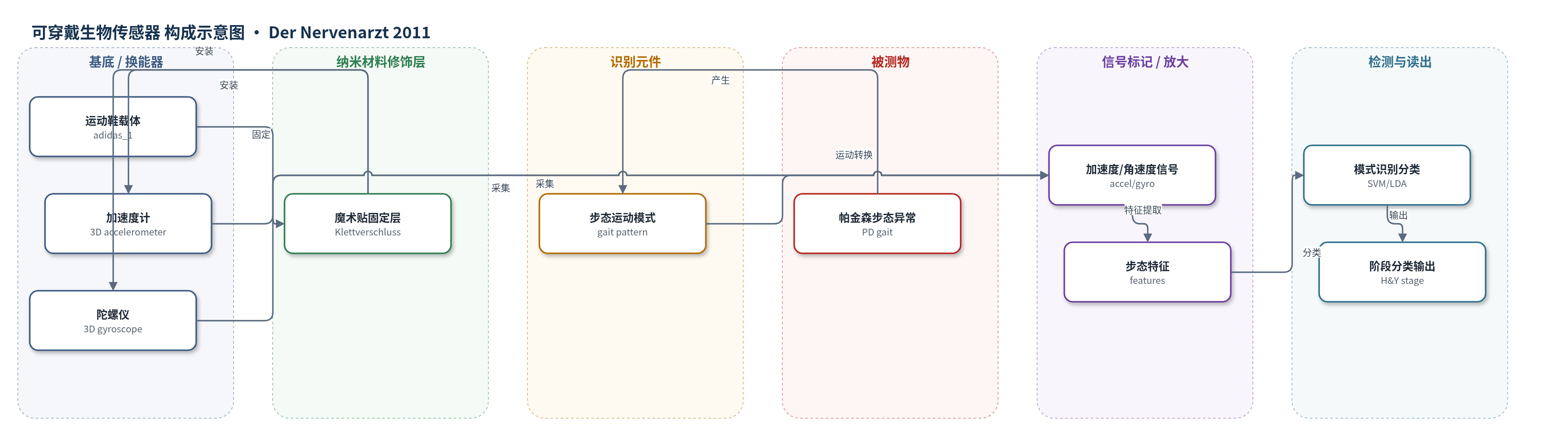
点击图片查看大图 · 依据论文自动绘制
传感器类型
可穿戴生物传感器
检测对象
帕金森综合征步态异常(Parkinson's disease gait disorder, PD gait)、运动波动/疾病阶段(motor fluctuations / Hoehn & Yahr stage);样品基质:人体步态运动信号(加速度计/陀螺仪信号)
检测原理
受试者穿着装有加速度计和陀螺仪的运动鞋完成标准化步态任务。帕金森综合征的运动障碍会改变步速、步时、摆动相、足部旋转和运动节律,使机械运动模式偏离健康对照。加速度计将三轴线性加速度转换为电信号,陀螺仪将三轴角速度转换为电信号,信号经蓝牙无线传输至计算机。系统通过傅里叶变换、极值、均值、标准差、熵、回归线和频率能量等提取步态特征,并用SVM或LDA在高维特征空间进行分类。疾病越重,特征偏离越大,分类结果越倾向于中期患者。该方案无化学放大,依靠多传感器信号融合、多特征提取和模式识别提高区分能力。
检测灵敏度
灵敏度/特异度: 90/92%(H&Y I vs 对照);100/100%(H&Y III vs 对照);100/100%(H&Y I vs H&Y III);R^2 = 0.604(主导频率与步时相关)
效应效果
本研究纳入20例特发性帕金森综合征患者(10例H&Y 1,10例H&Y 2.5–3.0)和12例年龄匹配对照。中期组UPDRS第III部分评分为35.2±11.2,较早期组8.4±4.0显著升高约4.2倍(p<0.01);左旋多巴等效剂量为634±359 mg,高于早期组347±465 mg(p=0.071)。系统对早期患者与对照的分类灵敏度/特异度为90%/92%,中期患者与对照为100%/100%,早期与中期患者之间为100%/100%。作者认为该方法可客观补充UPDRS主观评分,用于日常步态监测和运动波动评估。
传感器的构成
- 载体/基底:adidas_1运动鞋外侧踝下,作为传感器佩戴载体,保证标准化测量条件
- 固定层:魔术贴(Klettverschluss),将传感器模块固定于鞋外侧
- 换能器/传感元件:Shimmer Research 3D加速度计,测量三轴加速度(g)
- 换能器/传感元件:Shimmer Research 3D陀螺仪,测量三轴角速度(°/s)
- 通信模块:Bluetooth无线传输,将传感数据发送至计算机
- 识别/分析层:模式识别算法(SVM、LDA、特征提取与特征选择),从运动信号中提取步态特征并分类
- 信号读出:计算机/软件,输出患者/对照及疾病阶段分类结果
中文摘要
特发性帕金森综合征(IPS)以进行性运动和非运动症状为特征,给不同阶段的诊断和治疗带来挑战。本研究测试一种移动、计算机辅助的生物传感器步态分析系统,用于早期和中期帕金森患者与健康对照的比较。受试者穿着装有运动传感器的运动鞋完成标准化步态任务,包括正常行走、脚跟-脚尖点地和画圈运动。传感器采集三轴加速度和角速度信号,并通过无线方式传输至计算机。研究采用傅里叶变换、极值、均值、标准差、熵、回归线和频率能量等方法提取步态特征,再用支持向量机(SVM)和线性判别分析(LDA)进行分类。结果表明,该系统能够区分帕金森患者与对照,识别早期患者,并区分早期与中期患者。作者认为,移动生物传感器步态分析可为帕金森综合征的早期发现和日常运动波动监测提供客观工具,辅助患者、家属和治疗师。
英文摘要
Parkinson's disease (PD) is characterized by progressive motor and non-motor symptoms, leading to distinct diagnostic and therapeutic challenges in all stages of the disease. This study investigated a mobile biosensor-based gait analysis system for patients in early and intermediate stages of PD compared to controls. Subjects wearing a motion sensor-equipped shoe performed a standardized gait exercise. Accelerometer- and gyroscope-based signals were analysed using a complex set of pattern recognition algorithms. The analysis was able (1) to distinguish between PD patients and controls, (2) to identify patients at an early stage of the disease and (3) to distinguish between early and intermediate stage patients. Thus, using this mobile biosensor-based analysis system we were able to obtain objective classifications of gait characteristics in PD. Future studies will show that mobile biosensor-based movement detection technology will support identification of early PD stages and allow objective characterization of motor fluctuations in advanced stages of the disease. This will provide an important and supportive tool for patients, caregivers and therapists.