组成图示
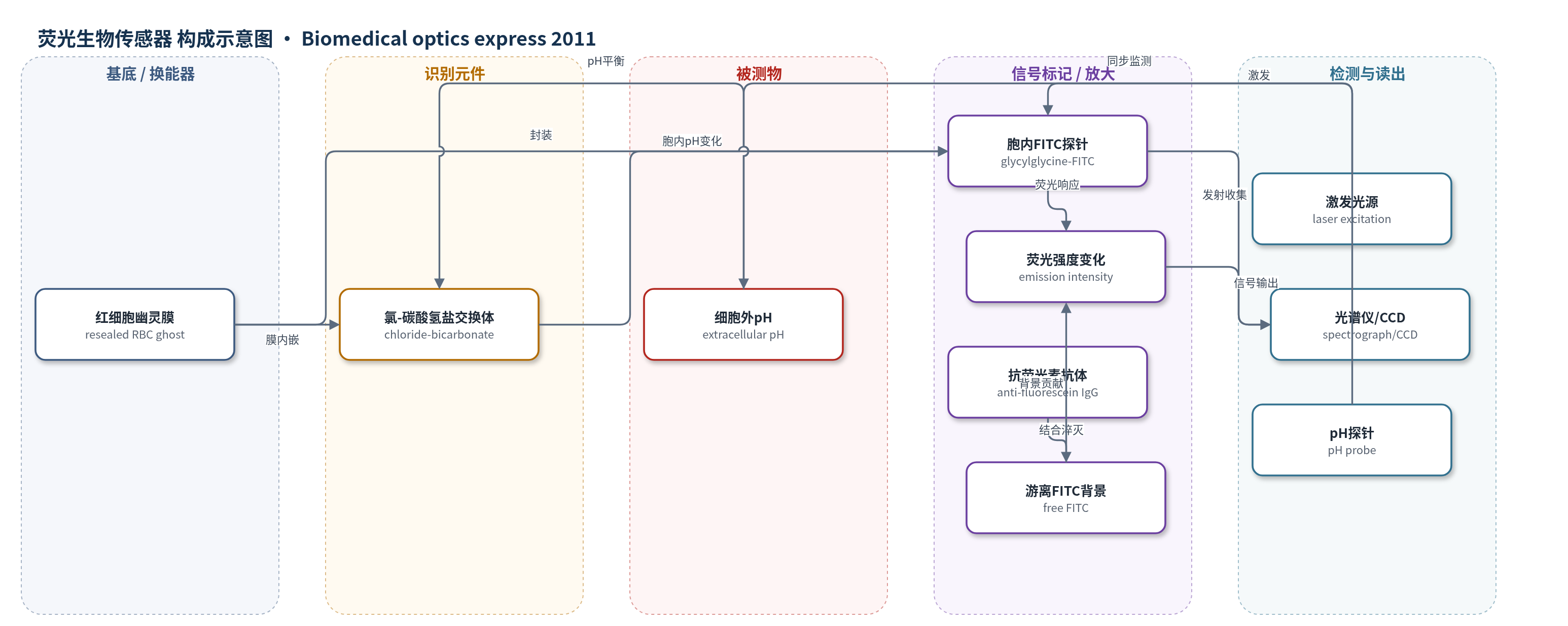
点击图片查看大图 · 依据论文自动绘制
传感器类型
荧光生物传感器
检测对象
细胞外pH(extracellular pH);样品基质:重封红细胞幽灵悬浮于等渗NaCl/PBS溶液(体外血液模拟环境)
检测原理
细胞外pH变化通过红细胞膜上的氯-碳酸氢盐交换体快速传入细胞内,使胞内pH与胞外pH平衡,交换半衰期小于1秒。封装在重封红细胞幽灵内的甘氨酰甘氨酸-FITC偶联物随胞内pH改变质子化状态;FITC的pKa约为6.4,pH升高时荧光强度增加。外部激光在440或488 nm激发胞内FITC,收集500–570 nm或514 nm发射荧光,荧光强度随细胞外pH升高而增强。抗荧光素抗体可结合并淬灭胞外游离FITC偶联物,降低背景。系统无酶促或核酸放大,信号为激发体积内所有装载幽灵的积分,因此可连续、可逆地报告pH。
检测灵敏度
灵敏度: 0.44 per pH unit;分辨率: 0.014 pH unit(动态系统);分辨率: 优于0.1 pH unit(静态系统);线性范围: pH 6.5–~7.4;pK: 6.65和6.59
效应效果
重封红细胞幽灵传感器在生理pH范围内可逆追踪pH变化,动态系统分辨率达0.014 pH单位,静态系统优于0.1 pH单位。响应时间通常小于1分钟;25分钟探测中,两次约pH 7的测量在16分钟、9次测量间隔内荧光强度在实验误差内一致,表明可逆且无明显光漂白。30分钟完整性测试中,第二次添加抗荧光素抗体前后荧光强度在实验误差内相同,提示膜未显著释放FITC偶联物。装载效率为30%–80%,约50%幽灵含染料。作者认为该平台可避免免疫生物污染,正常红细胞寿命约120天,有望实现1–2个月以上连续监测。
传感器的构成
- 载体基底:重封红细胞幽灵(resealed red cell ghosts, RBC ghosts)——提供生物相容循环载体与膜屏障。
- 识别/平衡元件:氯-碳酸氢盐交换体(chloride-bicarbonate exchanger)——使胞内pH快速平衡胞外pH。
- 信号标记物:甘氨酰甘氨酸-FITC偶联物(glycylglycine-FITC conjugate)——胞内pH敏感荧光探针,荧光强度随pH变化。
- 背景淬灭剂:抗荧光素抗体(anti-fluorescein/Oregon Green, rabbit IgG)——结合并淬灭胞外游离FITC偶联物。
- 换能读出:激发光源(Ti:sapphire laser/argon ion laser)与光谱仪-CCD/荧光计——激发440/488 nm,收集500–570 nm或514 nm荧光。
- 环境介质:等渗NaCl/PBS溶液——维持渗透压并稳定胞外pH。
中文摘要
长期、微创的血液分析物连续监测系统对糖尿病等疾病管理具有重要意义。现有指尖血糖检测依从性差,连续血糖监测仪寿命仅3–7天且需频繁校准。红细胞(RBCs)可作为生物相容性传感载体。本研究证明红细胞可装载分析物敏感荧光染料:将pH敏感荧光染料异硫氰酸荧光素(FITC)封装到重封红细胞幽灵中。由于红细胞通过氯-碳酸氢盐交换器快速与外部环境平衡,细胞内FITC可报告细胞外pH;细胞外pH升高时荧光强度增加。重封幽灵传感器在生理pH范围内可逆追踪pH变化,分辨率达0.014 pH单位。染料装载效率为30%–80%,但完全装载并非必需,因为荧光信号是激发体积内所有重封幽灵的积分。该重封幽灵有望作为寿命超过1–2个月的长期、连续循环生物传感器,用于糖尿病等疾病管理。
英文摘要
A need exists for a long-term, minimally-invasive system to monitor blood analytes. For certain analytes, such as glucose in the case of diabetics, a continuous system would help reduce complications. Current methods suffer significant drawbacks, such as low patient compliance for the finger stick test or short lifetime (i.e., 3-7 days) and required calibrations for continuous glucose monitors. Red blood cells (RBCs) are potential biocompatible carriers of sensing assays for long-term monitoring. We demonstrate that RBCs can be loaded with an analyte-sensitive fluorescent dye. In the current study, FITC, a pH-sensitive fluorescent dye, is encapsulated within resealed red cell ghosts. Intracellular FITC reports on extracellular pH: fluorescence intensity increases as extracellular pH increases because the RBC rapidly equilibrates to the pH of the external environment through the chloride-bicarbonate exchanger. The resealed ghost sensors exhibit an excellent ability to reversibly track pH over the physiological pH range with a resolution down to 0.014 pH unit. Dye loading efficiency varies from 30% to 80%. Although complete loading is ideal, it is not necessary, as the fluorescence signal is an integration of all resealed ghosts within the excitation volume. The resealed ghosts could serve as a long-term (>1 to 2 months), continuous, circulating biosensor for the management of diseases, such as diabetes.