组成图示
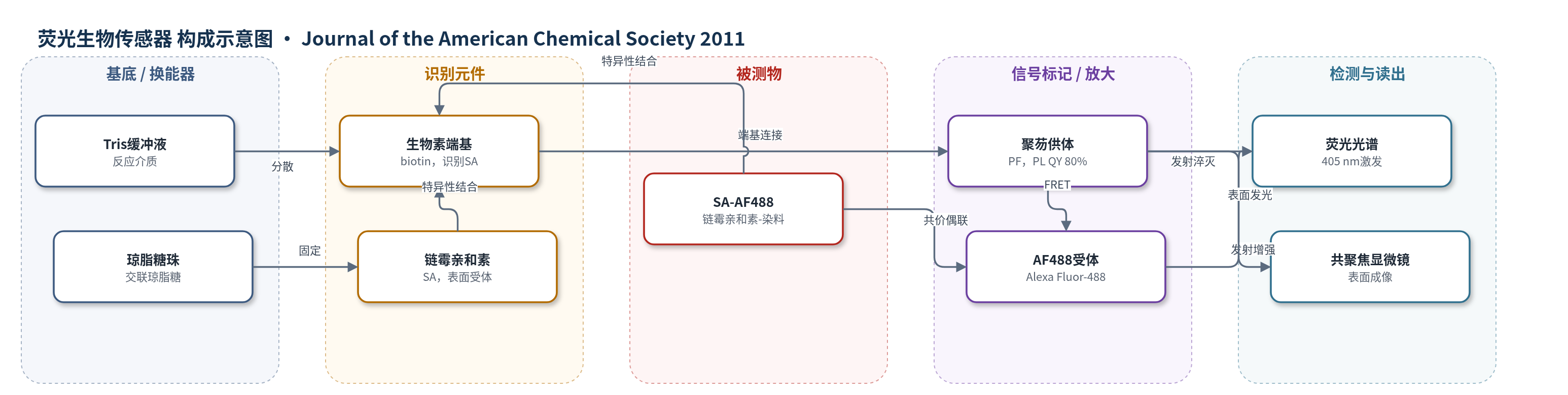
点击图片查看大图 · 依据论文自动绘制
传感器类型
荧光生物传感器
检测对象
链霉亲和素(streptavidin, SA)、链霉亲和素-Alexa Fluor-488偶联物(SA-AF488);样品基质:Tris缓冲液、链霉亲和素功能化交联琼脂糖珠表面
检测原理
该传感方案以生物素-链霉亲和素非共价结合为识别事件。生物素端基位于水溶性聚芴链端,当链霉亲和素-Alexa Fluor-488(SA-AF488)加入后,SA与生物素结合,使聚芴供体与AF488受体进入1–10 nm的FRET有效距离。聚芴具有大吸收截面和高PL量子产率,405 nm激发后通过π共轭链内激子迁移实现光捕获,并将能量非辐射转移至AF488,导致425 nm聚合物发射淬灭、520 nm染料发射增强。信号随SA-AF488浓度增加而增强,直至34.4 nM SA-AF488(相当于138 nM生物素结合位点)饱和。表面固定时,生物素化聚合物结合到链霉亲和素功能化琼脂糖珠上,405 nm激发产生蓝色荧光,用于成像。
检测灵敏度
—
效应效果
该材料在Tris缓冲液中表现出良好的生物识别选择性:无生物素端基的对照聚合物5或7与链霉亲和素-Alexa Fluor-488混合后,未出现明显聚合物荧光淬灭或染料发光,说明非特异性结合较低。FRET实验测得结合比例约0.8,与NMR和GPC估算的80%–90%生物素端基掺入率一致。水溶液中聚芴PL量子产率为0.8,405 nm激发时,FRET使AF488发射较直接激发增强5倍以上。表面实验中,链霉亲和素珠与生物素化聚合物8孵育后呈强蓝色荧光,对照5无荧光,共聚焦图像确认。论文未报告稳定性、RSD、回收率或与ELISA/HPLC/qPCR的定量对比,作者认为其适用于发光生物分析、体外标记和成像。
传感器的构成
- 荧光聚合物主体:水溶性聚芴(PF),9,9′-八聚乙二醇单甲醚侧链,提供水溶性、高PL量子产率(80%)和光捕获供体功能
- 端基反应基团:三甲基硅基乙炔端基(TMS-ethynyl),脱硅后形成末端炔,用于点击化学偶联
- 识别元件:生物素(biotin,经biotin-dPEG3+4-azide偶联),与链霉亲和素(SA)特异性结合
- 信号标记物:链霉亲和素-Alexa Fluor-488偶联物(SA-AF488),作为FRET受体,520 nm发射增强
- 表面固定基质:链霉亲和素功能化交联琼脂糖珠(streptavidin-functionalized cross-linked agarose beads),用于表面结合与成像
- 检测读出:荧光光谱与405 nm共聚焦显微镜,监测425 nm聚合物发射淬灭和520 nm AF488发射增强
中文摘要
本文报道了一类分子量可控、无离子基团、水溶性好且发射量子产率高的单功能化共轭聚合物,用于改善荧光生物传感器与成像应用。作者以2-溴-7-碘芴为预单体,在9,9′位引入八聚乙二醇单甲醚侧链,获得水溶性预单体4。通过高收率合成有机金属引发剂(dppe)Ni(Ph)Br,并在单晶X射线衍射中确认其结构,使预单体4在30秒内完成聚合,获得平均分子量与分散度均受控的聚芴。用[2-(三甲基硅基)乙炔基]溴化镁终止反应,得到三甲基硅基乙炔端基水溶性聚芴,其光致发光量子产率达80%。脱硅后通过铜催化叠氮-炔环加成反应,可方便地引入多种端基功能基;以生物素为例,所得生物素化共轭聚合物能与链霉亲和素结合,并作为光捕获发色团,光学放大结合在链霉亲和素上的Alexa Fluor-488发射。生物素端基还可将聚合物固定到链霉亲和素功能化交联琼脂糖珠上,从而引入大量光学活性片段。
英文摘要
Water-soluble conjugated polymers with controlled molecular weight characteristics, absence of ionic groups, high emission quantum yields, and end groups capable of selective reactions of wide scope are desirable for improving their performance in various applications and, in particular, fluorescent biosensor schemes. The synthesis of such a structure is described herein. 2-Bromo-7-iodofluorene with octakis(ethylene glycol) monomethyl ether chains at the 9,9'-positions, i.e., compound 4, was prepared as the reactive premonomer. A high-yielding synthesis of the organometallic initiator (dppe)Ni(Ph)Br (dppe = 1,2-bis(diphenylphosphino)ethane) was designed and implemented, and the resulting product was characterized by single-crystal X-ray diffraction techniques. Polymerization of 4 by (dppe)Ni(Ph)Br can be carried out in less than 30 s, affording excellent control over the average molecular weight and polydispersity of the product. Quenching of the polymerization with [2-(trimethylsilyl)ethynyl]magnesium bromide yields silylacetylene-terminated water-soluble poly(fluorene) with a photoluminescence quantum efficiency of 80%. Desilylation, followed by copper-catalyzed azide-alkyne cycloaddition reaction, yields a straightforward route to introduce a wide range of specific end group functionalities. Biotin was used as an example. The resulting biotinylated conjugated polymer binds to streptavidin and acts as a light-harvesting chromophore to optically amplify the emission of Alexa Fluor-488 chromophores bound onto the streptavidin. Furthermore, the biotin end group makes it possible to bind the polymer onto streptavidin-functionalized cross-linked agarose beads and thereby incorporate a large number of optically active segments.