组成图示
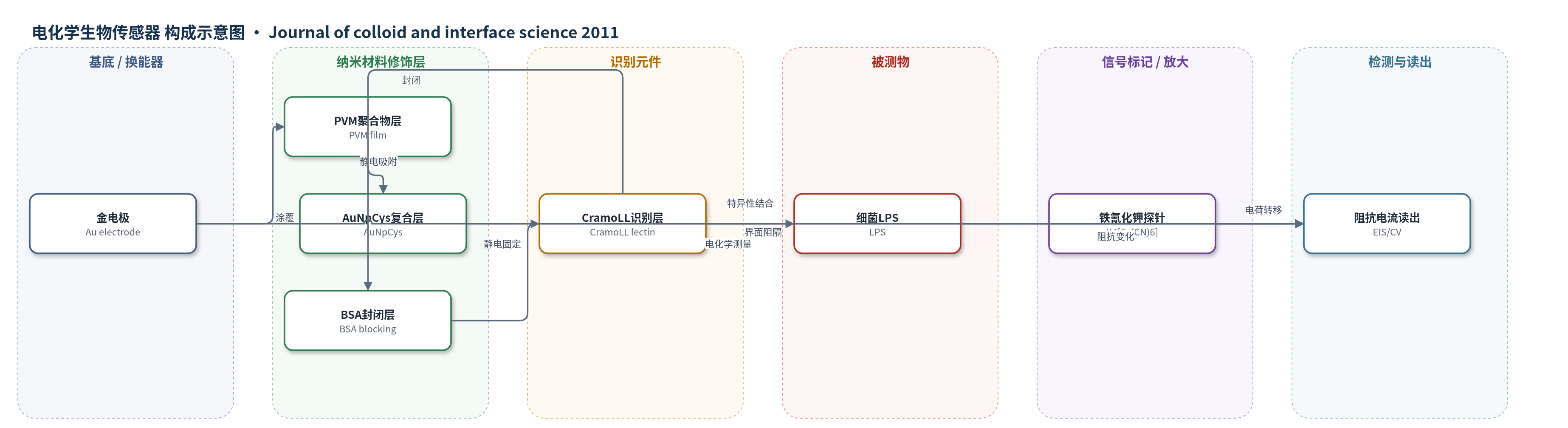
点击图片查看大图 · 依据论文自动绘制
传感器类型
电化学生物传感器
检测对象
大肠杆菌脂多糖(E. coli LPS)、粘质沙雷氏菌脂多糖(S. marcescens LPS)、肠沙门氏菌脂多糖(S. enterica LPS)、肺炎克雷伯菌脂多糖(K. pneumoniae LPS);样品基质:PBS 稀释的 LPS 溶液(10 mM pH 7.4 PBS)
检测原理
该传感器采用无标记阻抗检测。PVM 负电荷网络与带正电的 AuNpCys 通过静电作用结合,CramoLL 凝集素再静电固定于表面,其糖基结合位点可识别细菌 LPS 中的葡萄糖、甘露糖等残基。LPS 结合后,在电极界面形成更厚的生物阻隔层,增加 [Fe(CN)6]3-/4- 探针接近金电极界面的阻力,使电子转移变慢。EIS 中表现为电荷转移电阻 Rct 增大,CV 中表现为阳极峰电流降低和峰电位分离增大。LPS 浓度越高,界面阻隔越强,ΔRct 越大。葡萄糖可竞争占据 CramoLL 结合位点,使后续 LPS 结合受阻,Rct 增加不显著,从而验证识别机制。
检测灵敏度
原文未报告 LOD、线性范围、灵敏度斜率或相关系数。
效应效果
该传感器对四种细菌 LPS 均有响应并具菌株选择性:200 μg/mL 时 ΔRct 分别为大肠杆菌 137.45%、肠沙门氏菌 105.49%、粘质沙雷氏菌 264.60%、肺炎克雷伯菌 13.74%;CV ΔI 分别为 89.96%、15.91%、190.7%、1.02%。葡萄糖预占 CramoLL 位点后 LPS 响应不显著,证明识别依赖糖基结合。重现性 RSD 为 4.89%–5.78%。20 min 孵育使响应增大并趋于饱和。原文未报告实际样品回收率或与 LAL/ELISA 的定量对比,但作者认为可用于内毒素污染监测。
传感器的构成
- 基底/换能器电极:金电极(Au electrode),经抛光和超声清洗,作为电化学阻抗与伏安信号换能器。
- 聚合物修饰层:聚(氯乙烯-醋酸乙烯-马来酸)(PVM),形成带负电荷网络,提供静电吸附位点并阻碍电子转移。
- 纳米材料修饰层:L-半胱氨酸-金纳米颗粒复合体(AuNpCys,AuNPs 约15 nm),通过静电作用吸附于 PVM,提供高比表面积和电子传递通道。
- 识别元件:CramoLL 凝集素(CramoLL lectin,来自 Cratylia mollis 种子),通过静电作用固定于 AuNpCys–PVM 表面,特异性识别 LPS 糖基/甘露糖基等结构。
- 封闭剂:牛血清白蛋白(BSA,0.2% PBS),封闭剩余活性位点,降低非特异性吸附。
- 氧化还原探针/信号标记物:K4[Fe(CN)6]4-/K3[Fe(CN)6]3-(铁氰化钾/亚铁氰化钾,1:1,10 mM PBS + 0.1 M KCl),用于 EIS/CV 监测界面电荷转移变化。
中文摘要
本文报道了一种用于细菌脂多糖(LPS)的新型选择性电化学生物传感器。该传感器以裸金电极为基底,先在其表面构建聚(氯乙烯-醋酸乙烯-马来酸)(PVM)层,再通过静电作用固定 L-半胱氨酸-金纳米颗粒复合体(AuNpCys),最后将 CramoLL 凝集素自组装于 PVM–AuNpCys 修饰电极表面,作为识别元件。原子力显微镜(AFM)图像表明,LPS 可在 PVM–AuNpCys–CramoLL 表面被特异性识别。循环伏安(CV)和电化学阻抗谱(EIS)结果显示,PVM–AuNpCys–CramoLL 修饰层阻碍了氧化还原探针 K4[Fe(CN)6]4-/K3[Fe(CN)6]3- 的电子转移。实验表明,CramoLL 在修饰后仍保持生物活性,可识别大肠杆菌、粘质沙雷氏菌、肠沙门氏菌和肺炎克雷伯菌的 LPS。作者以电荷转移电阻和阳极峰电流作为输出信号,提出了一种可用于内毒素污染检测、并能对不同类型 LPS 进行选择性鉴别的高灵敏度传感器。
英文摘要
We report the development of a new selective and specific electrochemical biosensor for bacterial lipolysaccharide (LPS). An electrode interface was constructed using a l-cysteine-gold nanoparticle (AuNpCys) composite to be immobilized by electrostatic interaction in the network of a poly(vinyl chloride-vinyl acetate maleic acid) (PVM) layer on a gold bare electrode. The impedimetric biosensor is fabricated by self-assembled CramoLL lectin on the PVM-AuNpCys-modified gold electrode through electrostatic interaction. CramoLL is used as the recognition interface. AFM images showed that LPS was specifically recognized on the PVM-AuNpCys-CramoLL system surface. The measurements of cyclic voltammetry (CV) and electrochemical impedance spectroscopy (EIS) showed that the electrochemical response of a redox probe system (K(4)[Fe(CN)(6)](4-)/K(3)[Fe(CN)(6)](3-)) were blocked, due to the procedures of modified electrode with PVM-AuNpCys-CramoLL. In the majority of the experiments the lectin retained its activity as observed through its interaction with LPS from Escherichia coli, Serratia marcescens, Salmonella enterica and Klebsiella pneumoniae. The results are expressed in terms of the charge transfer resistance and current peak anodic using the EIS and CV techniques for the development of a biosensor for contamination by endotoxins. A new type of sensor for selective discrimination of LPS types with a high sensitivity has been obtained.