组成图示
点击图片查看大图 · 依据论文自动绘制
传感器类型
综述或非传感器论文
检测对象
埃博拉病毒(Ebolavirus,含 Zaire、Sudan、Reston、Bundibugyo、Côte d’Ivoire);样品基质:灭活/活病毒稀释液、Vero 细胞裂解液、模拟感染细胞制备物;未实际测试临床或环境样品。
检测原理
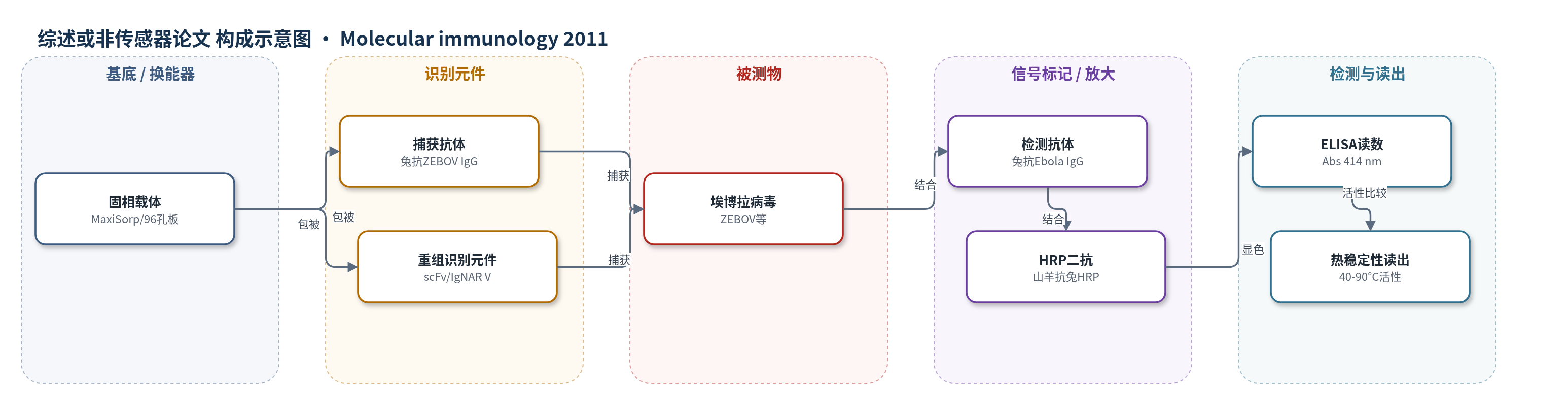
该研究未构建传感器,而是采用夹心 ELISA 免疫检测。兔抗 Zaire 埃博拉 IgG 或重组 scFv/IgNAR V 先固定于固相载体,形成捕获层;样品中的埃博拉病毒颗粒或蛋白与捕获抗体特异性结合,结合量随病毒浓度增加而增加。IgNAR V 主要识别核蛋白 NP,scFv 识别基质蛋白 VP40。随后加入兔抗埃博拉多克隆 IgG 作为检测抗体,再加入 HRP 标记二抗,通过酶促显色产生吸光度信号。信号大小反映捕获的病毒量。热稳定性实验则通过不同温度孵育后 ELISA 活性百分比评价抗体不可逆变性。未使用 HCR、RCA 或 CRISPR-Cas 等核酸/酶催化放大策略。
检测灵敏度
LOD: Reston 埃博拉病毒 6 × 10^4 pfu ml−1 (DSTL096) 至 2 × 10^3 pfu ml−1 (DSTL097);Sudan 埃博拉病毒 2 × 10^5 pfu ml−1 (DSTL96) 至 7 × 10^3 pfu ml−1 (DSTL97)。原文未报告线性范围、灵敏度斜率或 R^2。
效应效果
IgNAR V 捕获 ELISA 对 Reston、Sudan 和 Bundibugyo 埃博拉病毒交叉反应,但对 Côte d’Ivoire 埃博拉病毒无反应;对 Lake Victoria 马尔堡病毒和模拟感染 Vero 细胞制备物无反应。scFv 仅捕获 Zaire 埃博拉病毒,种属区分能力更强。热稳定性方面,scFv 在 50°C 孵育 3 h 后完全失活,DSTL094 在 40°C 保留 95% 活性,DSTL095 仅保留 6%;小鼠 mAb 在 60°C 保留 91±4% 和 94±2%,70°C 完全失活;IgNAR V 在 70°C 保留约 80%,80°C 时 DSTL097 保留 42±1%、DSTL096 保留 31±3%,90°C 完全失活,且高温下未出现 scFv/mAb 的白色沉淀。研究未验证临床或环境实际样品。
传感器的构成
- 非传感器论文:未构建具体传感器,仅报道 ELISA/Western blot 免疫检测体系。
- 固相载体:MaxiSorp StarTubes 或 96 孔微孔板,用于固定捕获抗体。
- 捕获识别层:兔抗 Zaire 埃博拉 IgG 多克隆抗体或重组 scFv/IgNAR V,用于捕获病毒抗原。
- 封闭层:2% 脱脂奶粉 PBS,用于封闭非特异结合位点。
- 被测物:灭活或活埃博拉病毒(ZEBOV 等),与捕获抗体结合。
- 检测抗体:兔抗埃博拉多克隆 IgG,用于识别捕获的病毒。
- 信号标记物:HRP 标记山羊抗兔 IgG 或抗小鼠 HRP,用于酶促显色。
- 读出方式:ELISA 吸光度(Abs 414 nm)或 Western blot ECL 显影。
中文摘要
埃博拉病毒属可引起人和非人灵长类暴发,病死率最高可达90%。为在临床和环境样品中快速、灵敏、特异地检测这些病原体,需要稳健的免疫检测试剂。本研究以扎伊尔埃博拉病毒免疫小鼠和护士鲨,分别构建小鼠单链抗体(scFv)和鲨源新抗原受体可变区(IgNAR V)重组抗体库,并通过噬菌体展示生物筛选获得候选抗体。这是首次报道护士鲨针对颗粒性抗原产生 IgNAR V 应答。两个小鼠 scFv 对病毒基质蛋白 VP40 具有特异性;两个 IgNAR V 结合病毒核蛋白 NP,并能高灵敏度捕获有活力的扎伊尔埃博拉病毒。基于 IgNAR V 的 ELISA 对 Reston、Sudan 和 Bundibugyo 埃博拉病毒交叉反应,但对科特迪瓦埃博拉病毒无反应。与小鼠 scFv 和单克隆 IgG 相比,IgNAR V 对不可逆热变性显著更耐受。其稳健性有望用于热带或亚热带地区埃博拉出血热的现场生物传感器应用。
英文摘要
Members of the genus Ebolavirus cause fulminating outbreaks of disease in human and non-human primate populations with a mortality rate up to 90%. To facilitate rapid detection of these pathogens in clinical and environmental samples, robust reagents capable of providing sensitive and specific detection are required. In this work recombinant antibody libraries were generated from murine (single chain variable domain fragment; scFv) and nurse shark, Ginglymostoma cirratum (IgNAR V) hosts immunised with Zaire ebolavirus. This provides the first recorded IgNAR V response against a particulate antigen in the nurse shark. Both murine scFv and shark IgNAR V libraries were panned by phage display technology to identify useful antibodies for the generation of immunological detection reagents. Two murine scFv were shown to have specificity to the Zaire ebolavirus viral matrix protein VP40. Two isolated IgNAR V were shown to bind to the viral nucleoprotein (NP) and to capture viable Zaire ebolavirus with a high degree of sensitivity. Assays developed with IgNAR V cross-reacted to Reston ebolavirus, Sudan ebolavirus and Bundibugyo ebolavirus. Despite this broad reactivity, neither of IgNAR V showed reactivity to Côte d'Ivoire ebolavirus. IgNAR V was substantially more resistant to irreversible thermal denaturation than murine scFv and monoclonal IgG in a comparative test. The demonstrable robustness of the IgNAR V domains may offer enhanced utility as immunological detection reagents in fieldable biosensor applications for use in tropical or subtropical countries where outbreaks of Ebolavirus haemorrhagic fever occur.