组成图示
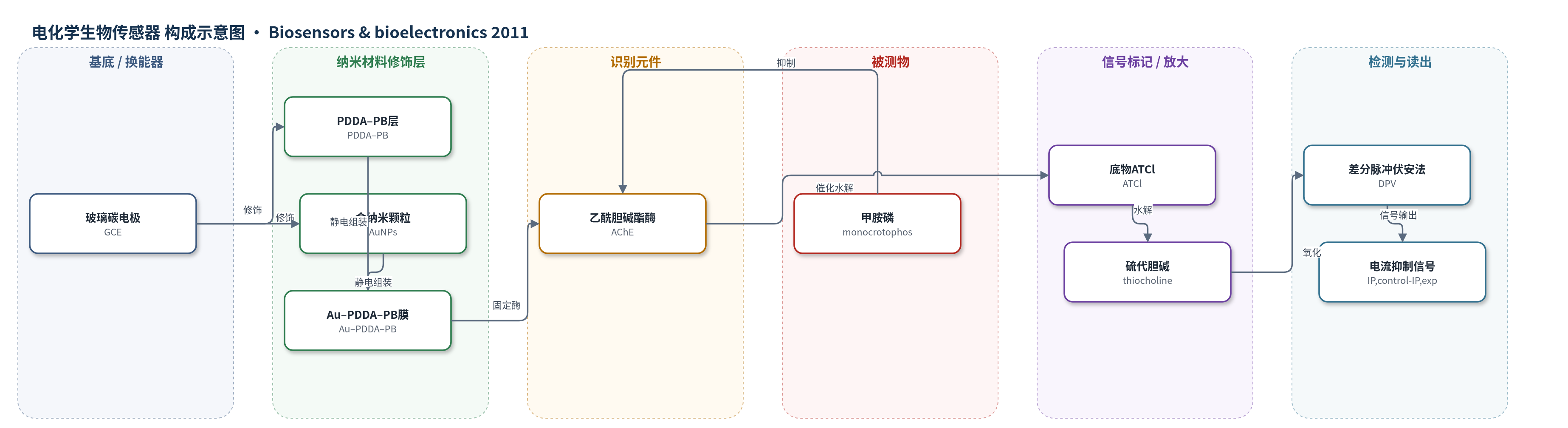
点击图片查看大图 · 依据论文自动绘制
传感器类型
电化学生物传感器
检测对象
甲胺磷(monocrotophos),样品基质:大蒜样品(加标)、PBS缓冲液标准溶液
检测原理
该传感器基于AChE对有机磷农药的不可逆抑制。AChE固定在Au–PDDA–PB/GCE表面,在pH 8.5 PBS中催化1.2 mM ATCl水解生成thiocholine;thiocholine在约0.7 V(vs SCE)发生电化学氧化,产生阳极电流。未加农药时,酶活性高,电流为IP,control;加入monocrotophos孵育10 min后,农药与AChE活性中心形成稳定磷酸化产物,使酶活性下降,ATCl水解减少,thiocholine氧化电流降至IP,exp。抑制率按(IP,control−IP,exp)/IP,control计算,随农药浓度升高而增大。AuNPs和PB提供导电网络与大比表面,PDDA–PB与AuNPs比例调控界面疏水性,使AChE定向固定并保持活性与稳定性,从而放大电流响应并降低检出限。
检测灵敏度
LOD: 0.8 pg/mL;线性范围: 1.0–1000 pg/mL 和 1.0–10 ng/mL;低浓度: y = 0.049x + 14.5, R^2 = 0.991;高浓度: y = 0.0015x + 60.9, R^2 = 0.996
效应效果
该传感器对1.0 ng/mL甲胺磷的批间重现性RSD为4.8%(5个电极)。4 ℃干燥保存时,前7天ATCl响应无明显下降,30天后仍保持初始电流的93.6%。ATCl表观Michaelis–Menten常数Kapp m为0.30 mM,低于文献报道值,显示对底物亲和力较高。大蒜样品加标回收率为92.8%–106%,RSD为3.2%–5.8%,表明方法准确、精密且可重复。与表1所列其他AChE生物传感器相比,本方法检出限更低,作者认为其更适合酶固定与活性保持,可用于超痕量有机磷农药检测。文中未报告选择性或抗干扰实验。
传感器的构成
- 基底电极:玻璃碳电极(GCE,直径3 mm),提供导电基底与电子转移动力
- 纳米修饰层:PDDA保护普鲁士蓝(PDDA–PB,poly(dimethyldiallylammonium chloride) protected Prussian blue),提供正电荷、导电通道和大比表面,并参与界面亲水性调控
- 纳米修饰层:负电荷金纳米颗粒(AuNPs,约4 nm,由HAuCl4、柠檬酸钠和NaBH4制备),与PDDA–PB静电组装形成Au–PDDA–PB,增强电子转移并提高界面疏水性
- 识别元件:乙酰胆碱酯酶(AChE,236 U/mg),催化水解底物ATCl,并被有机磷农药不可逆抑制
- 固定膜:聚乙烯醇(PVA,0.5%水溶液),将AChE–Au–PDDA–PB复合膜固定于GCE表面并维持酶构象
- 检测底物:乙酰硫代胆碱氯化物(ATCl,1.2 mM),作为AChE底物,水解产物thiocholine在电极上氧化产生电流
中文摘要
本文报道了一种超灵敏安培式乙酰胆碱酯酶(AChE)生物传感器。通过控制AChE在Au–PDDA–PB纳米复合修饰电极表面的固定,实现对有机磷农药的检测。其中,Au–PDDA–PB膜由金纳米颗粒(AuNPs)与聚二甲基二烯丙基氯化铵(PDDA)保护的普鲁士蓝(PB)组成,可作为优良的酶固定基质,不仅增强电子转移,而且具有较大比表面积。通过调节AuNPs与PDDA–PB的比例,可将Au–PDDA–PB复合膜的表面亲水性精细调控在静态水接触角25.6°–78.1°范围内。在优化疏水表面上,AChE呈现兼具良好活性与稳定性的取向,并经电化学方法证实。得益于Au–PDDA–PB纳米复合膜的优势以及AChE的良好活性和稳定性,该传感器对典型高毒有机磷农药甲胺磷(monocrotophos)表现出显著增强的灵敏度,线性范围为1.0–1000 pg/mL和1.0–10 ng/mL,检出限低至0.8 pg/mL。该传感器具有准确性、良好重现性和稳定性,可为蛋白质可控固定和高灵敏生物传感器设计提供有用信息。
英文摘要
An ultrasensitive amperometric acetylcholinesterase (AChE) biosensor was fabricated by controlled immobilization of AChE on gold nanoparticles/poly(dimethyldiallylammonium chloride) protected Prussian blue (Au-PDDA-PB) nanocomposite modified electrode surface for the detection of organophorous pesticide. The Au-PDDA-PB membrane served as an excellent matrix for the immobilization of enzyme, which not only enhanced electron transfer but also possessed a relatively large surface area. In addition, the surface hydrophilicity of the Au-PDDA-PB nanocomposite was finely controlled in the static water contact angle range of 25.6-78.1° by adjusting the ratio of gold nanoparticles to PDDA-PB. On an optimized hydrophobic surface, the AChE adopts an orientation with both good activity and stability, which has been proven by electrochemical methods. Benefit from the advantages of the Au-PDDA-PB nanocomposite and the good activity and stability of AChE, the biosensor shows significantly improved sensitivity to monocrotophos, a typical highly toxic organophorous pesticide, with wide linear range (1.0-1000 pg/mL and 1.0-10 ng/mL) and an ultra-low detection limit of 0.8 pg/mL. The biosensor exhibits accuracy, good reproducibility and stability. This strategy may therefore provide useful information for the controlled immobilization of protein and the design of highly sensitive biosensors.