组成图示
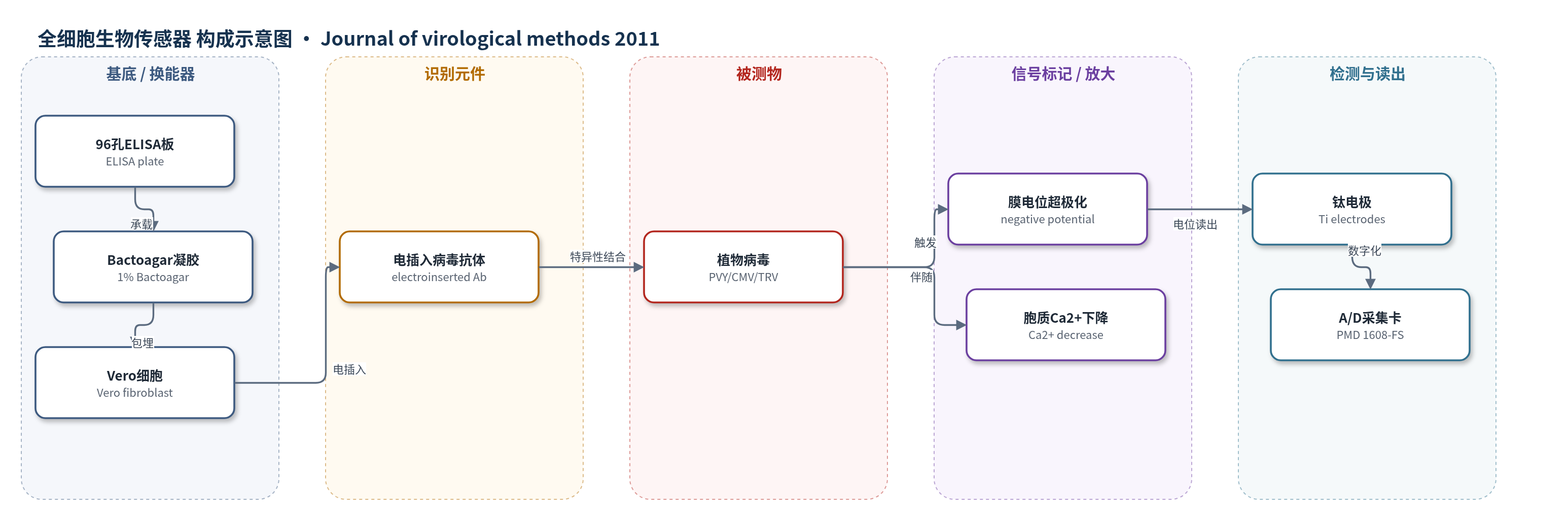
点击图片查看大图 · 依据论文自动绘制
传感器类型
全细胞生物传感器
检测对象
马铃薯Y病毒(PVY)、黄瓜花叶病毒(CMV)、烟草脆裂病毒(TRV);样品基质:PBS稀释的纯化病毒颗粒、感染植物组织汁液/提取物(烟草、黄瓜等,PBS-Tween/PVP匀浆)
检测原理
BERA-HTP以活Vero细胞为电学换能器,将CMV、TRV或PVY多克隆抗体经电脉冲(1800 V/cm)插入细胞膜,形成高密度识别界面。当样品中同源植物病毒颗粒与膜上抗体特异性结合时,触发细胞膜受体样相互作用,引起膜电位超极化(传感器电位负向变化)并伴随胞质Ca2+浓度下降;无病毒或异源病毒则出现正向电位且无Ca2+变化。钛测量电极与参比电极记录300 s内最大电位变化,经A/D卡数字化。由于每细胞约8×10^3抗体、每孔约1.5×10^4细胞,信号具有放大效应;CMV在1–100 ng ml−1呈线性(R^2=0.99),其余以定性判别为主。
检测灵敏度
LOD: 1 ng ml−1(原文表述:sensitivity comparable to DAS-ELISA (1 ng ml−1));线性范围: 1–100 ng ml−1(CMV);R^2 = 0.99
效应效果
BERA-HTP对同源病毒产生负向膜电位,对无病毒或异源病毒产生正向电位,选择性良好;在烟草和黄瓜中可识别CMV单感染及与TRV、PVY或CGMMV混合感染,TRV传感器对PVY有轻微负响应,需至少两个稀释度确认。响应重现性变异为5.5–9.0%。灵敏度与DAS-ELISA相当(1 ng ml−1),但方法目前适合定性检测。系统可8通道并行,5 min完成8个测试,96个样品约70 min,作者认为比常规免疫学方法、侧流试纸条和LAMP更快速高效,适用于田间高通量植物病毒筛查。
传感器的构成
- 基底/固定化载体:96孔ELISA板(ELISA plate)与1% Bactoagar®琼脂凝胶,承载并固定化工程化Vero细胞,形成可消耗传感器单元
- 换能器/生物识别单元:活Vero成纤维细胞(Vero fibroblast cells),以细胞膜电位变化作为电学换能信号
- 识别元件:CMV、TRV或PVY多克隆抗体(virus-specific polyclonal antibodies),经电脉冲(1800 V/cm)电插入Vero细胞膜,每细胞约8×10^3抗体
- 细胞维持介质:Dulbecco's medium加20%胎牛血清(FCS),用于细胞重悬、孵育和维持细胞活性
- 电极系统:钛电极(titanium electrodes),长测量电极插入含细胞凝胶,短参比电极浸入样品溶液,测量膜电位
- 数据采集读出:PMD 1608-FS A/D卡与InstaCal软件,记录300 s内最大电位变化并处理数据
中文摘要
基于活细胞的生物传感器具有高灵敏度、高选择性和快速响应特点。本研究开发了一种用于植物病毒检测的新型便携式细胞生物传感器系统,命名为高通量生物电识别检测(BERA-HTP)。该系统以固定化的Vero细胞为识别与换能单元,通过电插入技术在其细胞膜上高密度装载针对马铃薯Y病毒(PVY)、黄瓜花叶病毒(CMV)和烟草脆裂病毒(TRV)的特异性抗体。当PVY、CMV或TRV病毒颗粒与同源抗体结合时,引起细胞膜电位的病毒特异性变化;无病毒样品或异源病毒未出现该变化。荧光显微镜观察表明,病毒颗粒与携带同源抗体的细胞膜结合伴随胞质Ca2+浓度下降。BERA-HTP可在约70 min内完成96个样品检测,有望成为便携式、可靠、快速的植物病毒现场检测方法。
英文摘要
Biosensors based on living cells are characterized by high sensitivity, selectivity and rapid response times. A novel portable cell biosensor system for the detection of plant viruses, based on immobilized 'Vero' cells carrying on their membrane virus specific antibodies was developed and was designated as High Throughput Bioelectric Recognition Assay (BERA-HTP). BERA-HTP was tested for the detection of purified Potato virus Y (PVY), Cucumber mosaic virus (CMV) and Tobacco rattle virus (TRV) and of CMV and TRV in single, as well as in mixed infections in two different plant host species. The sensor was based on live, mammalian cells, the membrane of which has been artificially saturated with antibodies specific to different plant viruses. The attachment of PVY, CMV or TRV viral particles to the homologous electroinserted antibodies caused a virus-specific change of the cell membrane electric potential that was not observed with virus-free samples or with heterologous viruses. Fluorescence microscopy observations showed that attachment of virus particles to the cell membrane bearing the homologous antibody, was associated with a decrease of [Ca(2+)]cyt. The perspective for the development of BERA-HTP as a portable, reliable and rapid (duration of assay for 96 samples: ∼70 min) detection method of plant viruses in the field is discussed.