组成图示
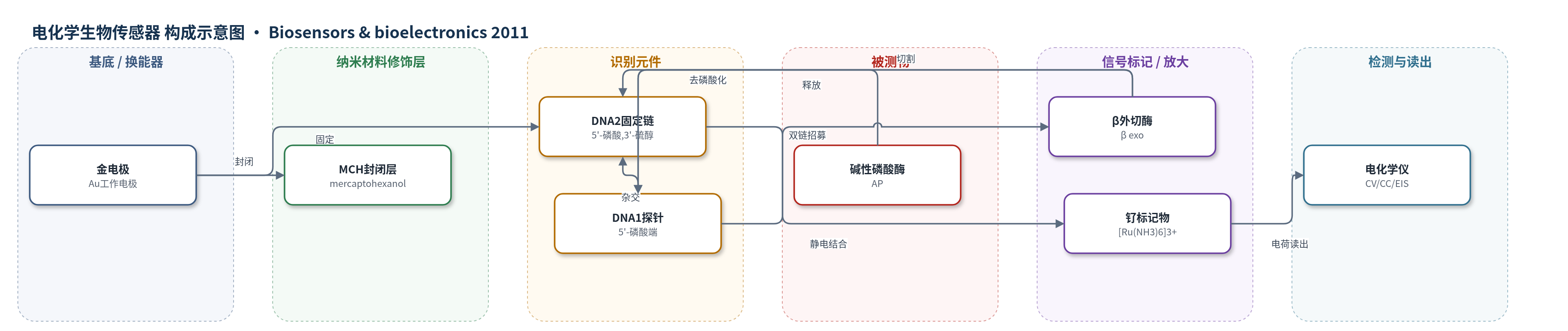
点击图片查看大图 · 依据论文自动绘制
传感器类型
电化学生物传感器
检测对象
碱性磷酸酶(alkaline phosphatase, AP);样品基质:缓冲液、1%胎牛血清(FCS)加标样品
检测原理
AP首先催化去除游离DNA1的5'-磷酸端,使DNA1能够与固定在金电极上的DNA2杂交形成双链。由于双链中DNA2仍保留5'-磷酸端,β外切酶(β exo)可识别并沿5'→3'方向切割DNA2;DNA2被完全消化后,DNA1释放并再次结合另一条DNA2,形成酶促循环放大。DNA2链上静电结合的六氨合钌(III)([Ru(NH3)6]3+)随DNA2移除而减少,导致电极表面可测氧化还原电荷下降。AP浓度越高,被去磷酸化的DNA1越多,DNA2被切割得越多,电化学信号下降越大,从而通过循环伏安或计时库仑法定量AP活性。
检测灵敏度
LOD: 0.1 unit/mL;线性范围: 1–20 unit/mL;回归方程: y = 0.14161 + 0.01387x;r = 0.99033;CV = 4.84%
效应效果
该传感器对AP具有较好选择性:5 mM Na3VO4可几乎完全抑制50 unit/mL AP活性;BSA、HSA和Hb等干扰蛋白即使浓度远高于AP,也仅引起很弱的电荷下降。方法平均变异系数为4.84%,重现性可接受。在1%胎牛血清(FCS)中分别加入5和50 unit/mL AP后,仍能观察到随AP浓度增加而增大的氧化还原电荷下降,说明其可用于复杂生物流体检测。相比荧光、化学发光和SERS等方法,该电化学策略操作简便、成本低,并借助β exo循环消化实现信号放大,具有临床应用潜力。
传感器的构成
- 基底/换能器电极:金电极(Au electrode,3 mm),经清洗、抛光和循环伏安活化,作为工作电极。
- 固定识别链:DNA2(5'-磷酸、3'-硫醇修饰寡核苷酸),通过金–硫键固定于金表面,作为可被β exo切割的固定链。
- 封闭/间隔层:甲硫醇(MCH,mercaptohexanol),填充金表面空隙,减少非特异吸附并规整DNA排列。
- 循环识别探针:DNA1(5'-磷酸端寡核苷酸),先被AP去磷酸化,再与DNA2杂交并被β exo循环释放。
- 酶促放大元件:β外切酶(β exo),识别双链中5'-磷酸端DNA2并切割,实现信号放大。
- 信号标记物:六氨合钌(III)氯化物([Ru(NH3)6]3+),静电结合DNA磷酸骨架,提供电化学氧化还原信号。
- 被测物:碱性磷酸酶(AP),催化DNA1 5'-磷酸去磷酸化,启动检测反应。
中文摘要
本文报道了一种基于两条互补DNA探针和β外切酶(β exo)的电化学生物传感器,用于检测碱性磷酸酶(AP)活性。首先,AP催化去除DNA1的5'-磷酸端;随后去磷酸化的DNA1与预先通过金–硫键固定在金电极表面的DNA2杂交。由于双链中仅DNA2保留5'-磷酸端,β exo可快速切割DNA2;DNA2被完全消化后,DNA1释放并可与另一条DNA2继续杂交,形成循环放大。DNA探针通过静电作用吸附六氨合钌(III)氯化物([Ru(NH3)6]3+),DNA2从电极表面移除导致电化学信号下降。该传感器在1–20 unit/mL范围内线性响应,检出限为0.1 unit/mL,并可在复杂生物流体中检测AP酶活性。
英文摘要
In this work we have developed a novel electrochemical biosensor for the detection of alkaline phosphatase (AP) by the use of two complementary DNA probes (DNA 1 and DNA 2) coupled with λ exonuclease (λ exo). Firstly, the 5'-phosphoryl end of DNA 1 is dephosphorylated by AP. Then DNA 1 hybridizes with DNA 2, previously modified on a gold electrode surface. In this double-strand DNA, DNA 2 strand will be promptly cleaved by λ exo with its phosphoryl at the 5' end. After the DNA 2 strand is completely digested, DNA 1 will be released from the double strands and then hybridizes with another DNA 2 strand on the electrode surface, thus the cycle of the release of DNA 1 and the digestion of DNA 2 continues. Since the DNA probes may absorb hexaammineruthenium(III) chloride, the electrochemical species, and the removal of the DNA 2 strand from the electrode surface will result in the decrease of the detected electrochemical signal, which is initially activated by AP, an electrochemical biosensor to assay the activity of AP is proposed in this work. This method may have a linear detection range from 1 to 20 unit/mL with a detection limit of 0.1 unit/mL, and the detection of the enzymatic activity in complex biological fluids can also be realized.