组成图示
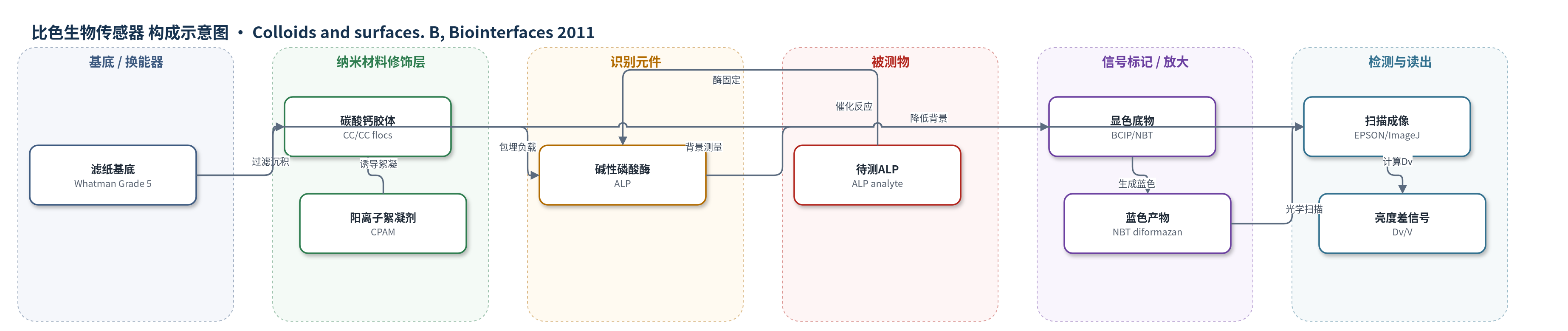
点击图片查看大图 · 依据论文自动绘制
传感器类型
比色生物传感器
检测对象
碱性磷酸酶(alkaline phosphatase, ALP);样品基质为pH 9.8缓冲液、ALP溶液或CC悬浮液
检测原理
该传感器以Whatman滤纸为基底,将ALP与CC胶体或CPAM诱导的CC絮团混合后过滤固定。CC絮团在纸内形成多孔无机微环境,提高ALP表面密度并维持酶构象/活性;CC同时提高纸白度、降低光学背景。检测时加入BCIP/NBT液体底物,ALP催化BCIP磷酸化,NBT被还原生成不溶性蓝色甲臜沉淀。蓝色产物在检测区累积,颜色深度随固定ALP量增加而增强。扫描仪测量反射率并转换为亮度值V,以背景V减去样品V得到Dv;Dv随ALP浓度升高而增大,从而实现比色定量。灵敏度提升主要来自胶体工程调控絮团结构、过滤固定和降低背景,而非核酸/酶级联放大。
检测灵敏度
LOD: 1.1 nM(CC flocs,3倍空白标准差,95%);LOD: 1.3 nM(CC colloids);LOD: 1.9 nM(S filtration);LOD: 58 nM(soaking method);LOD/最低检测量: 117 fmol/zone(5 mm circle,CC flocs);最低检测量: 134 fmol/zone(CC colloids);最低检测量: 194 fmol/zone(S filtration);最低检测量: 6066 fmol/zone(S soaking);线性范围: 0.001–0.00625 mg/mL(标准曲线线性);标准曲线斜率: a=6001.4, b=5604.5, c=4132.4, d=510.0(Dv对added ALP, mg/mL);R = 0.9990(pNPP溶液定量标准曲线)
效应效果
CC絮团过滤法使ALP检测限降至1.1 nM或117 fmol/5 mm区,较浸泡法58 nM低50倍,较喷墨点样1.9 pmol/区低一个数量级以上,接近IgG纸基ELISA的54 fmol/区。ALP负载效率由12%提高到27%;CC絮团标准曲线斜率最高(6001.4),背景亮度最高(V=253.1±0.3),稀释BCIP/NBT下活性最高。ALP溶液定量CV<4.9%(n=4),CPAM定量CV<7.8%(n=3),Dv取n=7平均并计算95%置信区间。作者认为胶体工程结合过滤可显著提升纸基比色传感器灵敏度,适用于低成本即时诊断。
传感器的构成
- 基底/换能器:Whatman Grade 5 滤纸,作为纸基载体、毛细流动通道和光学背景基底
- 胶体修饰层:碳酸钙(CC)胶体或CC絮团,作为无机模板/微环境,提高ALP负载、活性并降低光学背景
- 结构调控剂:阳离子二甲基氨基乙基甲基丙烯酸酯聚丙烯酰胺(CPAM),诱导并调控CC絮团结构
- 识别/催化元件:碱性磷酸酶(ALP),作为模型酶识别/催化元件,催化底物显色
- 信号底物:BCIP/NBT液体底物(5-bromo-4-chloro-3-indolyl phosphate/nitro blue tetrazolium),与ALP反应生成蓝色不溶产物
- 辅助定量底物:pNPP液体底物,用于溶液中ALP浓度定量
- 信号读出:EPSON PERFECTION 2450扫描仪与ImageJ软件,测量反射率/亮度值V并计算Dv
中文摘要
纸基生物传感器可为健康与环境应用提供即时、低成本的诊断,但灵敏度不足限制其与传统分析仪器竞争。为提高纸基比色生物传感器的灵敏度,本研究将胶体工程与过滤相结合,以降低纸基底背景并优化生物分子在纸上的固定。以碱性磷酸酶(ALP)和碳酸钙(CC)为模型体系,利用阳离子二甲基氨基乙基甲基丙烯酸酯聚丙烯酰胺(CPAM)诱导CC絮凝,通过调控悬浮液中CC絮团结构,再经过滤和纸的毛细作用将结构固定于纸上。将ALP在固定前并入CC絮团,可提供更优微环境并提高固定生物分子的表面密度。优化CC絮团使ALP检测限达到117 fmol/检测区(5 mm圆区),比常见浸泡固定法低50倍;单位基底面积所需最低生物分子量较喷墨点样法降低一个数量级以上。该体系还表现出最陡标准曲线斜率、最低背景和稀释BCIP/NBT底物下最高活性。
英文摘要
Paper-based biosensors represent a disruptive technology by providing instantaneous and low-cost diagnostics for health and environmental applications. The lack of sensitivity can be an obstacle for this technology to compete with traditional analytical instrumentations. Aiming to improve the sensitivity of a paper-based colorimetric biosensor, we have applied colloids engineering in combination with filtration to lower the paper substrate backgrounds and optimize the immobilization of bio-molecules on paper. A model system consisting of an enzyme, alkaline phosphatase (ALP), and an inorganic colloid, calcium carbonate (CC), flocculated by a cationic dimethylamino-ethyl-methacrylate polyacrylamide (CPAM), demonstrated that the optimized CC flocs are best for enhancing the detecting sensitivity of ALP. The CC floc structure on paper was optimized by modulating its structure in suspension. Subsequently, the filtration process and the wicking ability of paper enabled to freeze the deposited CC structure inherited from the suspension. The incorporation of biomolecules into the CC before immobilizing on paper through filtration provided not only a better microenvironment, but also a higher surface density of immobilized biomolecules. The ALP detection limit of 117 fmol per zone (5mm circle) in the current study was fifty times lower than that of the common soaking method for biomolecule immobilization. The minimum amount of biomolecules per unit substrate area required for detection was lowered by over an order of magnitude, compared with spotting methods (i.e. inkjet printing). The improvement was also demonstrated by the steepest slope of standard curve, the lowest background, and the highest activity of the bioactive paper probed with the diluted BCIP/NBT liquid substrates.