组成图示
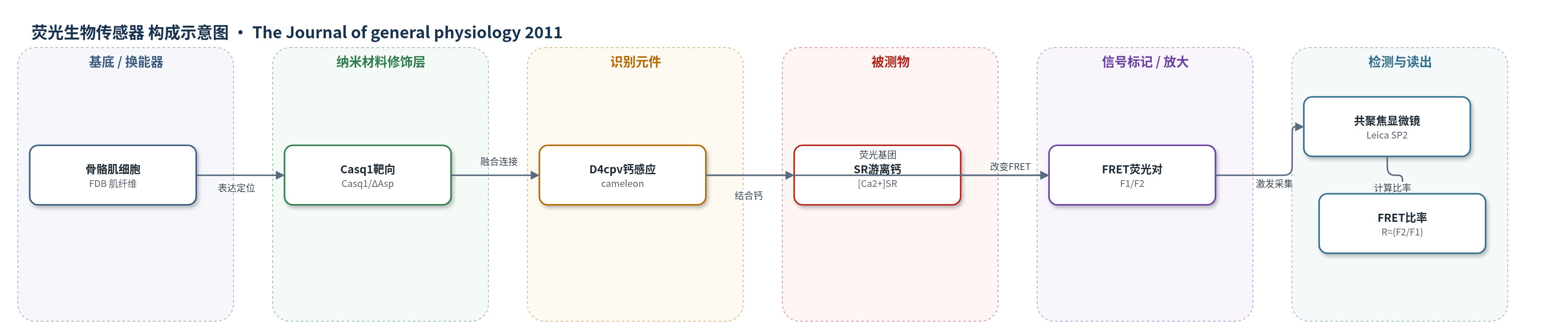
点击图片查看大图 · 依据论文自动绘制
传感器类型
荧光生物传感器
检测对象
肌浆网游离钙离子(sarcoplasmic reticulum free Ca2+, [Ca2+]SR);样品基质:成年小鼠骨骼肌 FDB 肌纤维/肌细胞(肌浆网腔)
检测原理
D4cpv-Casq1 由 Casq1 靶向域与 D4cpv cameleon 融合而成,表达后定位于骨骼肌肌浆网终末池。D4cpv 的钙调蛋白-肽受体结合 SR 腔内游离 Ca2+ 后发生构象变化,改变供体与受体荧光蛋白之间的距离/取向,从而改变 FRET 效率。458 nm 激发下同时采集供体 F1(470-510 nm)和受体 F2(520-580 nm),计算比率 R=(F2-bg2)/(F1-bg1)。R 随 [Ca2+]SR 按单位点结合方程变化,细胞内校准得 βKD=222 µM、Rmin=0.505、Rmax=1.74。比率型读出可抵消传感器浓度、光漂白和激发波动;D4 设计降低钙调蛋白内源配体干扰,Casq1 融合提高 SR 特异性,无需外源化学放大。
检测灵敏度
原文未报告 LOD、线性范围、灵敏度斜率或相关系数;报告有效 KD: 222 µM;动态范围 [(Rmax-Rmin)/Rmin]: 2.5。
效应效果
D4cpv-Casq1 与 Casq1 免疫荧光及 T 管染料 di-8-ANEPPS 共定位,证实靶向 SR 终末池;saponin 通透化后 D4cpv-X 含量平均变化 -7%(SEM 8%,14 细胞),D1ER 平均损失 29%(SEM 8%,7 细胞)。细胞内动态范围 2.45,约为 D1ER(0.59-0.83)的 3-4 倍。74 个细胞静息 Rm 1.31(SEM 0.02),对应 [Ca2+]SR 415 µM,中位数 374 µM;偏态尾部至 6 mM,可用约 10% 参数变异解释。高表达区比率低 3-15%(9/12 细胞),细胞平均无相关(r^2=-0.03),局部变异小且可量化。
传感器的构成
- 生物基底:成年小鼠 FDB 骨骼肌细胞及肌浆网终末池,提供传感器表达与钙库微环境
- 表达载体:pEYFP-N1-mouseCasq1 质粒,含 CMV 启动子,驱动融合蛋白表达
- 靶向定位元件:Casq1 或 Casq1-ΔAsp,融合于 N 端,将传感器靶向肌浆网终末池
- 连接肽:RSPRPRDNNRRRMDP,连接 Casq 与 D4cpv
- 钙感应识别元件:D4cpv cameleon,Ca2+ 结合后改变 FRET 效率
- 荧光信号标记:D4cpv 内源供体/受体荧光基团,458 nm 激发,F1 470-510 nm、F2 520-580 nm
- 读出换能器:Leica SP2 AOBS 共聚焦显微镜,采集 FRET 对并计算比率 R
中文摘要
现有骨骼肌肌浆网(SR)游离钙荧光监测工具定量价值有限:非比率信号难校准且特异性不足,FRET 传感器动态范围小,并受靶向不完全和钙网蛋白内源配体干扰。本文报道将 cameleon D4cpv 与钙网蛋白 1(Casq1)或低钙结合变体 Casq1-ΔAsp 融合的新型比率型荧光生物传感器,实现向 SR 终末池精确靶向。D4cpv-Casq1 在成年小鼠骨骼肌中表达浓度可达 22 µmol/L 肌细胞,质膜与 T 系统膜通透化后仍保留于细胞内。细胞内校准得有效 KD 222 µM,动态范围 [(Rmax-Rmin)/Rmin] 2.5,优于同类传感器。高表达区最大比率与静息比率略低,与距蛋白合成位点距离负相关。74 个存活细胞静息 [Ca2+]SR 平均 416 µM;比率分布高斯,计算 [Ca2+]SR 偏态,尾部达 6 mM。模型表明偏态源于传感器性能可量化的小幅局部变异。D4cpv-Casq1 在灵敏度、特异性和重现性上显著改进。
英文摘要
Current fluorescent monitors of free [Ca(2+)] in the sarcoplasmic reticulum (SR) of skeletal muscle cells are of limited quantitative value. They provide either a nonratio signal that is difficult to calibrate and is not specific or, in the case of Forster resonant energy transfer (FRET) biosensors, a signal of small dynamic range, which may be degraded further by imperfect targeting and interference from endogenous ligands of calsequestrin. We describe a novel tool that uses the cameleon D4cpv, which has a greater dynamic range and lower susceptibility to endogenous ligands than earlier cameleons. D4cpv was targeted to the SR by fusion with the cDNA of calsequestrin 1 or a variant that binds less Ca(2+). "D4cpv-Casq1," expressed in adult mouse at concentrations up to 22 µmole/liter of muscle cell, displayed the accurate targeting of calsequestrin and stayed inside cells after permeabilization of surface and t system membranes, which confirmed its strict targeting. FRET ratio changes of D4cpv-Casq1 were calibrated inside cells, with an effective K(D) of 222 µM and a dynamic range [(R(max) - R(min))/R(min)] of 2.5, which are improvements over comparable sensors. Both the maximal ratio, R(max), and its resting value were slightly lower in areas of high expression, a variation that was inversely correlated to distance from the sites of protein synthesis. The average [Ca(2+)](SR) in 74 viable cells at rest was 416 µM. The distribution of individual ratio values was Gaussian, but that of the calculated [Ca(2+)](SR) was skewed, with a tail of very large values, up to 6 mM. Model calculations reproduce this skewness as the consequence of quantifiably small variations in biosensor performance. Local variability, a perceived weakness of biosensors, thus becomes quantifiable. It is demonstrably small in D4cpv. D4cpv-Casq1 therefore provides substantial improvements in sensitivity, specificity, and reproducibility over existing monitors of SR free Ca(2+) concentration.