组成图示
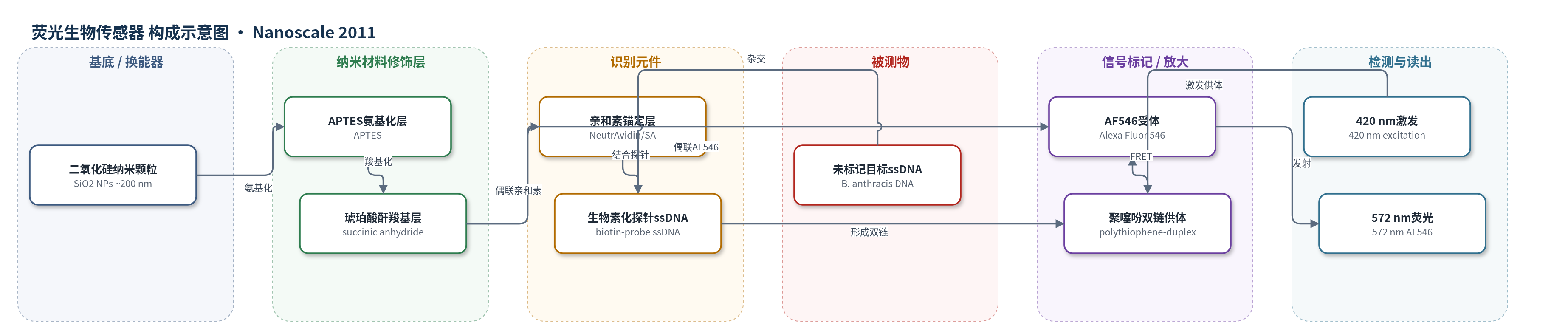
点击图片查看大图 · 依据论文自动绘制
传感器类型
荧光生物传感器
检测对象
未标记目标单链寡核苷酸(unlabelled target ss-oligonucleotide / ssDNA,炭疽杆菌 Bacillus anthracis 特征序列);样品基质:水样/缓冲液溶液(100 µL检测体积,可磁浓缩1–2 mL水样)
检测原理
传感器表面固定生物素化探针ssDNA,并与阳离子聚噻吩按电荷中和形成双链复合物。此时聚噻吩骨架被探针束缚呈刚性平面,吸收红移,420 nm激发下荧光弱。当未标记互补目标ssDNA加入并与探针杂交形成三链/杂交结构时,聚噻吩恢复扭曲构象,吸收蓝移,荧光开启。开启的聚噻吩作为FRET供体,将能量转移至邻近AF546受体,AF546在572 nm发射增强。目标浓度越高,杂交位点越多,供体开启越多,572 nm荧光越强。纳米颗粒上调控AF546与供体距离和比例可增强FRET并降低背景;过多AF546会自猝灭。可选磁珠固相实现磁浓缩。
检测灵敏度
LOD: ~2 nM ssDNA(原文摘要:~2 × 10^-12 moles of ss-oligonucleotide in a 100 mL sample);LOD: ~2 nM(Aduplex(1.5),以非互补寡核苷酸响应3σ计);LOD: ~3 nM(Bduplex);LOD: ~5 nM(n-MB固相);磁浓缩后原始水样等效检测浓度: 0.3–0.4 nM;相对聚噻吩本身LOD降低: 至少10倍
效应效果
在竞争实验中,传感器可区分完全互补目标ssDNA与非互补ssDNA;非互补序列存在时仍有部分响应,但互补目标在约2 nM(Aduplex(1.5))和约3 nM(Bduplex)仍可检出(以非互补响应3σ计)。固相n-MB传感器LOD约5 nM,标准差略高,归因于大磁珠散射和缓慢沉降。相比易失稳的胶束体系,纳米颗粒共价组装在磁珠表面保持功能,适合微流控/现场部署。通过磁浓缩1–2 mL水样并重悬至100 µL,可将原始水样中0.3–0.4 nM目标检出。无需PCR,使用标准荧光计,适用于炭疽杆菌等生物战剂现场检测。
传感器的构成
- 基底/纳米颗粒支架:约200 nm二氧化硅纳米颗粒(SiO2 NPs),Stöber法制备,提供共价组装平台
- 表面氨基化层:3-氨基丙基三乙氧基硅烷(APTES)修饰SiO2表面,引入氨基用于后续偶联
- 羧基化连接层:琥珀酸酐(succinic anhydride)与氨基反应生成羧基,用于EDC偶联AF546或亲和素
- FRET受体层:Alexa Fluor 546(AF546)经AF546-NHS直接偶联(架构A)或经链霉亲和素-AF546偶联(架构B),作为FRET受体
- 亲和素锚定层:NeutrAvidin或链霉亲和素(streptavidin)结合生物素化探针,将识别元件固定于表面
- 识别元件:生物素化探针ssDNA(biotin-probe ssDNA,5′-biotin-C6 spacer-ACAAATACCTGTAATTAGCGTTGCC-3′),捕获互补目标DNA
- 信号换能层:阳离子共轭聚合物聚噻吩(polythiophene)与探针ssDNA按电荷1:1形成双链复合物,作为FRET供体
- 可选固相载体:20 µm羧基化磁珠(magnetic beads, MB)偶联氨基化SiO2 NPs,形成n-MB用于磁浓缩和固相检测
中文摘要
本文报道了一种基于二氧化硅纳米颗粒的无标记DNA生物传感器,可用于检测炭疽杆菌(Bacillus anthracis)相关未标记单链寡核苷酸。该传感器利用固定在纳米颗粒表面的阳离子共轭聚合物聚噻吩与单链寡核苷酸及杂交寡核苷酸相互作用时发生的光学变化:只有当与聚合物结合的探针ssDNA与互补目标杂交后,才出现荧光信号。为提高灵敏度,作者构建了两种纳米颗粒架构,用于研究纳米颗粒表面邻近荧光团对聚噻吩/寡核苷酸复合物(FRET供体)与荧光团(FRET受体)之间Förster共振能量转移(FRET)的影响。结果表明,该二氧化硅纳米颗粒FRET平台相比聚噻吩本身至少将检出限降低10倍,并可用标准荧光计在100 µL样品中检测约2 nM ssDNA(原文摘要以约2×10^-12 mol ssDNA表述)。此类纳米颗粒传感器因共价组装而具有稳健性和稳定性,可为无需PCR的灵敏无标记DNA检测提供新工具。
英文摘要
A silica nanoparticle-based DNA biosensor capable of detecting Bacillus anthracis bacteria through the use of unlabelled ss-oligonucleotides has been developed. The biosensor makes use of the optical changes that accompany a nanoparticle-immobilized cationic conjugated polymer (polythiophene) interacting with single-stranded vs. hybridized oligonucleotides, where a fluorescence signal appears only when hybridized DNA is present (i.e. only when the ss-oligonucleotide interacting with the polymer has hybridized with its complement). In order to enhance the sensitivity of the biosensor, two different nanoparticle architectures were developed and used to elucidate how the presence of neighboring fluorophores on the nanoparticle surface affects Förster-resonant energy transfer (FRET) between the polythiophene/oligonucleotide complex (FRET donor) and the fluorophores (FRET acceptors). We demonstrate that the silica nanoparticle-based FRET platform lowers the limit of detection at least 10-fold in comparison to the polythiophene itself, and allows the detection of ∼2 × 10(-12) moles of ss-oligonucleotide in a 100 μL sample with a standard fluorimeter (i.e. has a limit of detection of ∼2 nM ssDNA). Such nanoparticle-based biosensor platforms are beneficial because of the robustness and stability inherent to their covalent assembly and they provide a valuable new tool that may allow for the sensitive, label-free detection (the target DNA that produces the fluorescence signal is unlabelled) without the use of polymerase chain reaction.