组成图示
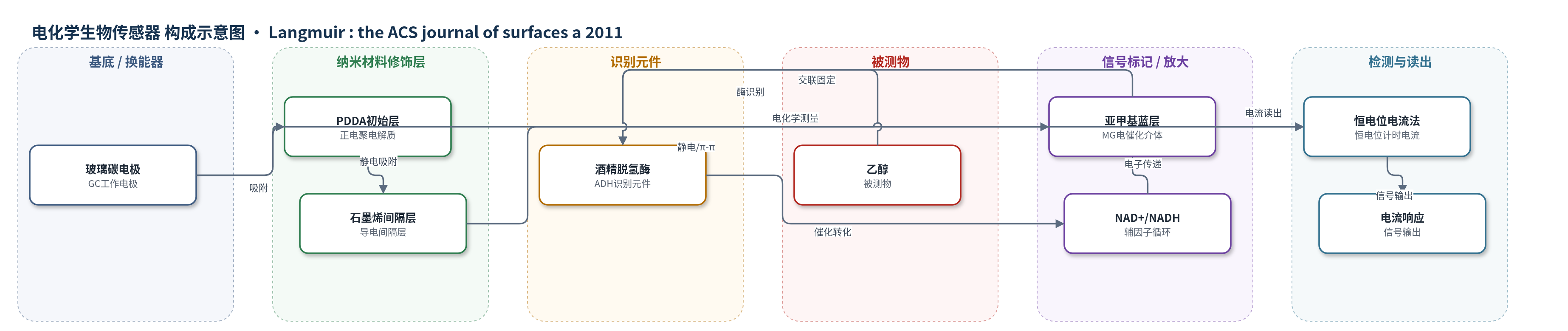
点击图片查看大图 · 依据论文自动绘制
传感器类型
电化学生物传感器
检测对象
乙醇(ethanol/alcohol),样品基质为0.10 M磷酸盐缓冲液(pH 7.0,含10 mM NAD+)
检测原理
该传感器以ADH为识别元件,乙醇进入电极界面后被ADH催化氧化为乙醛,同时溶液中的NAD+被还原为NADH。生成的NADH在MG修饰的石墨烯多层膜上发生电催化氧化:MG作为可逆氧化还原介体,在较低电位(约-0.10 V)接受NADH的电子并将电子传递至GC电极。石墨烯间隔层提供高导电网络和大比表面积,促进MG负载与电子转移,从而放大电流响应。在+0.10 V恒电位下,计时电流随乙醇浓度增加而增大,实现电化学检测。
检测灵敏度
线性范围: 0.5–11.0 mM;灵敏度: 24.7 nA mM−1 cm−2;相关系数: 0.988;K0m: 45.8 mM
效应效果
文中未报告选择性、抗干扰、RSD或实际样品回收率。稳定性方面,(graphene/MG)5修饰电极在-0.50至+0.30 V范围内连续循环至少50次后峰电流保持稳定。ADH生物传感器在+0.10 V下对乙醇产生明显电流响应,线性范围0.5–11.0 mM,相关系数0.988,灵敏度24.7 nA mM−1 cm−2,表观K0m为45.8 mM,接近文献值,提示ADH保持天然构象。NADH氧化电位由裸GC的+0.70 V降至约-0.10 V。葡萄糖/O2生物燃料电池开路电压0.69 V,最大功率密度22.50 μW cm−2(0.48 V),与文献酶燃料电池相当。
传感器的构成
- 基底/工作电极:玻璃碳电极(GC),提供导电基底与电化学换能界面
- 初始修饰层:聚二甲基二烯丙基氯化铵(PDDA),带正电,用于启动层层自组装
- 间隔/导电层:石墨烯纳米片(graphene),作为间隔层形成导电网络并增强电子传递
- 电催化/信号层:亚甲基蓝(MG),作为电活性介体催化NADH氧化并产生电流信号
- 识别元件:酒精脱氢酶(ADH),识别乙醇并催化其氧化生成NADH
- 交联固定层:牛血清白蛋白(BSA)与戊二醛(glutaraldehyde),用于交联固定ADH
- 辅因子/电子传递组分:NAD+,在缓冲液中接受ADH反应电子并循环为NADH
中文摘要
本研究证明石墨烯可作为间隔层,通过层层自组装(LBL)化学在电极表面可控构建电化学功能化多层纳米结构。以亚甲基蓝(MG)和带正电甲基咪唑功能化多壁碳纳米管(MWNTs)为例,分别作为电活性分子和电化学功能组分,利用石墨烯与它们之间的静电作用和/或π-π堆叠作用,在玻璃碳电极上形成石墨烯/MG和石墨烯/MWNT多层纳米结构。扫描电镜、紫外-可见光谱和循环伏安法表征表明组装过程均匀有效,石墨烯间隔层使纳米结构规整且保持良好导电性。电化学测试显示,所组装纳米结构具有优异的电化学性能和对NADH氧化的电催化活性,可作为分子生物电子器件中的电子换能器。作者进一步以酒精脱氢酶(ADH)构建的电化学生物传感器和葡萄糖脱氢酶(GDH)构建的葡萄糖/O2生物燃料电池为例,验证了该换能器在生物传感和生物燃料电池中的应用潜力。该工作为可控制备石墨烯基电化学功能纳米结构、发展生物传感器和生物燃料电池等分子生物电子器件提供了简便路线。
英文摘要
This study demonstrates the capability of graphene as a spacer to form electrochemically functionalized multilayered nanostructures onto electrodes in a controllable manner through layer-by-layer (LBL) chemistry. Methylene green (MG) and positively charged methylimidazolium-functionalized multiwalled carbon nanotubes (MWNTs) were used as examples of electroactive species and electrochemically useful components for the assembly, respectively. By using graphene as the spacer, the multilayered nanostructures of graphene/MG and graphene/MWNT could be readily formed onto electrodes with the LBL method on the basis of the electrostatic and/or π-π interaction(s) between graphene and the electrochemically useful components. Scanning electron microscopy (SEM), ultraviolet-visible spectroscopy (UV-vis), and cyclic voltammetry (CV) were used to characterize the assembly processes, and the results revealed that nanostructure assembly was uniform and effective with graphene as the spacer. Electrochemical studies demonstrate that the assembled nanostructures possess excellent electrochemical properties and electrocatalytic activity toward the oxidation of NADH and could thus be used as electronic transducers for bioelectronic devices. This potential was further demonstrated by using an alcohol dehydrogenase-based electrochemical biosensor and glucose dehydrogenase-based glucose/O(2) biofuel cell as typical examples. This study offers a simple route to the controllable formation of graphene-based electrochemically functionalized nanostructures that can be used for the development of molecular bioelectronic devices such as biosensors and biofuel cells.