组成图示
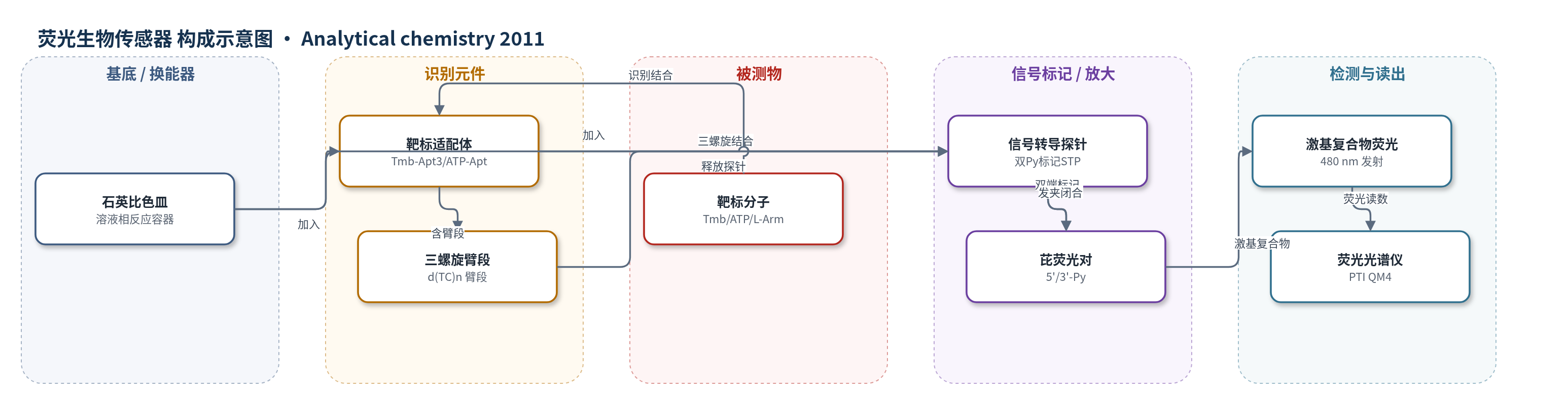
点击图片查看大图 · 依据论文自动绘制
传感器类型
荧光生物传感器
检测对象
人α-凝血酶(human α-thrombin, Tmb)、三磷酸腺苷(adenosine triphosphate, ATP)、L-精氨酰胺(L-argininamide, L-Arm);样品基质:磷酸钠缓冲液(含KCl或NaCl、MgCl2,pH 6.2)
检测原理
该传感平台以适配体为识别元件,以双芘标记STP为荧光报告探针。STP初始为发夹结构,两端Py靠近,产生480 nm激基复合物荧光;在pH 6.2下,适配体两端d(TC)n臂段与STP环d(AG)5通过Watson–Crick和Hoogsteen配对形成三螺旋,使STP打开,Py分离,激基复合物荧光被抑制。加入靶标后,适配体与Tmb、ATP或L-Arm结合形成稳定复合物,三螺旋解离,STP释放并恢复发夹构象,Py重新靠近,激基复合物荧光增强。荧光增强幅度随靶标浓度增加而增大,从而实现无标记适配体的荧光检测。
检测灵敏度
Tmb: LOD: ∼0.1 nM;线性范围: 0.5–250 nM
效应效果
Tmb检测中,THMS3数分钟内响应>95%,100 nM时E/E0=4.12,较双螺旋开关STP0(E/E0=1.20)提高3.43倍;LOD约0.1 nM,低于常规染料-淬灭剂标记适配体。300 nM溶菌酶、IgG、BSA、细胞色素c无明显干扰,含干扰蛋白滴定曲线与单独Tmb几乎重合。ATP检测中0.5 mM使荧光增强3.43倍,TTP、UTP、CTP、GTP无响应;L-Arm在2 mM有效响应。未报告实际样品回收率、RSD和长期稳定性。作者认为可拓展至多种分析物。
传感器的构成
- 溶液相反应体系:磷酸钠缓冲液(0.01 M sodium phosphate buffer,pH 6.2)与石英比色皿,无固定电极或纳米修饰层
- 识别元件:靶标特异性适配体(Tmb-Apt3、ATP-Apt、L-Arm适配体),负责识别Tmb、ATP或L-Arm
- 三螺旋臂段:适配体两端d(TC)n序列,与STP环d(AG)5形成T-A•T和C-G•C+三螺旋,控制探针开闭
- 信号转导探针:双芘标记寡核苷酸STP(5′-Py-GAGGAGAGAGAGAGATCCTC-Py-3′),初始发夹,传递构象变化
- 信号标记物:芘(Py)荧光基团,位于STP两端,通过激基复合物/单体荧光报告状态
- 信号读出:荧光光谱仪(PTI QM4 Fluorescence System),340 nm激发、480 nm监测激基复合物发射
中文摘要
为成功开发适配体生物传感器,需同时构建高选择性识别元件与新型信号转导机制。本文报道一种基于三螺旋分子开关(THMS)的适配体传感平台。THMS由中心靶标特异性适配体序列、两侧互补臂段以及双标记信号转导探针(STP)组成。STP在5′和3′端分别标记芘(Py),初始呈发夹构象,使两个Py靠近并产生激基复合物荧光。适配体两端臂段与STP环序列通过Watson–Crick和Hoogsteen碱基配对形成三螺旋,迫使STP打开,Py分离,激基复合物荧光减弱。当靶标与适配体结合后,适配体/靶标复合物形成,三螺旋解离并释放STP,STP恢复发夹构象,Py重新靠近,480 nm激基复合物荧光增强。作者以人α-凝血酶(Tmb)、三磷酸腺苷(ATP)和L-精氨酰胺(L-Arm)适配体为模型,证明该平台无需标记适配体、可更换适配体序列而保持同一三螺旋框架,具有通用性。
英文摘要
For successful assay development of an aptamer-based biosensor, various design principles and strategies, including a highly selective molecular recognition element and a novel signal transduction mechanism, have to be engineered together. Herein, we report a new type of aptamer-based sensing platform which is based on a triple-helix molecular switch (THMS). The THMS consists of a central, target specific aptamer sequence flanked by two arm segments and a dual-labeled oligonucleotide serving as a signal transduction probe (STP). The STP is doubly labeled with pyrene at the 5'- and 3'-end, respectively, and initially designed as a hairpin-shaped structure, thus, bringing the two pyrenes into spacer proximity. Bindings of two arm segments of the aptamer with the loop sequence of STP enforce the STP to form an "open" configuration. Formation of aptamer/target complex releases the STP, leading to new signal readout. To demonstrate the feasibility and universality of our design, three aptamers which bind to human α-thrombin (Tmb), adenosine triphosphate (ATP), and L-argininamide (L-Arm), respectively, were selected as models. The universality of the approach is achieved by virtue of altering the aptamer sequence without change of the triple-helix structure.