组成图示
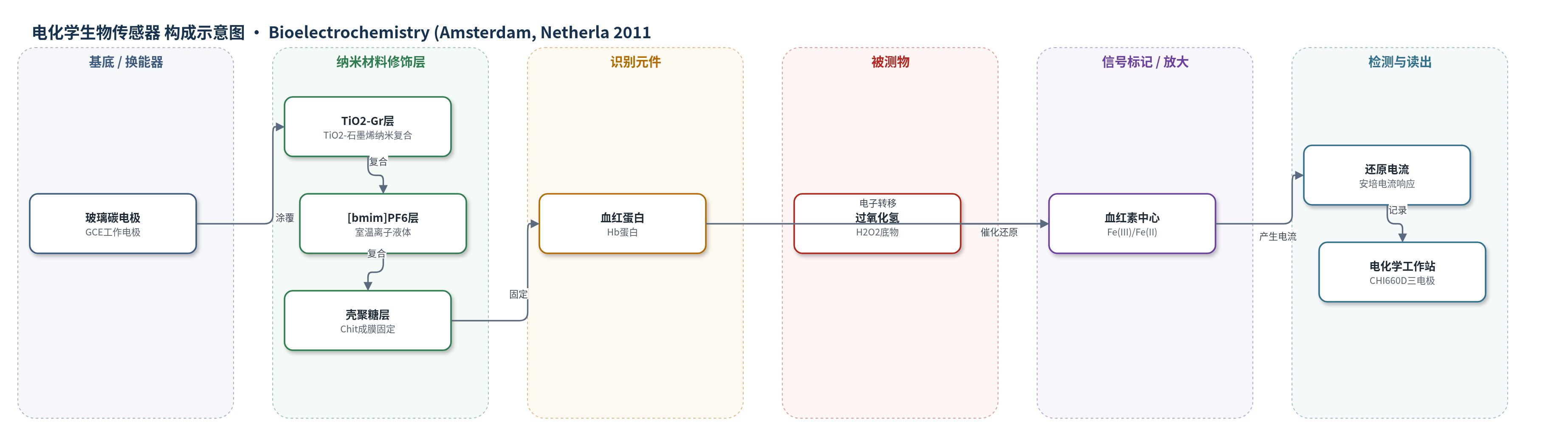
点击图片查看大图 · 依据论文自动绘制
传感器类型
电化学生物传感器
检测对象
过氧化氢(Hydrogen peroxide, H2O2),样品基质为 PBS 缓冲溶液(pH 7.0)及加标溶液
检测原理
Hb 被固定在 Chit-[bmim]PF6-TiO2-Gr 复合膜中,壳聚糖、离子液体和 TiO2-Gr 共同提供导电、生物相容的微环境,使 Hb 血红素中心保持天然构象并暴露于电极界面。在 PBS(pH 7.0)中,Hb 的 Fe(III)/Fe(II) 中心与 GCE 之间发生直接电子转移,循环伏安法可观察到准可逆氧化还原峰。当 H2O2 扩散至修饰电极表面时,Hb 以过氧化物酶样活性催化 H2O2 还原,电子经血红素中心在电极与 H2O2 之间传递,产生还原电流。恒电位 -300 mV 下,稳态电流随 H2O2 浓度升高而增大,无需外加电子媒介体,信号放大主要来自蛋白电催化和复合膜促进电子转移。
检测灵敏度
LOD: 3.0×10⁻⁷ M (S/N=3)(0.3 μM);线性范围: 1.0×10⁻⁶–1.17×10⁻³ M(1–1170 μM);灵敏度斜率: 0.0707 μA μM−1;相关系数: 0.994
效应效果
该传感器响应较快,加入 H2O2 后 2.5 s 内达到稳态电流的 95%。选择性方面,乙酸、葡萄糖、乙醇、抗坏血酸、尿酸和 L-酪氨酸(2.0×10⁻⁴ M)对 1.0×10⁻⁴ M H2O2 的干扰信号变化低于 5%。稳定性良好,4 °C PBS 中保存 20 d 保留 95% 初始响应,循环扫描 100 次峰电流变化小于 3.0%。重现性方面,同一电极连续测定 5.0×10⁻⁵ M H2O2 的 RSD 为 4.4%,七个独立电极 RSD 为 5.36%。标准添加法测定 0.2–0.8 mM H2O2 回收率为 97.2%–99.1%,RSD 4.1%–4.7%。与表 1 中其他 Hb 修饰电极相比,其线性范围更宽、检出限更低,适合低浓度 H2O2 检测。
传感器的构成
- 基底/换能器电极:玻璃碳电极(GCE),经抛光清洗,作为工作电极提供电子转移界面
- 纳米材料修饰层:TiO2-石墨烯纳米复合材料(TiO2-Gr),由 Ti(OiPr)4 在氧化石墨烯(Gr oxide)中水解/水热制备,提供导电与电催化微环境
- 离子液体修饰层:1-丁基-3-甲基咪唑六氟磷酸盐([bmim]PF6),提高导电性并稳定蛋白微环境
- 聚合物固定层:壳聚糖(Chit),成膜、生物相容并固定血红蛋白
- 识别/催化元件:血红蛋白(Hb),保留血红素 Fe(III)/Fe(II) 直接电子转移和 H2O2 电催化活性
- 缓冲介质:0.1 M PBS(pH 7.0),维持 Hb 活性并提供质子环境
- 信号读出:CHI660D 电化学工作站三电极体系,恒电位安培法/循环伏安法检测还原电流
中文摘要
本文通过氧化石墨烯胶体中钛酸四异丙酯水解并原位水热处理制备了 TiO2-石墨烯(TiO2-Gr)纳米复合材料。将室温离子液体 1-丁基-3-甲基咪唑六氟磷酸盐([bmim]PF6)、壳聚糖(Chit)与 TiO2-Gr 复合修饰玻璃碳电极(GCE),并固定血红蛋白(Hb),构建了 Hb/Chit-[bmim]PF6-TiO2-Gr/GCE 电化学生物传感器。紫外-可见光谱、扫描电镜和电化学方法表明,Hb 在复合膜中保持天然构象和生物活性,呈现准可逆 Fe(III)/Fe(II) 氧化还原峰。作者测定了形式电位、电子转移速率常数、表面覆盖度和 Michaelis–Menten 常数等动力学参数。该传感器对 H2O2 还原具有良好的电化学响应,线性范围为 1–1170 μM,检出限为 0.3 μM(S/N=3)。该复合膜兼具良好生物相容性与电催化活性,可用于生物电子器件开发及其他血红素蛋白界面电化学研究。
英文摘要
TiO(2)-graphene nanocomposite was prepared by hydrolysis of titanium isopropoxide in colloidal suspension of graphene oxide and in situ hydrothermal treatment. The direct electrochemistry and electrocatalysis of hemoglobin in room temperature ionic liquid 1-Butyl-3-methylimidazolium hexafluorophosphate, chitosan and TiO(2)-graphene nanocomposite modified glassy carbon electrode were investigated. The biosensor was examined by using UV-vis spectroscopy, scanning electron microscopy and electrochemical methods. The results indicated that hemoglobin remained its bioactivity on the modified electrode, showing a couple of well-defined and quasi-reversible redox peaks, corresponding to hemoglobin Fe(III)/Fe(II) couple. The kinetic parameters for the electrode reaction, such as the formal potential (E(o')), the electron transfer rate constant (k(s)), the apparent coverage (Γ), and Michaelis-Menten constant (K(m)) were evaluated. The biosensor showed good electrochemical responses to the reduction of H(2)O(2) in the ranges of 1-1170 μM. The detection limit was 0.3 μM (S/N=3). The properties of this composite film, together with the bioelectrochemical catalytic activity, could make them useful in the development of bioelectronic devices, and investigation of electrochemistry of other heme proteins at functional interface.