组成图示
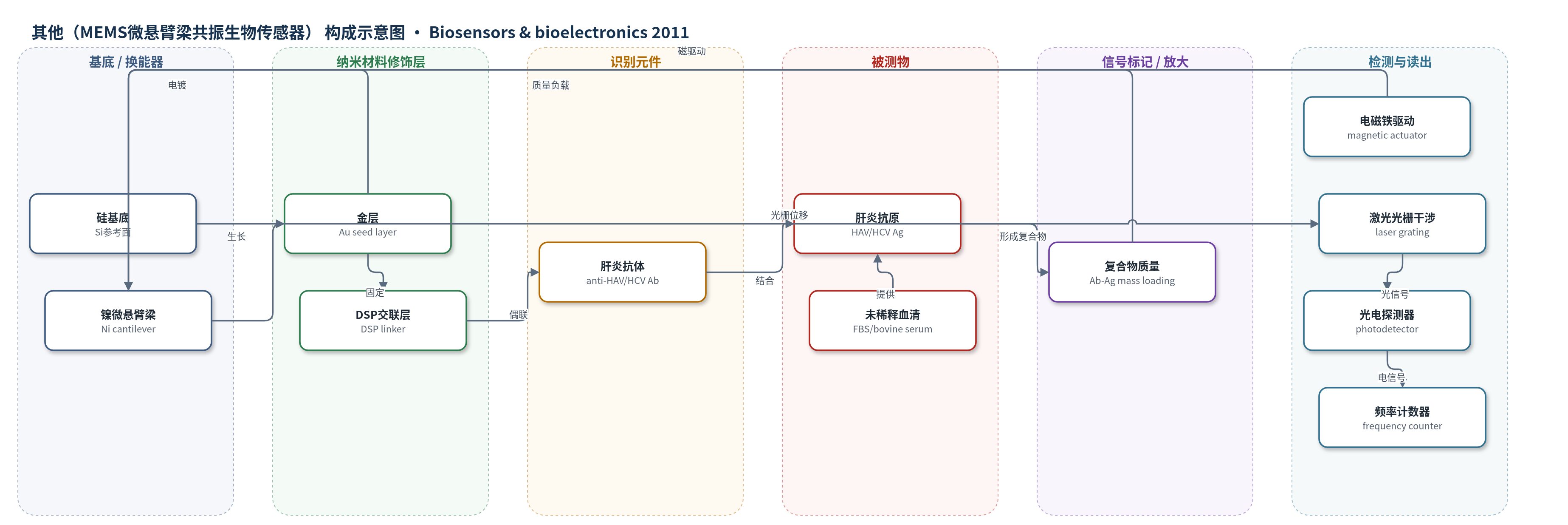
点击图片查看大图 · 依据论文自动绘制
传感器类型
其他(MEMS微悬臂梁共振生物传感器)
检测对象
甲型肝炎病毒抗原(Hepatitis A antigen, HAV Ag)、丙型肝炎病毒抗原(Hepatitis C antigen, HCV Ag);样品基质:未稀释牛血清/胎牛血清(fetal bovine serum, FBS)
检测原理
传感器采用动态模式微悬臂梁共振检测。金表面经DSP固定抗HAV或抗HCV抗体后,未稀释血清中的相应抗原与抗体特异性结合,在悬臂梁表面形成抗原-抗体复合物。结合事件增加悬臂梁有效质量,使其共振频率下降;抗原浓度越高,质量负载越大,频率偏移越大。电磁铁远程驱动悬臂梁自维持振荡,激光照射尖端嵌入的衍射光栅,硅基底参考面与镍移动面构成干涉仪,光强随悬臂梁位移变化。光电探测器输出交流信号,闭环电路锁定90°相位,频率计数器读取共振频率偏移。孵育后以PBS洗涤并在PBS中测量,用参考悬臂梁扣除背景,实现无标记、无放大检测。
检测灵敏度
LOD: 0.1 ng/ml (1.66 pM);线性范围: up to 100 ng/ml (∼1.66 nM);灵敏度斜率: around 190 ppm/(ng/ml);动态范围: in excess of 1000:1
效应效果
该传感器在阴性对照(抗HAV芯片遇HCV抗原、抗HCV芯片遇HAV抗原)中频率偏移仅约6–7 ppm,表明对交叉抗原具有良好选择性;阳性响应在0.1–100 ng/mL范围内近似线性,动态范围>1000:1。重复实验中,HAV Ab&Ag Exp1标准偏差<5%均值,多数数据点峰峰值变化<10%,芯片间和阵列内重现性良好。作者称0.1 ng/mL(1.66 pM)检出限与ELISA等标记法相当,且无需标记或质量放大。系统无电连接、可一次性使用、功耗低、抗振动,适合便携式POC诊断。
传感器的构成
- 基底/换能器:硅基底(Si substrate)经KOH蚀刻形成参考表面,电镀镍(Ni)微悬臂梁约1 μm厚,作为机械共振换能器
- 金属功能化平台:100 nm金(Au)层位于镍层下,作为电镀种子层和生物功能化平台
- 交联修饰层:DSP(Dithiobis succinimidyl propionate,2 mM)连接金表面与抗体,实现抗体固定
- 识别元件:抗HAV VP3蛋白抗体和抗HCV抗体(Abcam,约1000 ng/mL)固定于金表面,用于特异性结合抗原
- 驱动元件:电磁铁线圈,远程磁驱动悬臂梁共振
- 光学读出元件:5 mW激光二极管、透镜、悬臂梁尖端嵌入衍射光栅、光电探测器,实现干涉位移检测
- 电子读出:自维持闭环控制电路与频率计数器,监测共振频率偏移
中文摘要
本文报道了一种用于无标记、实时监测分析物并检测生物分子的共振微悬臂梁阵列生物传感器。电镀镍MEMS微悬臂梁经肝炎抗体功能化后,用于检测不同浓度的甲型肝炎病毒(HAV)和丙型肝炎病毒(HCV)抗原;抗原直接加入未稀释牛血清中。所有功能化、孵育和测量均在专门设计的流池液相环境中完成,悬臂梁全程不干燥。驱动与传感均远程实现,因此MEMS悬臂梁无需电连接,便于制备一次性传感器芯片。电磁铁提供磁驱动,激光照明与每个悬臂梁尖端嵌入的衍射光栅实现干涉光学检测。动态模式下的共振频率通过自维持闭环控制电路和频率计数器监测。通过检测HAV和HCV抗原及其阴性对照,验证了传感器特异性。这是首次报道共振悬臂梁在未稀释血清中检测肝炎抗原。两种抗原的动态范围均超过1000,最低可检测浓度为0.1 ng/mL(1.66 pM),与ELISA等标记检测方法相当。
英文摘要
Resonant microcantilever arrays are developed for the purpose of label-free and real-time analyte monitoring and biomolecule detection. MEMS cantilevers made of electroplated nickel are functionalized with Hepatitis antibodies. Hepatitis A and C antigens at different concentrations are introduced in undiluted bovine serum. All preparation and measurement steps are carried out in the liquid within a specifically designed flowcell without ever drying the cantilevers throughout the experiment. Both actuation and sensing are done remotely and therefore the MEMS cantilevers have no electrical connections, allowing for easily disposable sensor chips. Actuation is achieved using an electromagnet and the interferometric optical sensing is achieved using laser illumination and embedded diffraction gratings at the tip of each cantilever. Resonant frequency of the cantilevers in dynamic motion is monitored using a self-sustaining closed-loop control circuit and a frequency counter. Specificity is demonstrated by detecting both Hepatitis A and Hepatitis C antigens and their negative controls. This is the first report of Hepatitis antigen detection by resonant cantilevers exposed to undiluted serum. A dynamic range in excess of 1000 and with a minimum detectable concentration limit of 0.1ng/ml (1.66pM) is achieved for both Hepatitis A and C. This result is comparable to labeled detection methods such as ELISA.