组成图示
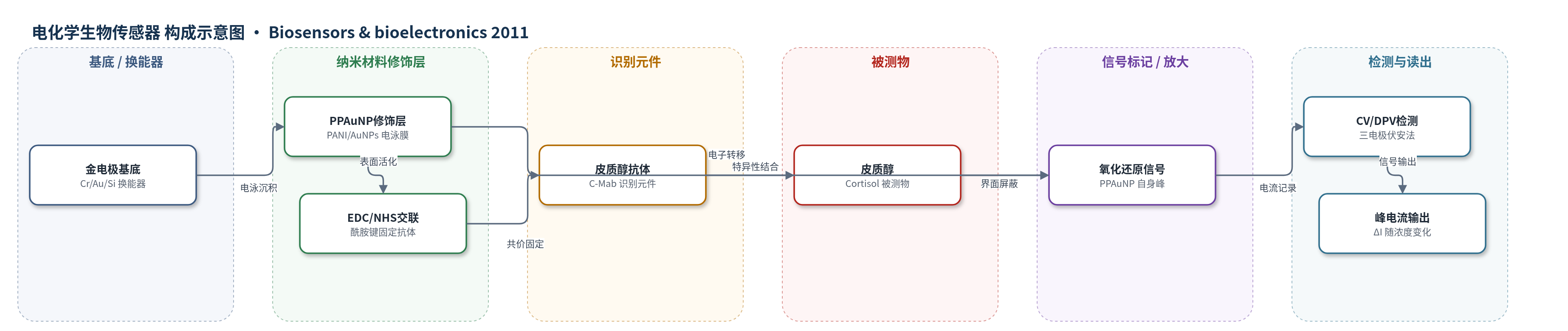
点击图片查看大图 · 依据论文自动绘制
传感器类型
电化学生物传感器
检测对象
皮质醇(Cortisol,Hydrocortisone),样品基质:磷酸盐缓冲液(PBS,10 mM,pH 7.0,0.9% NaCl)
检测原理
PPAuNPs 由聚苯胺包覆金纳米颗粒构成,具有导电性和可逆氧化还原活性,在 pH 7.0 PBS 中产生稳定氧化还原峰。C-Mab 经 EDC/NHS 共价固定于 PPAuNP 表面,BSA 封闭非特异性位点。当皮质醇加入后,抗原与抗体特异性结合,使电极界面蛋白质层增厚、绝缘性增强,阻碍 PPAuNP 与溶液间电子转移,导致 CV/DPV 氧化峰电流下降。峰电流变化量 ΔI 与皮质醇浓度对数呈线性关系,无需外部介质或二次标记。该检测基于免疫识别引起的界面电子转移阻抗变化,属于无标记电化学免疫传感。
检测灵敏度
线性范围: 1 pM–100 nM;CV: ΔI (μA) = 21.85 + 1.63 log[cortisol conc. (M)],灵敏度: 1.63 μA M−1,R^2 = 0.989;DPV: ΔI (μA) = 32.59 + 2.39 log[cortisol conc. (M)],灵敏度: 2.39 μA M−1,R^2 = 0.989
效应效果
传感器在 PBS pH 7.0 中稳定,反复扫描无降解,氧化还原峰可重复;同批 PPAuNP/Au 电极电流最大变化 ±1.5%,BSA/C-Mab/PPAuNP/Au 电极最大变化 ±3%。校准中每个浓度至少使用 3 个电极,重复性在 6% 以内。干扰实验显示对 10 μg/mL BSA 和 100 nM 17-β-羟基孕酮无明显响应,表现出对皮质醇的选择性。与文献中荧光、化学发光、ELISA、SPR、EIS 等皮质醇检测方法相比,该体系无需外部介质或二次标记,在中性 pH 下实现 1 pM–100 nM 宽范围检测,作者认为其可用于压力生物标志物皮质醇的灵敏、简便检测。
传感器的构成
- 基底/换能器电极:金电极(Au,Cr/Au 10 nm/100 nm 于热氧化 Si 片),导电基底与电化学换能器。
- 纳米材料修饰层:聚苯胺保护金纳米颗粒(PPAuNPs,PANI/AuNPs),电泳沉积约250 nm均匀膜,提供导电性、氨基与高比表面。
- 交联/活化层:EDC/NHS,活化 C-Mab 羧基与 PANI 氨基形成酰胺键,实现抗体共价固定。
- 识别元件:皮质醇特异性单克隆抗体(C-Mab),特异性结合皮质醇。
- 封闭剂:牛血清白蛋白(BSA),封闭非特异性吸附位点。
- 信号标记物:无外部标记/介质,利用 PPAuNP 自身氧化还原峰作为信号。
- 信号读出:循环伏安(CV)/差分脉冲伏安(DPV)三电极体系,记录 PPAuNP 氧化还原峰电流变化。
中文摘要
聚苯胺保护金纳米颗粒(PPAuNPs)经电泳沉积于金电极表面,用于构建无标记、无介质的皮质醇电化学生物传感器。皮质醇特异性单克隆抗体(C-Mab)通过 EDC/NHS 化学共价固定于 PPAuNP/Au 电极表面,牛血清白蛋白(BSA)用于封闭非特异性吸附。采用透射电镜、原子力显微镜和电化学阻抗谱表征 PPAuNP 形成及电极制备过程。循环伏安法和差分脉冲伏安法用于在磷酸盐缓冲液(PBS)中测定皮质醇浓度。结果表明,PPAuNP 基电极在反复扫描中稳定,具有可重复的氧化还原峰;BSA/C-Mab/PPAuNP/Au 电极在 PBS 中可在 1 pM–100 nM 范围内准确检测皮质醇,灵敏度为 1.63 μA M−1。该传感器对 BSA 和 17-β-羟基孕酮具有选择性。研究证明 PPAuNP 基矩阵可用于构建无标记、无介质皮质醇电化学生物传感器,为压力生物标志物检测提供可行方案。
英文摘要
Polyaniline protected gold nanoparticles (PPAuNPs) were electrophoretically deposited onto a gold electrode, and utilized to fabricate an electrochemical cortisol biosensor. Cortisol specific monoclonal antibody (C-Mab) was covalently immobilized onto the surface of a PPAuNP/Au electrode using N-ethyl-N'-(3-dimethylaminopropyl) carbodiimide and N-hydroxysuccinimide (EDC/NHS) chemistry. BSA was employed for blocking nonspecific adsorption on the electrode surface. PPAuNP formation and BSA/C-Mab/PPAuNP/Au electrode fabrication were characterized using transmission electron microscopy, atomic force microscopy and electrochemical impedance techniques, respectively. Cyclic voltammetry and differential pulse voltammetric techniques were used to determine the cortisol concentration in a phosphate buffer saline (PBS) solution. Results confirmed that the PPAuNP based electrode was stable during repeated scans and exhibited repeatable redox peaks. Further, the BSA/C-Mab/PPAuNP/Au electrode in the PBS buffer accurately detected cortisol in the range of 1 pM-100 nM with a sensitivity of 1.63 μAM(-1). The biosensor was found to be selective against BSA and 17-α-hydroxy progesterone. This research establishes the feasibility of using a PPAuNP based matrix for a label and mediator free electrochemical biosensor for cortisol, a stress biomarker.