组成图示
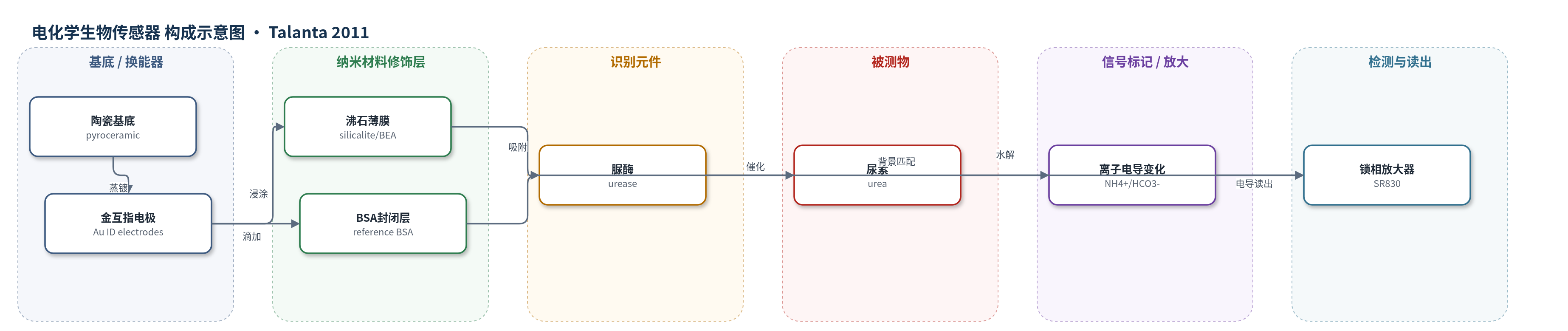
点击图片查看大图 · 依据论文自动绘制
传感器类型
电化学生物传感器
检测对象
尿素(urea);样品基质为磷酸盐缓冲液(PBS, pH 7.2)模型溶液,每次注入 1 mM 尿素。
检测原理
该传感器以脲酶为识别元件,以金互指电极间的溶液电导为换能信号。当尿素进入电极表面时,固定于沸石薄膜上的脲酶催化尿素水解:(NH2)2CO + 2H2O + H+ → 2NH4+ + HCO3-。反应生成 NH4+ 和 HCO3- 等带电离子,使电极间隙局部离子浓度和电导率发生变化。锁相放大器通过交流电导测量读出该变化,信号大小随尿素浓度升高而增大。沸石薄膜提供多孔高比表面和可调控的疏水/酸性微环境,增强脲酶吸附与催化可及性;ZCT 结构省去戊二醛交联膜,减少扩散屏障,因而响应更快、信号更强。该体系主要依靠酶催化反应实现化学放大,而非核酸或纳米酶放大。
检测灵敏度
原文未报告LOD、线性范围、灵敏度斜率及相关系数。
效应效果
该传感器对尿素选择性高,尿酸、肌酸、葡萄糖和肌酐单独存在时无响应。ZCT在8 mM尿素下响应27.5 µS,高于SMT的16.8 µS,动态范围相近。SMT约80 s稳定,ZCT约8 s,快于文献溶胶-凝胶传感器的16.5 min。RSD分别为SMT 5%、ZMT 6.7%、ZCT 3.6%,ZCT因薄膜厚度可控更好。ZCT工作6 h保持初始活性;储存1周损失约50%,之后维持约1个月。作者认为其制备简单、稳定性好、信号增强,可推广至其他电化学生物传感器。
传感器的构成
- 基底/换能器电极:pyroceramic 陶瓷基底上真空蒸镀 Au 金互指电极(Au ID electrodes),提供电导换能界面
- 纳米材料修饰层:5% silicalite 或 zeolite Beta(BEA40/BEA50/BEA60)悬浮液浸涂形成沸石薄膜,用于吸附固定脲酶并调节微环境
- 识别元件:5% urease(脲酶)PBS 溶液滴加于工作电极侧,催化尿素水解
- 对照/封闭层:reference 电极侧滴加 5% BSA PBS 溶液(ZCT)或 10% BSA+10% glycerol(SMT/ZMT),用于背景匹配与非特异封闭
- 交联固定剂:glutaraldehyde(GA)蒸气处理 35 min,用于 SMT/ZMT 中脲酶/BSA 膜交联;ZCT 不使用
- 缓冲介质:5 mM phosphate buffer solution(PBS, pH 7.2),提供离子环境并作为电导测量介质
中文摘要
本文报道了一种用于尿素测定的新型电导生物传感器。作者将丝光沸石(silicalite)和Beta沸石(zeolite Beta)薄膜沉积到电导生物传感器的金互指电极表面,用于固定脲酶,并将该体系与标准膜换能器(SMT)进行比较。研究比较了沸石膜换能器(ZMT)和沸石涂层换能器(ZCT)两种表面修饰方式,其中ZMT将沸石颗粒混入脲酶固定化膜中,ZCT则先在金电极上浸涂沸石薄膜,再滴加脲酶溶液。实验采用丝光沸石以及Si/Al比为40、50和60的Beta沸石,以考察沸石参数对传感器响应的影响。ZCT固定脲酶无需交联剂,因此可首次直接评估同种沸石Si/Al比对电导响应的影响。结果表明,添加丝光沸石或Beta沸石的电极响应均高于SMT;ZCT响应始终高于ZMT;Beta沸石修饰的ZMT和ZCT响应随Si/Al比升高而增强,可能源于沸石疏水性增强和/或介质酸强度增加。
英文摘要
A new approach was developed for urea determination where a thin film of silicalite and zeolite Beta deposited onto gold electrodes of a conductometric biosensor was used to immobilize the enzyme. Biosensor responses, operational and storage stabilities were compared with results obtained from the standard membrane methods for the same measurements. For this purpose, different surface modification techniques, which are simply named as Zeolite Membrane Transducers (ZMTs) and Zeolite Coated Transducers (ZCTs) were compared with Standard Membrane Transducers (SMTs). Silicalite and zeolite Beta with Si/Al ratios 40, 50 and 60 were used to modify the conductometric electrodes and to study the biosensor responses as a function of changing zeolitic parameters. During the measurements using ZCT electrodes, there was no need for any cross-linker to immobilize urease, which allowed the direct evaluation of the effect of changing Si/Al ratio for the same type of zeolite on the biosensor responses for the first time. It was seen that silicalite and zeolite Beta added electrodes in all cases lead to increased responses with respect to SMTs. The responses obtained from ZCTs were always higher than ZMTs as well. The responses obtained from zeolite Beta modified ZMTs and ZCTs increased as a function of increasing Si/Al ratio, which might be due to the increased hydrophobicity and/or the acid strength of the medium.