组成图示
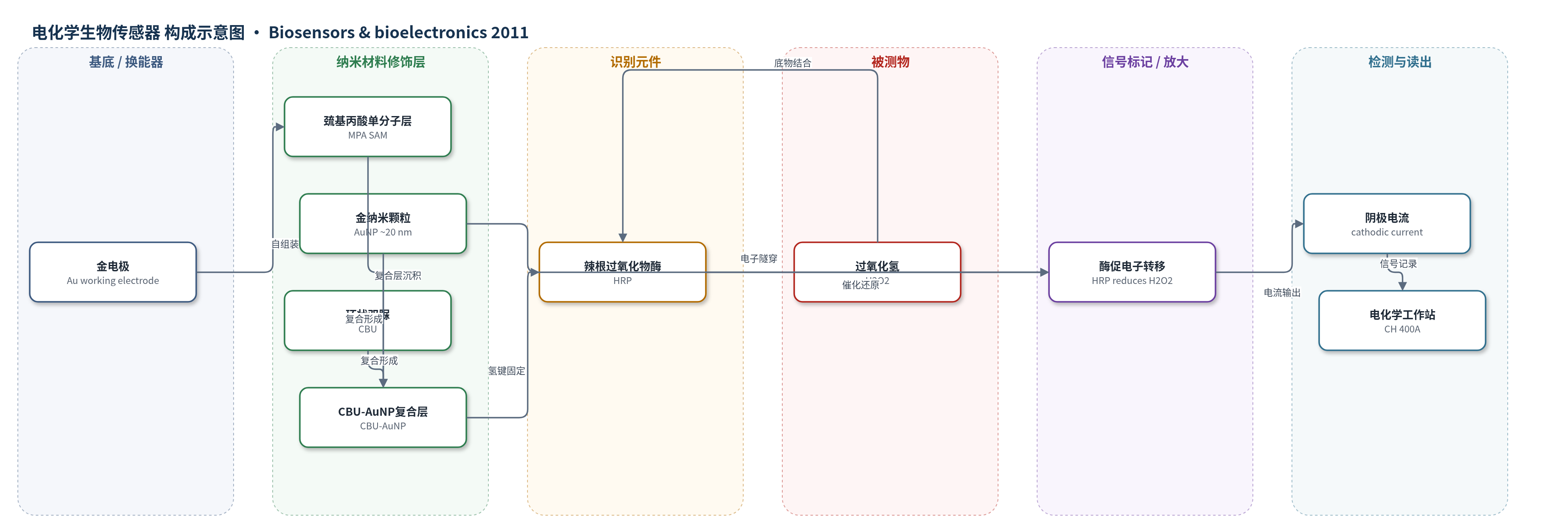
点击图片查看大图 · 依据论文自动绘制
传感器类型
电化学生物传感器
检测对象
过氧化氢(hydrogen peroxide, H2O2);样品基质:0.1 M PBS缓冲液(pH 7.4)
检测原理
传感器以金电极为基底,MPA自组装层提供界面,CBU/AuNP复合层通过氢键固定HRP并保持其活性取向。H2O2到达电极表面后,氧化HRP中的Fe(III)生成含氧铁卟啉(Fe4+O)和卟啉阳离子自由基的化合物I;随后化合物I从电极获得电子形成化合物II,再获得一个电子恢复为天然HRP。AuNP作为导电中心促进酶与电极间的电子隧穿,并增强电催化还原。H2O2浓度越高,HRP催化还原产生的阴极电流越大,从而实现电化学定量检测。
检测灵敏度
LOD: 50 nM;线性范围: 400 nM–900 nM;校准范围: 50 nM–1.6 mM;KappM: 4.5 μM
效应效果
该传感器对H2O2具有较高选择性,在1 mM葡萄糖、牛血清白蛋白(BSA)和抗坏血酸存在下未出现可检测干扰电流,分析响应基本不受影响。四个独立制备电极对1 μM H2O2的响应相对标准偏差(RSD)为6.4%,表明制备重现性良好。4 ℃储存30天后仍保持初始灵敏度的80%,稳定性较高。引入AuNP后灵敏度较无AuNP电极提高1000倍以上,50 nM H2O2即可产生明显催化电流,KappM为4.5 μM,低于多数报道值。作者认为该体系快速、简单、低成本,适用于H2O2检测并可拓展到其他酶基生物传感器。
传感器的构成
- 基底/换能器电极:金电极(Au),经抛光和Piranha溶液处理,作为电子转导基底
- 自组装单分子层:巯基丙酸(MPA),在金表面形成有序单分子层,提供功能化界面
- 纳米复合修饰层:环状双脲(CBU)/金纳米颗粒(AuNP)复合层,CBU通过二硫键结合AuNP,AuNP提供电催化与电子隧穿通道
- 识别/催化元件:辣根过氧化物酶(HRP),通过CBU氢键固定,催化H2O2还原
中文摘要
本文报道了一种基于金电极上逐层组装巯基丙酸(MPA)、半胱氨酸基聚亚甲基桥联环状双脲(CBU)/金纳米颗粒(AuNP)复合层和辣根过氧化物酶(HRP)的新型电化学生物传感器表面,用于高灵敏检测过氧化氢(H2O2)。CBU的化学与空间结构可提供大量氢键,使酶以有利取向固定并保持催化活性;AuNP具有高效电子隧穿和电催化作用,从而提高H2O2检测灵敏度。循环伏安法中观察到HRP直接电子转移产生的阴极电流,表明传感器表面具有优异电催化活性。该AuNP/CBU修饰生物传感器表面将H2O2检出限降至50 nM;在−0.3 V计时电流法下测得表观米氏常数KappM为4.5 μM。新传感器表现出高稳定性、良好重现性和高灵敏度。
英文摘要
A novel electrochemical sensor surface with enhanced sensitivity for the detection of hydrogen peroxide has been developed based on the layer-by-layer assembly of mercapto propionic acid (MPA), cystine-based polymethylene-bridged cyclic bisureas (CBU)/gold nanoparticle (AuNP) and horseradish peroxidase (HRP) on gold electrode. Possibility of a large number of hydrogen bonds, allowed by the chemical and sterical structure of the CBU ensures the proper immobilization of the enzyme in favorable orientation and retention of enzymatic activity. Efficient electron tunneling property of AuNP together with its electrocatalytic activity leads to higher sensitivity in the detection of H(2)O(2). In cyclic voltammetry measurements a cathodic current due to direct electron transfer of HRP is observed which, indicates excellent electrocatalytic activity of the sensor surface. The biosensor surface modified with gold nanoparticle and CBU showed a lower detection limit of 50 nM for hydrogen peroxide. Chronoamperometry is performed at -0.3 V and Michaelis-Menten constant K(M)(app) value is estimated to be 4.5 μM. The newly developed sensor surface showed very high stability, reproducibility and high sensitivity.