组成图示
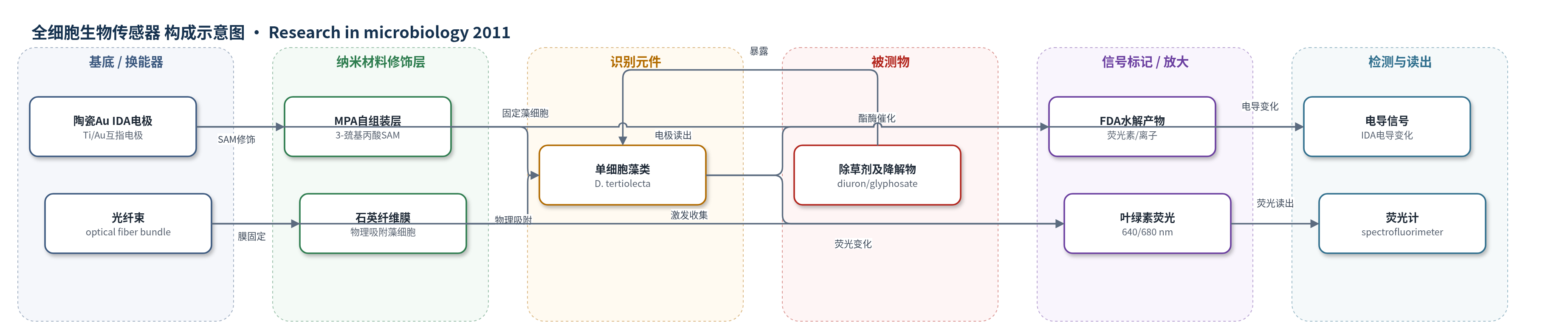
点击图片查看大图 · 依据论文自动绘制
传感器类型
全细胞生物传感器
检测对象
莠去津(diuron)、草甘膦(glyphosate)、DCPU、DCPMU、AMPA;样品基质为水样/培养介质(模拟地中海潟湖与近岸水)
检测原理
该传感器以完整单细胞藻类作为识别与响应元件。藻细胞暴露于莠去津、草甘膦或其光降解产物后,污染物与细胞膜/代谢系统相互作用,改变细胞外膜酯酶活性或光合电子传递状态。在电导式传感器中,藻膜酯酶催化底物FDA水解,产生荧光素及离子性产物;离子在互指金电极间迁移,使电极表面离子电导发生变化,电导计据此读出信号。在光学传感器中,藻细胞被固定于石英纤维膜并接触光纤束,激发光诱导叶绿素荧光发射;除草剂干扰光合过程后,荧光强度或光谱随污染物浓度发生可测变化。整体信号表现为酶活性抑制/诱导或荧光增强/减弱,随被测物浓度呈剂量相关,但作者强调其主要用于定性预警而非精确浓度定量。
检测灵敏度
原文未报告LOD、线性范围、灵敏度斜率或相关系数。
效应效果
游离藻与固定化藻结果一致,表明SAM固定未明显损害藻类代谢活性。莠去津对D. tertiolecta酯酶活性呈剂量依赖抑制,0.5 mg/L暴露48 h后残余活性约62%;电导式传感器中1 mg/L莠去津使一个传感器残余活性降至约30%。AMPA在24 h内即可显著抑制,草甘膦在电导式传感器中无明显效应。光学传感器对0.4–0.004 mg/L莠去津显示荧光正相关。作者选择信号变异≤10%的传感器,但未报告RSD、回收率或方法对比。作者认为其可快速用于近岸水预警,但属定性方法,需微型化并提高稳健性与灵敏度。
传感器的构成
- 基底/换能器:陶瓷基底上50 nm Ti粘附层与15 nm互指金电极(Au IDA),用于电导式传感和藻细胞固定
- 自组装修饰层:3-巯基丙酸(MPA)自组装单分子层(SAM),修饰金电极表面并提供藻细胞固定位点
- 识别元件:固定化单细胞海洋藻类Dunaliella tertiolecta或Phaeodactylum tricornutum,以膜酯酶和光合系统作为生物响应元件
- 底物/信号标记:荧光素二乙酸酯(FDA),被藻膜酯酶水解为荧光素(fluorescein),用于酯酶活性检测
- 光学固定/换能层:石英纤维膜(quartz fiber membrane)物理吸附藻细胞,并连接光纤束(optical fiber bundle)
- 读出介质:重组海水培养基(Instan Ocean 33 g/L + Guillard f/2 90 mg/L),维持藻细胞活性与离子强度
中文摘要
地中海潟湖和近岸水常受农业径流、河流及直接排放带入的农药等化学品污染,外源化合物对生态系统健康构成风险,需在造成不可逆损害前进行早期预警。本研究开发一种基于固定化单细胞海洋藻类代谢活性的生物传感器,用于快速检测环境中常见除草剂及其光降解产物,包括莠去津(diuron)、草甘膦(glyphosate)以及DCPU、DCPMU和AMPA。传感器以完整藻细胞作为生物识别元件,通过监测细胞外膜酯酶活性和叶绿素荧光变化来响应污染物。研究采用Dunaliella tertiolecta和Phaeodactylum tricornutum两种藻类,分别构建电导式和光学式传感系统,并比较游离藻与固定化藻的响应。结果表明,两种除草剂可干扰传感器信号,固定化未明显改变藻类代谢活性,该系统可作为需要持续监测环境的快速预警工具。
英文摘要
Lagoons and coastal waters are contaminated by a large number of chemicals discharged directly or carried by rivers and runoff water that drain catchment areas in which agricultural activities take place. The inflow of these exogenous compounds constitutes a genuine risk for the health of ecosystems. It is therefore important to detect their presence in the natural environment before they cause irreversible damage. Here we present a study aimed at developing a tool for rapid detection of pesticides and other chemicals in environments liable to be contaminated, in order to propose an early warning system for decision-makers. The study carried out focuses on two herbicides commonly encountered in the environment, i.e. diuron and glyphosate, as well as several of their photodegradation products (DCPU, DCPMU, AMPA). The results presented contribute toward developing a biosensor based on measuring the metabolic activities of immobilized unicellular marine algae. The sensor's operation is based on measuring the esterase localized on the external membrane of the algae cells and chlorophyll fluorescence. The tests carried out show that the signal emitted by the sensor is disturbed by the presence of the two herbicides studied. The system proposed appears useful as a tool for controlling environments requiring monitoring.