组成图示
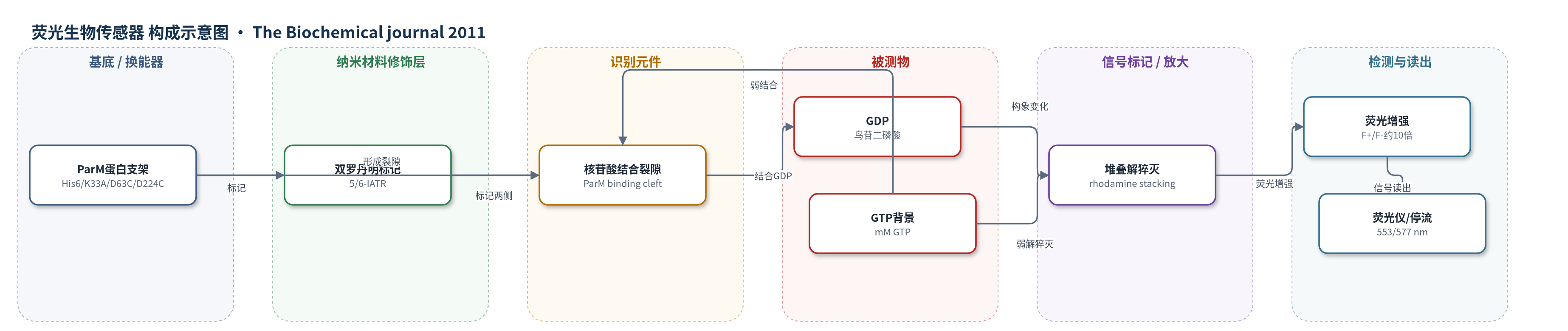
点击图片查看大图 · 依据论文自动绘制
传感器类型
荧光生物传感器
检测对象
GDP(鸟苷二磷酸,GDP)、ADP(腺苷二磷酸,ADP)等核苷二磷酸;样品基质为体外缓冲液(Tris/HCl 或 Hepes,含 mM GTP 背景及 hGBP5、Ras-GDP/Soscat 等酶反应体系)
检测原理
ParM 突变体在 Cys63 和 Cys224 上共价连接两个 5/6-IATR 罗丹明。无核苷酸时,两个罗丹明位于结合裂隙两侧并发生堆叠,荧光被强烈猝灭。GDP 结合后,ParM 两个亚结构域相对旋转约 25°,结合裂隙闭合,改变罗丹明间距与取向,破坏堆叠相互作用,使荧光增强约 10 倍。GTP 结合较弱且荧光变化小,因此传感器对 GDP 的灵敏度比 GTP 高 100 倍以上,可在 mM GTP 背景检测 μM GDP。响应时间 <200 ms,主要由结合/解离控制(kon=0.047 μM−1 s−1,koff=4.8 s−1)。荧光强度随 GDP 浓度增加而增强,低浓度近似线性,高浓度呈双曲线,可实时监测 GTPase 水解或 GEF 催化核苷酸交换释放的 GDP。
检测灵敏度
LOD: 未报告;实际可检测低至 2 μM GDP(mM GTP 背景);线性范围: 5–500 μM(10%–90% 饱和);荧光响应在 <~20 μM 近似线性;灵敏度斜率: 6.3 μM−1、6.1 μM−1、5.8 μM−1(0、0.5、1 mM GTP 校准)
效应效果
传感器对 GDP 选择性显著:10 μM GDP 引起 >2 倍荧光变化,相同变化需 >1 mM GTP;GTP 贡献在 ~800 μM 以下 <5%。响应时间 <200 ms。hGBP5 GTPase 测定得 KM=79 μM、Vmax=0.467 μM·min−1、kcat=2.1 min−1,与 HPLC 法 1.7 min−1 一致。Ras–GDP 在 Soscat 催化下交换半衰期 240、80、25、2.5 s(0.1、0.3、1、10 μM),单轮 k=0.28 s−1,比先前低 Ras 条件快 >10 倍;内禀交换 3.6×10⁻⁵ s−1,加速 >5 个数量级。作者认为其通用、无需标记核苷酸或蛋白,可用于 GTPase/激酶研究和抑制剂筛选。
传感器的构成
- 识别元件:ParM 突变体(His6/K33A/D63C/T174A/T175N/D224C/C287A),细菌肌动蛋白同源物,结合 GDP 并发生构象变化
- 信号标记物:5-IATR 或 6-IATR(iodoacetamidotetramethylrhodamine,碘乙酰胺四甲基罗丹明),共价连接 Cys63 与 Cys224,形成双罗丹明堆叠猝灭/解猝灭
- 识别位点工程:K33A、T174A、T175N、C287A 等突变,增强对核苷二磷酸的选择性并阻止 ParM 聚合,保持单体
- 反应介质:Tris/HCl、KCl、MgCl2、BSA(部分体系含 DTT),维持蛋白稳定性、离子强度与巯基保护
- 读出系统:Cary Eclipse 荧光分光光度计或 HiTech SF61 DX2 停流荧光仪,激发 553/546 nm,发射 577 nm 或 570 nm 长通
中文摘要
开发新型荧光方法检测关键生物分子对基础研究和药物发现具有重要意义。ADP和GDP是细胞内多种反应的产物,包括核苷三磷酸酶和激酶催化的反应。本实验室此前基于细菌肌动蛋白同源物ParM的荧光团加合物开发了ADP生物传感器。本研究证明其中一种传感器——四甲基罗丹明标记的ParM(rhodamine–ParM)也可监测GDP。该传感器能在毫摩尔GTP背景下测量微摩尔GDP浓度。其荧光响应快速,响应时间小于0.2 s,因此可用于GTP酶和GTP依赖性激酶反应的实时测量。作者以两种不同GTP酶为例,展示了该GDP生物传感器在测定GTP水解速率和核苷酸交换速率中的应用。
英文摘要
The development of novel fluorescence methods for the detection of key biomolecules is of great interest, both in basic research and in drug discovery. Particularly relevant and widespread molecules in cells are ADP and GDP, which are the products of a large number of cellular reactions, including reactions catalysed by nucleoside triphosphatases and kinases. Previously, biosensors for ADP were developed in this laboratory, based on fluorophore adducts with the bacterial actin homologue ParM. It is shown in the present study that one of these biosensors, tetramethylrhodamine-ParM, can also monitor GDP. The biosensor can be used to measure micromolar concentrations of GDP on the background of millimolar concentrations of GTP. The fluorescence response of the biosensor is fast, the response time being <0.2 s. Thus the biosensor allows real-time measurements of GTPase and GTP-dependent kinase reactions. Applications of the GDP biosensor are exemplified with two different GTPases, measuring the rates of GTP hydrolysis and nucleotide exchange.