组成图示
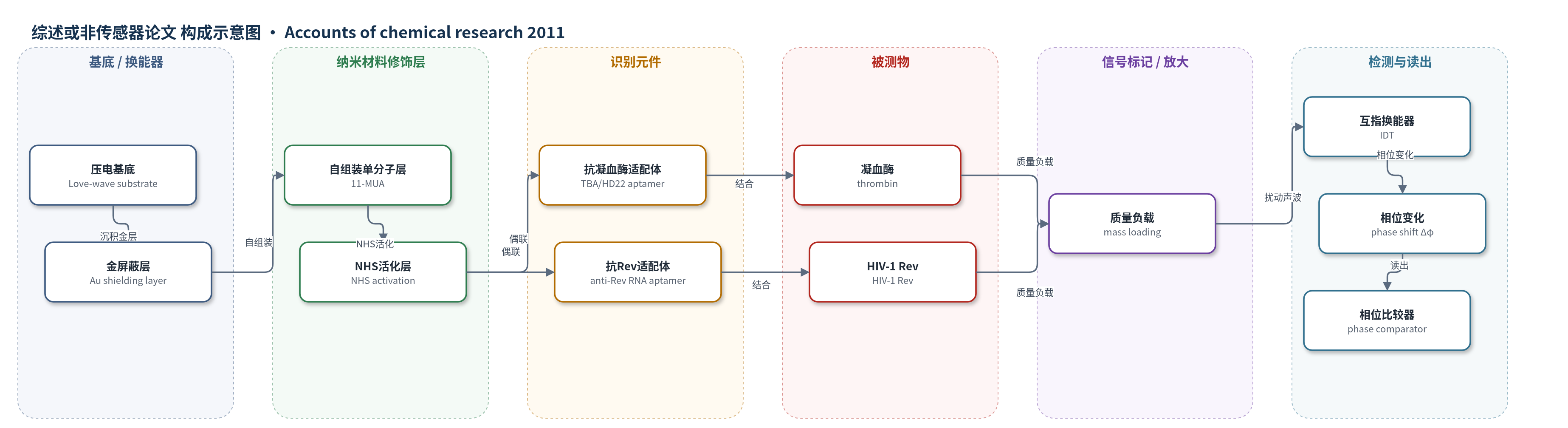
点击图片查看大图 · 依据论文自动绘制
传感器类型
综述或非传感器论文
检测对象
凝血酶(thrombin)、HIV-1 Rev 肽(HIV-1 Rev peptide)、血小板源性生长因子(PDGF)、可卡因(cocaine)、ATP、溶菌酶(lysozyme)、蓖麻毒素(ricin)、HIV-1 RT/gp120 蛋白;样品基质包括缓冲液、血清、血浆、血液、细胞/组织
检测原理
适配体传感器以适配体为识别元件,通过特异性结合靶标触发信号。在 Love-wave/SAW 配置中,适配体经 SAM 固定于压电表面,靶标结合造成表面质量负载和黏弹性变化,扰动表面声波传播,使输入/输出相位或频率改变,相位比较器将变化转换为与结合量相关的信号,浓度越高信号越大。在电化学 E-AB 配置中,适配体结合靶标后发生构象变化,使末端亚甲基蓝(MB)靠近电极,电子转移效率提高,产生氧化还原电流。荧光、比色、纳米颗粒或 SERRS 配置则利用结合引起的荧光开关、颜色变化、纳米颗粒聚集或拉曼增强。多重平台通过编码阵列或磁珠富集实现并行检测,部分系统可在线动力学分析并耦合质谱鉴定。
检测灵敏度
LOD: 3.3 ng cm^-2(免疫球蛋白 E,QCM);LOD: ∼75 pg cm^-2(凝血酶与 HIV-1 Rev 肽,Love-wave);表1凝血酶检测限(pM):纳米颗粒/质谱 10;生物条形码/电化学 6.2;金电极/电化学 0.055;石英传感器/SAW 400;石墨电极/伏安法 55500;aptaPCR/qPCR 0.45;分子信标/增强化学发光 0.05;OECA/荧光 0.47;磁性纳米颗粒/荧光 60;SERRS/拉曼 100-1000
效应效果
Love-wave 适配体传感器多次结合/再生后保持灵敏度,检测限约 75 pg cm^-2,较此前 SAW 装置高约 2 个数量级。E-AB 可在血清中直接检测皮摩尔级 PDGF。磁珠电化学方法成本低并可富集分析物。Adloc 单线氧通道化读出兼容高通量筛选。Love-wave 耦合 MALDI-ToF 可在未纯化样品中实现动力学分析、无标记鉴定与定量,并识别 RT948-2 突变。Gold 平台可同时检测 813 种蛋白,用于慢性肾病和肺癌标志物发现。FACS-SELEX 获得 Burkitt 淋巴瘤 B 细胞特异性适配体 C10,不结合健康 B 细胞。作者认为多数适配体传感器尚未进入临床,瓶颈是真实靶标适配体与真实样品验证。
传感器的构成
- 基底/换能器:压电 Love-wave 传感器基底与金屏蔽层(Au),承载声波传播并提供表面功能化位点
- 修饰层:11-巯基十二烷酸(11-MUA)自组装单分子层(SAM),提供羧基用于后续偶联
- 活化层:N-羟基琥珀酰亚胺(NHS)活化羧基,形成适配体共价偶联位点
- 识别元件:抗凝血酶 DNA 适配体(TBA/HD22)或抗 HIV-1 Rev RNA 适配体,特异性结合靶标蛋白
- 信号读出:互指换能器(IDT)、高频发生器与相位比较器,将表面质量负载转换为相位变化 Δφ
中文摘要
适配体是一类可通过体外筛选获得的非天然寡核苷酸分子识别支架,能够以高亲和力和高特异性结合多种蛋白质及其他靶标。由于适配体可完全化学合成,可方便地引入各类报告基团,并偶联到载体、表面、纳米颗粒或其他生物分子上,因而具有高度模块化特征。许多适配体在结合靶标时发生显著构象重排,可将结合事件转换为可检测信号,因此已被适配到多种读出配置,并越来越多地用作生物分析方法中的捕获元件。尽管适配体传感器已取得显著进展,但要实现其在临床和环境生物传感与诊断中的更广泛应用,仍需克服若干挑战。当前,可并行检测多种分析物的多重适配体传感器配置正取得重要进展。本文综述了通过多种物理化学相互作用将配体结合转换为信号的概念,介绍了适配体作为捕获剂的特性,重点讨论了表面声波适配体传感器、多重适配体传感器、临床诊断挑战与展望,以及可区分疾病细胞与健康细胞的适配体传感器潜力。
英文摘要
Aptamers comprise a range of molecular recognition scaffolds that can be engineered to bind to a legion of different proteins and other targets with excellent specificity and affinity. Because these non-natural oligonucleotides are accessible entirely synthetically, aptamers can be equipped with all sorts of reporter groups and can be coupled to many different carriers, surfaces, nanoparticles, or other biomolecules. They can be used in a highly modular fashion and often recognize their targets by a mechanism in which the aptamer undergoes considerable structural rearrangement, which can be exploited for transducing a binding event into a signal. As a consequence, aptamers have been adapted to a huge variety of "read-out configurations" and are increasingly used as capture agents in many different bioanalytical methods. But despite considerable success with these applications, many remaining challenges must still be overcome for the more widespread incorporation of aptasensors in clinical and environmental biosensing and diagnostics to take place. Some particularly noteworthy progress on this front is currently being made with aptasensor configurations that can be used for the multiplexed sensing of many analytes in parallel. In this Account, we describe some of the concepts involved in transducing the binding of a ligand into a signal through various physico-chemical interactions. Research in this area usually involves the combination of the molecular biology of proteins and nucleic acids with biotechnology, synthetic chemistry, physical chemistry, and surface physics. We begin with a brief introduction of the properties and characteristics that qualify aptamers as capture agents for many different analytes and their suitability as highly versatile biosensor components. We then address approaches that apply to surface acoustic wave configurations, drawing largely from our own contributions to aptasensor development, before moving on to describe previous and recent progress in multiplexed aptasensors. Obtaining proteome-wide profiles in cells, organs, organisms, or full populations requires the ability to accurately measure many different analytes in small sample volumes over a broad dynamic range. Multiplexed sensing is an invaluable tool in this endeavor. We discuss what we consider the biggest obstacles to the broader clinical use of aptasensor-based diagnostics and our perspective on how they can be surmounted. Finally,we explore the tremendous potential of aptamer-based sensors that can specifically discriminate between diseased and healthy cells. Progress in these areas will greatly expand the range of aptasensor applications, leading to enhanced diagnosis of diseases in clinical practice and, ultimately, improved patient care.