组成图示
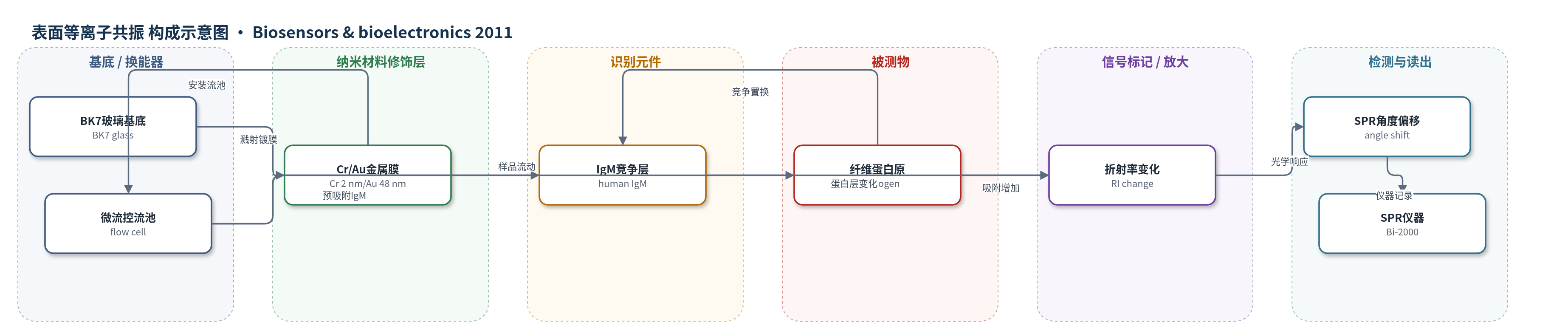
点击图片查看大图 · 依据论文自动绘制
传感器类型
表面等离子共振(SPR)生物传感器
检测对象
纤维蛋白原(fibrinogen);样品基质:未稀释人血清(undiluted human serum)/加标血清
检测原理
该传感器基于无标记SPR光学换能机制。先在Au表面预吸附人源IgM形成饱和蛋白层;随后未稀释人血清流经微流控通道,其中纤维蛋白原凭借较强的表面吸附能力,通过Vroman竞争性吸附/交换过程置换部分IgM。表面蛋白组成、覆盖度和厚度随之改变,引起金属膜附近局部折射率变化。SPR仪器通过监测反射光角度偏移记录该界面变化,角度偏移量与纤维蛋白原浓度在0.5–2.5 mg/mL范围内近似线性相关。检测后使用次氯酸钠漂白液洗脱表面蛋白,实现传感面再生和重复测量。高于2.5 mg/mL时,纤维蛋白原凝血导致样品中可溶性蛋白减少,使角度偏移出现下降和波动。
检测灵敏度
线性范围: 0.5–2.5 mg/mL;灵敏度: 42 mDeg/(mg/mL)(通道2为44 mDeg/(mg/mL))
效应效果
该传感器可在同一芯片上通过漂白再生重复测量,降低一次性传感器批次间不可重复性和实验条件波动带来的假阳性/假阴性风险。实验对每个浓度重复六次,0.5–2.5 mg/mL范围内SPR角度偏移与纤维蛋白原浓度呈线性关系,通道1灵敏度为42 mDeg/(mg/mL),通道2为44 mDeg/(mg/mL),说明双通道响应一致。再生六次后基线接近恢复,表明传感面可重复使用。高于2.5 mg/mL时角度偏移下降并波动,作者归因于纤维蛋白原凝血,而非表面饱和或灵敏度下降。该方法无需抗体、酶或DNA等生物受体,具有无标记、实时、高通量特点,作者认为可用于心血管疾病风险相关纤维蛋白原监测。
传感器的构成
- 基底:BK7玻璃片(150 μm,18 mm×18 mm),作为SPR芯片支撑基底。
- 金属换能层:Cr 2 nm粘附层与Au 48 nm金膜,形成SPR敏感金属表面。
- 微流控层:双通道微流控流池(flow cell),引导血清样品流过传感表面。
- 竞争识别层:人源IgM(约900 kDa),预吸附形成饱和蛋白层,被纤维蛋白原竞争置换。
- 再生清洗层:次氯酸钠漂白液(NaOCl,含NaOH稳定),洗脱表面蛋白实现传感面再生。
- 光学读出层:SPR仪器Bi-2000与半圆柱棱镜,监测金属膜附近折射率变化引起的角度偏移。
中文摘要
流行病学研究表明,血浆纤维蛋白原水平升高与心血管疾病风险增加相关。正常纤维蛋白原水平约为1.5–4.5 mg/mL,受遗传和环境因素影响;较正常水平升高0.25 mg/mL常提示心血管疾病高风险,因此监测患者血清中纤维蛋白原水平对临床诊断具有重要意义。本文报道一种可再生表面等离子共振(SPR)生物传感器,用于实时检测未稀释人血清中的纤维蛋白原。该传感器采用高灵敏度光学SPR技术,不同于传统生物传感器,不使用抗体、酶或DNA等生物受体,而是利用蛋白质竞争性吸附(Vroman效应)实现纤维蛋白原的选择性检测。实验测量了纤维蛋白原加标血清样品,浓度范围为1.5–4.5 mg/mL,并通过传感表面再生方法重复六次测量,获得测量结果的统计分布。结果表明,该SPR生物传感器在0.5–2.5 mg/mL纤维蛋白原浓度范围内灵敏度为42 mDeg/(mg/mL);对于高于2.5 mg/mL的加标样品,测量值难以与浓度建立稳定关联。
英文摘要
Epidemiological studies suggest that elevated plasma fibrinogen levels are associated with an increased risk of cardiovascular disorders. Normal fibrinogen level is in the range of 1.5-4.5mg/mL, depending upon both genetic (intrinsic) and environmental (extrinsic) factors. An increase of 0.25mg/mL from the normal level can often be correlated with a high risk of cardiovascular disease. Thus, it is useful to monitor fibrinogen level in serum of a patient for clinical diagnosis. We report a regenerative biosensor that measures real-time fibrinogen levels in undiluted serum. The biosensor uses Surface Plasmon Resonance (SPR), highly sensitive optical technique. The biosensor does not use bio-receptors (i.e., antibodies, enzymes, DNA, etc.) unlike conventional biosensors, and deploys the nature of competitive adsorption of proteins to achieve selective detection of fibrinogen. We measured fibrinogen-spiked serum samples with a concentration of 1.5-4.5 mg/mL, and repeated six measurement trials to obtain statistical distribution of the measurements using the regeneration method of the sensing surface. The SPR biosensor has a sensitivity of 42 mDeg/(mg/mL) for a fibrinogen concentration in the range of 0.5-2.5 mg/mL, whereas it was hard to correlate the measurements to the spiked-fibrinogen samples of above 2.5 mg/mL.