组成图示
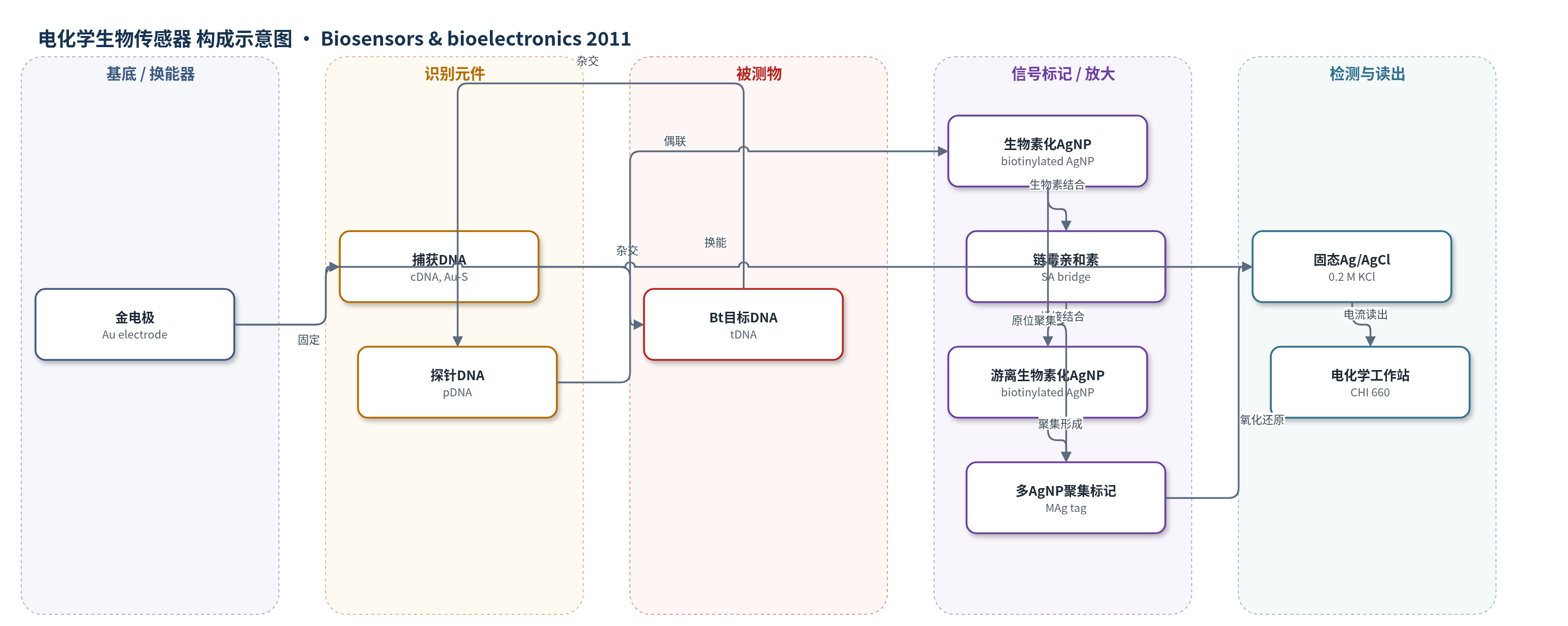
点击图片查看大图 · 依据论文自动绘制
传感器类型
电化学生物传感器
检测对象
Bt转基因序列DNA寡核苷酸(Bt transgenic sequence DNA oligonucleotide, tDNA);样品基质:DNA溶液/缓冲液(原文未报告实际食品或饲料基质)
检测原理
该传感器以Au电极为基底,cDNA通过Au–S键固定,tDNA与cDNA杂交后,携带生物素化AgNP的pDNA再与tDNA杂交,形成单AgNP标记SAg。随后SA通过生物素–SA高亲和作用桥接SAg上的生物素与游离生物素化AgNP,使AgNP在电极表面原位聚集为MAg tag。检测时在0.2 M KCl中进行固态Ag/AgCl伏安:正向扫描Ag氧化为Ag+并与Cl−生成AgCl,反向扫描AgCl还原为Ag,峰电流与电极表面AgNP数量成正比。tDNA浓度越高,结合pDNA-AgNP及聚集MAg越多,氧化峰电流越大。生物素–SA诱导的AgNP原位聚集实现约12倍信号放大,使检测限降至10 fM。
检测灵敏度
LOD: 10 fM;线性范围: 10−12–10−6 M;回归方程: Y = 23.45 + 1.928X (X: M);R = 0.981
效应效果
该传感器对完全互补tDNA产生明显固态伏安信号,对单碱基错配DNA仅出现很弱信号,表明序列选择性良好。未杂交tDNA的对照电极无明显峰,说明非特异吸附可忽略。MAg tag较SAg label产生12倍电流放大,检测限较SAg label提高三个数量级。三个独立制备传感器的变异系数为7.38%,显示制备重现性可接受。与已发表非PCR转基因序列检测方法相比,其1.0×10⁻¹⁴ M检测限和1.0×10⁻¹²–1.0×10⁻⁶ M线性范围具有竞争力。作者认为该电化学DNA传感器可用于Bt转基因序列快速、低成本监测,但原文未报告实际食品或饲料样品加标回收率。
传感器的构成
- 基底/换能器电极:金电极(Au electrode,2 mm直径),作为工作电极与固态Ag/AgCl信号换能基底
- 捕获识别层:5′-硫醇修饰捕获DNA(cDNA,5′-HS-ATC CCT ATA CCC TCT-3),通过Au–S自组装固定于Au电极,用于捕获Bt目标DNA
- 探针识别层:5′-硫醇修饰探针DNA(pDNA,5′-HS-TGG TAG TGG CGT GTA-3′),与tDNA杂交并携带生物素化银纳米颗粒
- 信号标记层:生物素化银纳米颗粒(biotinylated Ag nanoparticles,约20 nm),偶联于pDNA形成单银纳米颗粒标记(SAg label)
- 桥接放大层:链霉亲和素(SA,1 μM),通过生物素–SA高亲和结合桥接SAg label与游离生物素化银纳米颗粒
- 聚集信号层:游离生物素化银纳米颗粒(biotinylated Ag nanoparticles),结合后在Au电极原位聚集形成多银纳米颗粒标记(MAg tag)
- 检测介质/读出层:0.2 M KCl溶液,提供Cl−参与固态Ag/AgCl氧化还原过程,并由电化学工作站进行伏安读出
中文摘要
本文报道了一种基于银纳米颗粒聚集的电化学生物传感器,用于检测短DNA寡核苷酸形式的枯草芽孢杆菌(Bt)转基因序列。首先将硫醇修饰的捕获DNA(cDNA)固定于金(Au)电极表面,随后目标DNA(tDNA)与固定化cDNA杂交。接着,由生物素化银纳米颗粒功能化的探针DNA(pDNA)与固定tDNA结合,形成单银纳米颗粒标记(SAg label)。最后,游离生物素化银纳米颗粒通过桥接分子链霉亲和素(SA)与SAg label上的生物素发生特异性生物素–SA相互作用,在金电极表面原位诱导银纳米颗粒聚集,形成含多个银纳米颗粒的新型标记(MAg tag)。该标记在固态Ag/AgCl过程中表现出优异电活性,并成功用于Bt转基因序列检测。检测限达10 fM,较SAg label提高三个数量级,且对tDNA具有良好选择性。
英文摘要
A novel electrochemical biosensor was developed for detecting short DNA oligonucleotide of Bacillus thuringiensis (Bt) transgenic sequence based on Ag nanoparticle aggregates. To fabricate this DNA biosensor, the thiol-modified capture DNA (cDNA) was first anchored on gold (Au) electrode, and then the target DNA (tDNA) was hybridized with the immobilized cDNA. Subsequently, the probe DNA (pDNA) functionalized by biotinylated Ag nanoparticle was associated with the fixed tDNA, and the single Ag nanoparticle label was obtained (cited as SAg label). Finally, dissociative biotinylated Ag nanoparticle was bound to the resultant biotinylated SAg label assembled on Au electrode by virtue of bridge molecule streptavidin (SA) through biotin-SA specific interaction, which could lead to in situ aggregate of Ag nanoparticles on Au electrode and induce a novel tag including multiple Ag nanoparticles (cited as MAg tag). The novel tag exhibited excellent electroactive property in the solid-state Ag/AgCl process and was successfully applied to Bt transgenic sequence assay. A detection limit of 10 fM was achieved, which was improved by three orders of magnitude as compared to the SAg label. Furthermore, this novel DNA biosensor demonstrated a good selectivity towards tDNA.