组成图示
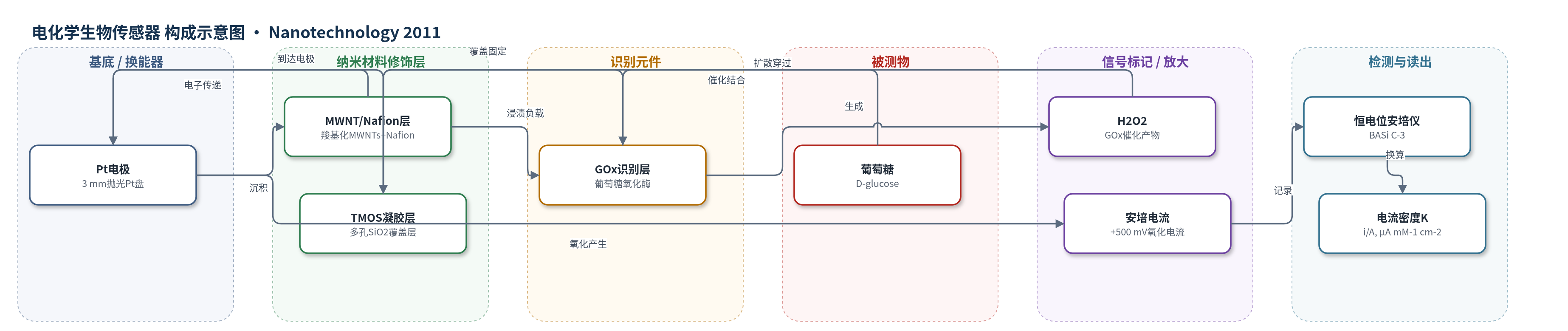
点击图片查看大图 · 依据论文自动绘制
传感器类型
电化学生物传感器
检测对象
葡萄糖(glucose/D-glucose);样品基质为PBS缓冲液,文中同时关联人血葡萄糖浓度范围和细胞培养基(如RPMI 1640)应用场景
检测原理
该传感器采用酶促-安培换能机制。葡萄糖氧化酶(GOx)识别并催化葡萄糖氧化,生成葡萄糖酸和H2O2。H2O2穿过TMOS溶胶-凝胶层和MWNT/Nafion层扩散至Pt电极表面,在+500 mV(vs Ag/AgCl)恒电位下发生电氧化,产生与葡萄糖浓度成正比的安培电流。羧基化MWNTs提高有效换能面积和电子传递,并增加GOx负载;TMOS多孔网络固定并保护GOx;Nafion排斥抗坏血酸等阴离子干扰物。随葡萄糖浓度升高,电流线性增加至约12 mM,之后因扩散限制、氧限制和酶位点饱和而呈指数响应。
检测灵敏度
LOD: 3.7 μM;线性范围: 0.0037–12 mM;灵敏度: 1110.1 ± 15.4 nA mM−1;电流密度: 18.3 ± 0.5 μA mM−1 cm−2
效应效果
CNT–TMOS传感器在PBS中对葡萄糖选择性良好:6 μM抗坏血酸和10 μM对乙酰氨基酚的电流分别仅为1 mM葡萄糖的7.6%和9.9%,归因于Nafion阴离子排斥。响应时间小于8 s,灵敏度变异系数2%,连续3天无显著变化,平均相对标准误差2%;4 ℃保存45天后灵敏度下降58%。其线性范围覆盖人血葡萄糖和常见细胞培养基浓度。与文献中GC/Au电极及MWNT/NaFion/GOx等设计相比,该Pt基CNT–TMOS方案在电流密度、检出限和线性范围方面更优,作者认为适合临床和体外生理葡萄糖检测。
传感器的构成
- 基底/换能器电极:抛光铂(Pt)盘电极(直径3 mm),焊接铜线并玻璃封装,作为H2O2电催化氧化和电流换能表面
- 纳米材料修饰层:羧基化多壁碳纳米管(MWNTs)与Nafion混合沉积,增强电子传递、提供多孔结合位点并排斥阴离子干扰物
- 识别元件:葡萄糖氧化酶(GOx)浸渍负载于MWNT/Nafion层,催化葡萄糖氧化生成H2O2
- 保护/固定层:四甲基硅氧烷(TMOS)溶胶-凝胶覆盖层,形成多孔SiO2网络,固定GOx并维持酶活性
- 信号中间体:无外源标记物,GOx催化产生的H2O2在Pt表面氧化产生安培电流
- 工作介质:0.01 M PBS缓冲液,提供离子传导并维持酶活性
中文摘要
本研究比较了利用纳米材料提升生物传感器性能的不同策略。作者以葡萄糖生物传感器为模型,系统研究了溶胶-凝胶包埋和戊二醛交联等常用酶固定化方法,并考察多壁碳纳米管(MWNTs)存在与否对性能的影响。由于现有生物传感器设计和电极/纳米材料差异较大,仅比较线性范围和灵敏度不足以准确评价传感器效能。为此,提出一种同时考虑纳米材料沉积后可用于换能的有效面积和灵敏度的比较方案。按该方案,在无纳米材料时,TEOS/GOx传感器效能最高,其次为BSA/GA/GOx和TMOS/GOx。含羧基化MWNTs、葡萄糖氧化酶(GOx)及上层TMOS溶胶-凝胶层的新传感器表现出最优效能:电流密度18.3±0.5 μA mM−1 cm−2,线性范围0.0037–12 mM,检出限3.7 μM,变异系数2%,响应时间小于8 s,并具有良好的稳定性、选择性和重现性。H2O2响应测试表明,性能提升最可能源于酶负载量增加。该设计可作为通用生物传感平台。
英文摘要
This work addresses the comparison of different strategies for improving biosensor performance using nanomaterials. Glucose biosensors based on commonly applied enzyme immobilization approaches, including sol-gel encapsulation approaches and glutaraldehyde cross-linking strategies, were studied in the presence and absence of multi-walled carbon nanotubes (MWNTs). Although direct comparison of design parameters such as linear range and sensitivity is intuitive, this comparison alone is not an accurate indicator of biosensor efficacy, due to the wide range of electrodes and nanomaterials available for use in current biosensor designs. We proposed a comparative protocol which considers both the active area available for transduction following nanomaterial deposition and the sensitivity. Based on the protocol, when no nanomaterials were involved, TEOS/GOx biosensors exhibited the highest efficacy, followed by BSA/GA/GOx and TMOS/GOx biosensors. A novel biosensor containing carboxylated MWNTs modified with glucose oxidase and an overlying TMOS layer demonstrated optimum efficacy in terms of enhanced current density (18.3 ± 0.5 µA mM(-1) cm(-2)), linear range (0.0037-12 mM), detection limit (3.7 µM), coefficient of variation (2%), response time (less than 8 s), and stability/selectivity/reproducibility. H(2)O(2) response tests demonstrated that the most possible reason for the performance enhancement was an increased enzyme loading. This design is an excellent platform for versatile biosensing applications.