组成图示
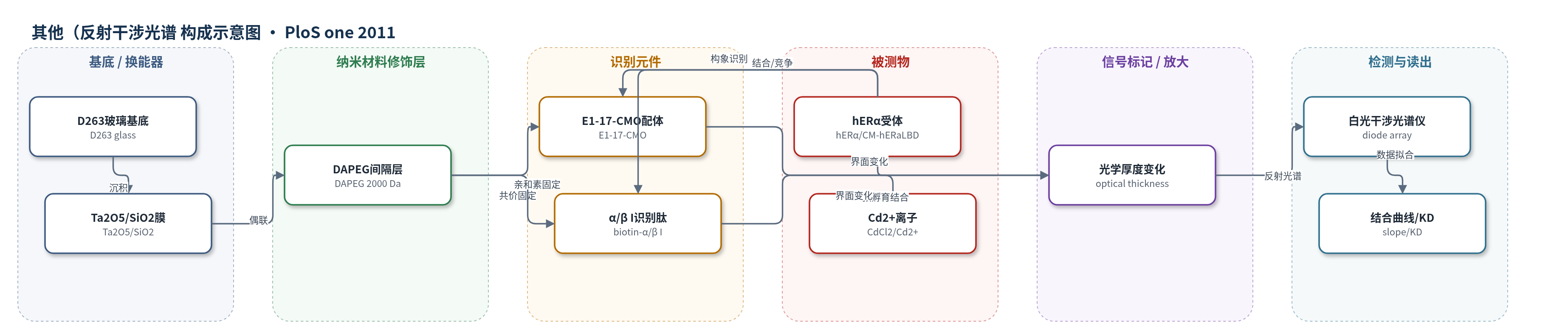
点击图片查看大图 · 依据论文自动绘制
传感器类型
其他(反射干涉光谱(RIfS)生物传感器)
检测对象
镉离子(cadmium, Cd2+/CdCl2)及其与人雌激素受体α(human estrogen receptor alpha, hERα)的结合/构象效应;样品基质:重组hERα/CM-hERaLBD蛋白的Tris-KCl缓冲液
检测原理
RIfS芯片由玻璃基底和Ta2O5/SiO2多层膜构成,白光在各界面反射形成干涉光谱。表面经DAPEG间隔层固定E1-17-CMO或α/β I肽。将hERα与CdCl2预孵育后注入芯片:若镉占据或干扰ERα配体结合口袋,游离受体减少,结合到E1-17-CMO表面的受体减少,光学厚度上升幅度和相对斜率降低;结合曲线按质量作用方程拟合可得KD。构象芯片中,α/β I肽识别ERαLBD激动构象(AF-2/helix12);若镉诱导激动构象,受体结合增加,光学厚度上升;若破坏激动构象,则结合减少。该方法无标记、无酶放大,信号直接来自界面光学厚度变化,并随镉浓度呈剂量依赖变化。
检测灵敏度
原文未报告LOD、线性范围、灵敏度斜率或相关系数;CdCl2测试浓度范围: 2.9 nM–285.7 mM;E2测试浓度范围: 3.3 nM–1.3 mM。
效应效果
实验重复3次,以平均光学厚度和标准差表示。与放射性配体置换法相比,RIfS为无标记、实时方法,并避免金/硫醇化学对镉的干扰。对全长hERα,CdCl2剂量依赖降低表面光学厚度,拟合KD=6.1×10^-7 M,弱于Stoica报道的5×10^-10 M,但支持镉与hERα强结合;对CM-hERaLBD,E2 KD=2.0×10^-10 M,与全长受体报道一致,说明芯片有效。构象芯片显示E2诱导激动构象,4-OHT不诱导;Cd对全长hERα破坏E2诱导的激动构象,对CM-hERaLBD则促进激动构象。作者认为该平台可解析镉与ERα相互作用的矛盾报道,并检验不同ERα池的响应。
传感器的构成
- 基底/换能器:D263玻璃基底,10 nm Ta2O5与330 nm SiO2多层膜,作为RIfS光学换能芯片
- 硅烷化/间隔层:3-环氧丙氧基丙基三甲氧基硅烷活化表面并偶联DAPEG(二氨基聚乙二醇,2000 Da),形成柔性间隔层并降低非特异吸附
- 识别元件(配体捕获芯片):E1-17-CMO(雌酮-17-N-羧甲基肟)共价固定于DAPEG表面,作为ERα配体衍生物捕获游离hERα
- 识别元件(构象芯片):生物素化α/β I肽(Ser-Ser-Asn-His-Gln-Ser-Ser-Arg-Leu-Ile-Glu-Leu-Leu-Ser-Arg)经链霉亲和素固定,识别ERαLBD激动构象/AF-2
- 交联/偶联剂:二异丙基碳二亚胺(DIC)用于E1-17-CMO偶联;TBTU(2-(1H-苯并三唑-1-基)-1,1,3,3-四甲基脲四氟硼酸盐)用于生物素偶联
- 信号标记物:无标记(label-free),不添加荧光、酶或纳米标记物
- 流动相/再生液:500 mM Tris、100 mM KCl、pH 7.4缓冲液用于结合测量;6 M盐酸胍(pH 2)用于再生
中文摘要
镉是环境中普遍存在的有毒重金属,并随食物链进入人类膳食。已有研究提出,镉可在环境相关浓度下干扰内分泌系统,尤其靶向雌激素信号通路。然而,关于镉与人雌激素受体α(hERα)的结合亲和力以及镉体内雌激素活性的报道相互矛盾,镉与受体的相互作用模式仍不清楚。本研究采用一种新型无标记生物传感器技术——反射干涉光谱(RIfS),在分子水平上研究镉与hERα的相互作用,考察镉与hERα的结合以及镉处理后受体的构象变化。结果表明,镉与ERα的配体结合域(LBD)相互作用并影响受体构象;但结合事件及其诱导的构象变化在很大程度上取决于LBD中半胱氨酸残基侧链的可及性。由于LBD半胱氨酸残基在体内可发生翻译后修饰,作者提出假设:细胞内不同状态的ERα池对镉的响应不同,该理论有助于解释此前关于镉雌激素样活性相互矛盾的结果。
英文摘要
Cadmium is a toxic heavy metal ubiquitously present in the environment and subsequently in the human diet. Cadmium has been proposed to disrupt the endocrine system, targeting in particular the estrogen signaling pathway already at environmentally relevant concentrations. Thus far, the reports on the binding affinity of cadmium towards human estrogen receptor alpha (hERα) have been contradicting, as have been the reports on the in vivo estrogenicity of cadmium. Hence, the mode of interaction between cadmium and the receptor remains unclear. Here, we investigated the interaction between cadmium and hERα on a molecular level by applying a novel, label-free biosensor technique based on reflectometric interference spectroscopy (RIfS). We studied the binding of cadmium to hERα, and the conformation of the receptor following cadmium treatment. Our data reveals that cadmium interacts with the ligand binding domain (LBD) of the ERα and affects the conformation of the receptor. However, the binding event, as well as the induced conformation change, greatly depends on the accessibility of the cysteine tails in the LBD. As the LBD cysteine residues have been reported as targets of post-translational modifications in vivo, we present a hypothesis according to which different cellular pools of ERα respond to cadmium differently. Our proposed theory could help to explain some of the previously contradicting results regarding estrogen-like activity of cadmium.