组成图示
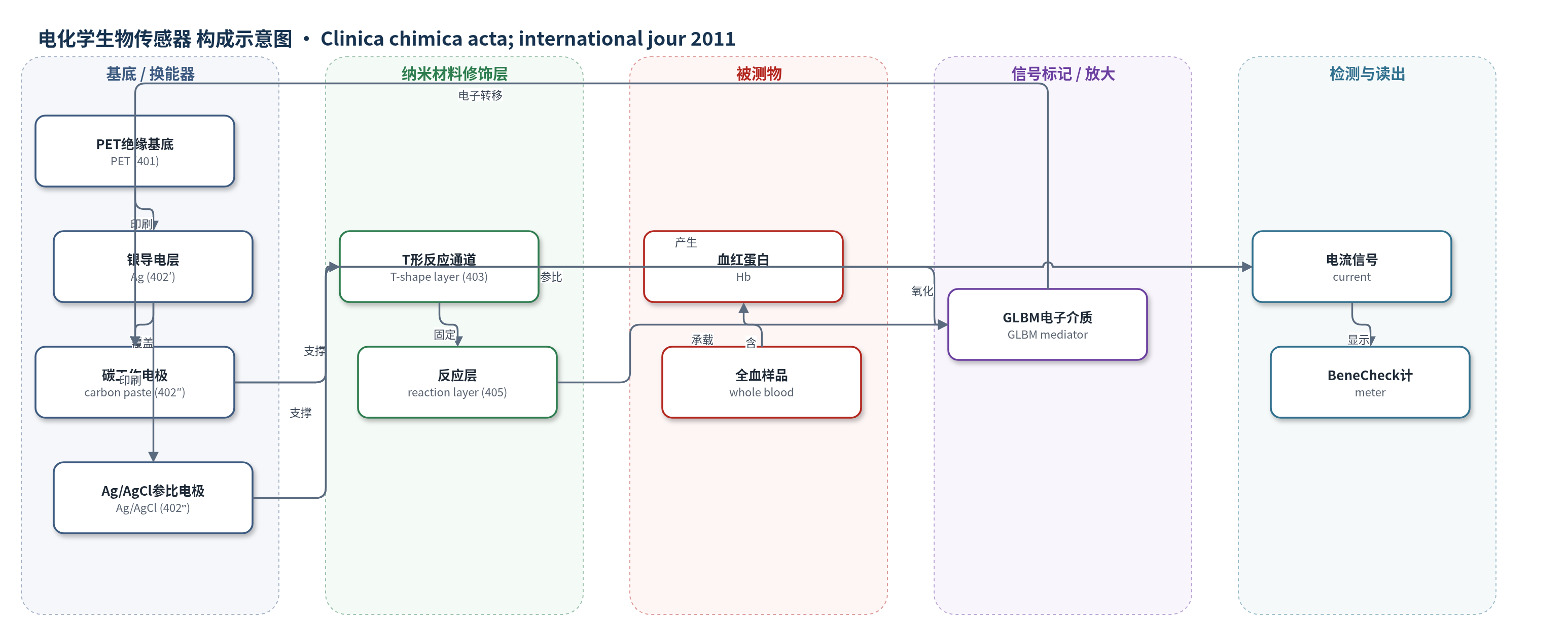
点击图片查看大图 · 依据论文自动绘制
传感器类型
电化学生物传感器
检测对象
血红蛋白(hemoglobin, Hb);样品基质:人全血(whole blood),包括静脉血和指尖毛细血管血。
检测原理
BeneCheck试条以碳工作电极为换能界面,表面负载电子介质GLBM。全血样品经毛细通道进入反应层后,血红蛋白(Hb)与GLBM发生氧化还原反应:GLBM被Hb氧化,电子转移至Hb中的Fe(III),使其还原为Fe(II),从而消耗工作电极表面的GLBM。反应设定时间后,BeneCheck计施加高于0.7 V的电位,将剩余GLBM氧化并产生电流。电流强度与电极表面剩余GLBM浓度成正比,与样品中Hb浓度成反比,因此通过电流大小即可反推全血Hb浓度。该方法无需酶或核酸放大,直接利用Hb自身氧化还原活性实现电化学检测。
检测灵敏度
相关系数: R2=0.912(BeneCheck vs HemoCue 201,毛细血管血);R2=0.8483(BeneCheck vs HemoCue 201,静脉血);R2=0.9771(BeneCheck vs Sysmex KX-21N,毛细血管血对静脉血);R2=0.94(BeneCheck vs Beckman Coulter,静脉血)
效应效果
该传感器抗干扰良好:室温或2–8 ℃保存7 d、部分溶血(血浆Hb约10 g/l)及胆红素至150 mg/l均无明显影响;胆红素干扰试验合并CV为7%(平均Hb 134 g/l)和4.4%(平均156 g/l)。指尖血重复性CV为3.2%–8.1%,静脉血精密度CV为2.4%–4.7%。与HemoCue 201、Sysmex KX-21N、Beckman Coulter和Cell-Dyn 3700比较,多数结果在±5%、±10%、±15%偏差内分别超过50%、85%、95%;如毛细血管血对HemoCue 201的R2=0.912,对Sysmex的R2=0.9771。仅需1 μl血样、约10 s出结果,作者认为其成本、便携性和易用性适合献血者Hb初筛。
传感器的构成
- 基底/绝缘层:PET(401),提供机械支撑与绝缘。
- 导电层:银(Ag,402′),丝网印刷形成导电线路。
- 工作电极:碳浆(carbon paste,402″),覆盖于银层上并扩展为工作电极。
- 参比电极:Ag/AgCl(402‴),丝网印刷提供稳定电位参考。
- 反应通道/反应层:T形层(403)与反应层(405),限定反应区并承载介质。
- 电子介质:GLBM,位于工作电极表面,被Hb氧化或>0.7 V氧化并传递电子。
- 毛细通道/顶层:顶层(407)与T形层形成毛细通道,侧通道(403b)作为空气孔。
中文摘要
本研究开发了一种用于人全血血红蛋白(Hb)检测的电化学生物传感器BeneCheck,作为传统光学比色法的替代方案,并在专业检测环境中进行验证。研究评估了样本新鲜度、溶血和胆红素对电化学方法的影响,以及重复性、精密度和准确度,并以光学方法设备作为参考。结果表明,样本在室温或2–8 ℃冷藏保存7 d、部分或完全溶血,以及胆红素浓度高达150 mg/l时,均未对检测结果产生明显干扰。9名志愿者指尖血连续6次检测的重复性变异为3%–8%。BeneCheck结果与Sysmex、Beckman Coulter、Cell-Dyn和HemoCue方法具有良好相关性,95%的检测结果偏差在±15%以内。结论认为,BeneCheck血红蛋白检测系统准确可靠,仅需1 μl血样和约10 s检测时间,在成本、准确性、样本量、测量时间、易读性和便携性方面具有优势。
英文摘要
BACKGROUND: An electrochemical based biosensor for hemoglobin measurement was developed as an alternative to the traditional optical method, and underwent testing for use in professional settings.
METHODS: The affects of samples' freshness, hemolysis, bilirubin on the electrochemical method, as well as the repeatability, precision and accuracy were studied, using optical method devices as references.
RESULTS: Samples were stored at room temperature or in a cold environment for 7 days, partially or completely hemolyzed samples, and samples containing bilirubin with a concentration of up to 150 mg/l were investigated with no effects for interfering studies. Repeatability of finger blood testings was verified with six consecutive tests on nine volunteers, results ranged from 3% to 8% variation. The test results of BeneCheck were correlated with Sysmex, Beckman Coulters, Cell-Dyn and HemoCue methods, the results have shown similar and 95% of test results were within a ±15% bias.
CONCLUSIONS: BeneCheck hemoglobin test system performed well and accurately, while requiring 1 μl of blood sample and 10 s detection time. Based on the cost, accuracy, sample volume, measuring time, ease of viewing and portability, BeneCheck deliver the best characteristics for these purposes.