组成图示
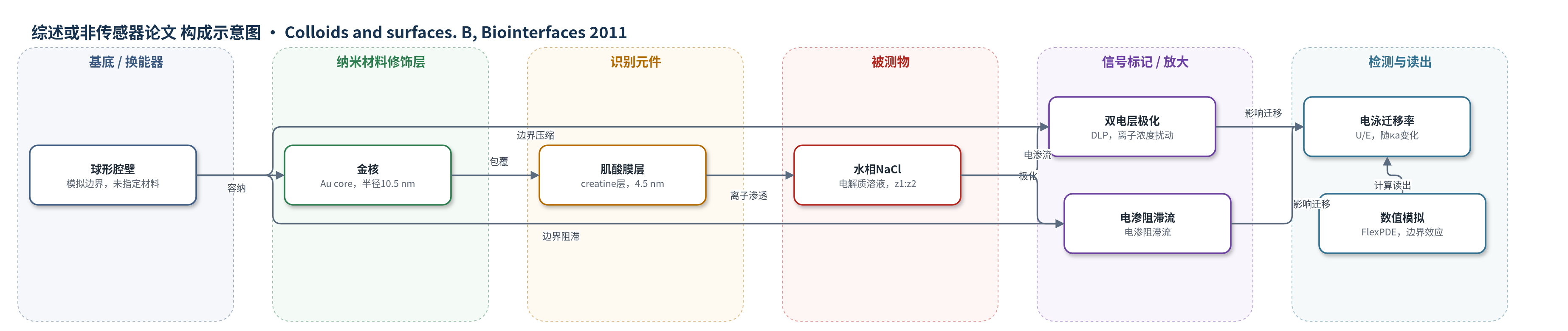
点击图片查看大图 · 依据论文自动绘制
传感器类型
综述或非传感器论文
检测对象
软颗粒/生物胶体(soft biocolloids,如细胞、微生物、肌酸包覆金纳米颗粒);样品基质:水相 NaCl 溶液
检测原理
该文以软颗粒(刚性核+带电多孔膜层)在球形腔中的电泳为模型,外加均匀电场驱动颗粒与电解质离子。膜层固定电荷与反离子形成双电层;颗粒运动使双电层发生极化(DLP),改变局部离子浓度和电场分布,从而产生附加阻力。同时,电场驱动双电层反离子运动形成电渗阻滞流,边界压缩流场和双电层,使 DLP 与电渗阻滞流相互竞争。净驱动力由电场驱动力和电渗/粘性力共同决定,最终表现为电泳迁移率 U/E 随无量纲双电层厚度 κa、膜层摩擦系数、膜厚、腔尺寸 λ 和位置 M 变化。高固定电荷密度或厚膜层增强 DLP,可出现迁移率局部极小;大边界效应或大摩擦系数可使电渗阻滞流抵消 DLP,使迁移率随双电层厚度增加而降低。
检测灵敏度
原文未报告 LOD、线性范围、灵敏度斜率或相关系数。
效应效果
该文未报道选择性、抗干扰、稳定性、重现性或实际样品加标回收率。作者用模型拟合 López-Viota 等文献中肌酸包覆金纳米颗粒电泳数据:颗粒半径 15 nm,金核半径 10.5 nm,膜层厚度 4.5 nm,水相 NaCl 溶液;取 z1=-z2=1,ε=7.08×10^-10 C V^-1 m^-1,T=298 K,μ=10^-3 kg m^-1 s^-1,D1=1.33×10^-9 m^2/s,D2=2.03×10^-9 m^2/s,M=0%,Pe1=0.351,Pe2=0.23,λ=0.08。在 ρfix/F=-25 mol/m^3、λ^-1=3.33/3.75/4.29 nm 下,模型成功预测迁移率随 NaCl 浓度变化的趋势,并解释高盐下迁移率趋于非零常数及局部极小。作者认为结果可用于纳米孔传感等生物分析装置设计。
传感器的构成
- 基底/换能器:球形腔壁(spherical cavity wall,未指定材料,模拟边界效应)
- 颗粒刚性核:金核(Au core,半径10.5 nm,验证实验中的不可渗透核)
- 颗粒膜层:肌酸覆盖多孔膜层(creatine-covered ion-penetrable membrane layer,厚度4.5 nm,携带固定电荷)
- 识别元件:无(未报道抗体/适配体/酶等识别元件)
- 信号标记物:无(未报道荧光/电化学标记物)
- 读出方式:电泳迁移率(electrophoretic mobility, U/E,由数值模拟和文献实验数据获得)
中文摘要
本文建立了由刚性核和带电多孔膜层组成的软颗粒在狭窄空间中的电泳模型,用于模拟细胞、微生物等生物胶体的毛细电泳以及生物传感器类器件中的行为。研究指出,除边界效应外,双电层极化(DLP)和电渗阻滞流也可能显著影响颗粒电泳行为。当膜层和/或边界摩擦系数较大时,DLP 效应可被电渗阻滞流抵消,使颗粒迁移率随双电层厚度增加而降低;该趋势与文献中许多实验观察定性一致,但此前分析未清楚解释。此外,膜层摩擦作用会随双电层厚度不同而表现为阻碍或加速颗粒运动,这是此前未报道的结果。本文首次给出边界对 DLP 效应及软颗粒电泳行为影响的有力证据。所提模型通过文献实验数据验证,数值模拟结果为纳米孔传感等生物分析装置设计和相关实验数据解释提供依据。
英文摘要
The electrophoresis of a soft particle comprising a rigid core and a charged porous membrane layer in a narrow space is modeled. This simulates, for example, the capillary electrophoresis of biocolloids such as cells and microorganisms, and biosensor types of device. We show that, in addition to the boundary effect, the effects of double-layer polarization (DLP) and the electroosmotic retardation flow can be significant, yielding interesting electrophoretic behaviors. For example, if the friction coefficient of the membrane layer and/or the boundary is large, then the DLP effect can be offset by the electroosmotic retardation flow, making the particle mobility to decrease with increasing double layer thickness, which is qualitatively consistent with many experimental observations in the literature, but has not been explained clearly in previous analyses. In addition, depending upon the thickness of double layer, the friction of the membrane layer of a particle can either retard or accelerate its movement, an interesting result which has not been reported previously. This work is the first attempt to show solid evidence for the influence of a boundary on the effect of DLP and the electrophoretic behavior of soft particles. The model proposed is verified by the experimental data in the literature. The results of numerical simulation provide valuable information for the design of bio-analytical apparatus such as nanopore-based sensing applications and for the interpretation of relevant experimental data.