组成图示
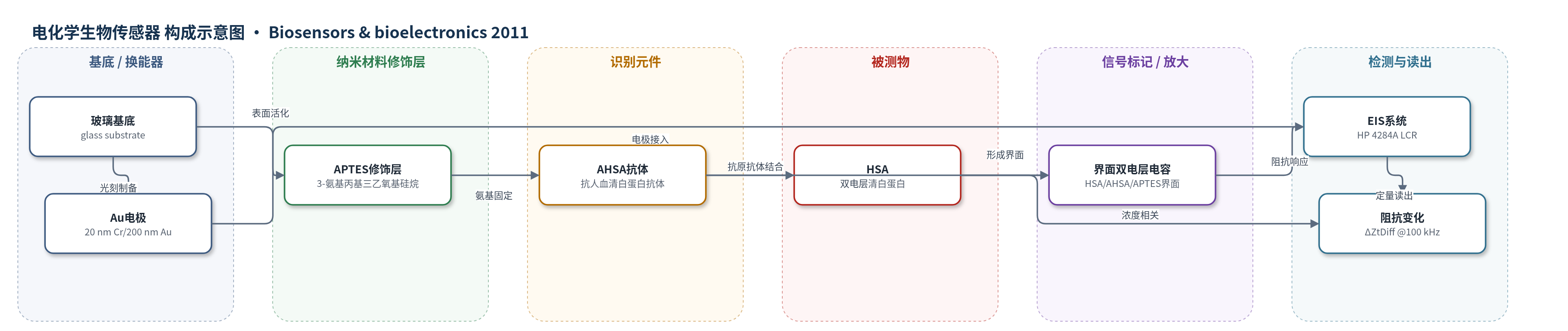
点击图片查看大图 · 依据论文自动绘制
传感器类型
电化学生物传感器
检测对象
人血清白蛋白(HSA, human serum albumin);样品基质:PBS缓冲液标准溶液(用于肝功能/血清白蛋白检测)
检测原理
传感器以玻璃基底上相邻Au电极为换能器,玻璃表面经APTES硅烷化后固定AHSA抗体,并用脱脂奶粉封闭。样品中HSA与AHSA特异性结合,在电极间形成HSA/AHSA/封闭剂/APTES界面单元。每个单元贡献双电层电容和电阻;在100 kHz交流激励下,阻抗以电容耦合为主,电阻可忽略。HSA浓度越高,结合单元数m越大,等效总电容越小,两电极间阻抗越大。通过测量结合前后阻抗差ΔZtDiff,并在对数坐标下与HSA浓度建立线性关系,即可定量HSA浓度。该过程无需酶或荧光标记,依靠界面电容变化实现信号读出。
检测灵敏度
LOD: 2 × 10^-4 mg/ml;实验浓度范围: 6 mg/ml–2 × 10^-12 mg/ml;对数坐标下阻抗变化与HSA浓度线性相关
效应效果
荧光显微镜验证AHSA固定后保留生物活性:APTES/玻璃表面无FITC标记anti-IgG荧光,AHSA修饰后呈绿色;脱脂奶粉封闭有效。不同HSA浓度(2×10^-8、2×10^-6、2×10^-3、2×10^-1 mg/ml)下荧光亮度随浓度增加。背景阻抗约1×10^8–2×10^8 Ω;0.2 mg/ml HSA在1 V直流下电流约7×10^-13±1.4×10^-14 A,电阻约10^13 Ω。检测限约2×10^-4 mg/ml,低于该浓度时归一化阻抗约3×10^6 Ω,提示结合不连续。未报告RSD、回收率及与ELISA对比。作者强调单步光刻、低成本、易集成生物芯片,适合肝功能检测。
传感器的构成
- 基底/换能器电极:玻璃基底(glass substrate)上单步光刻制备 20 nm Cr/200 nm Au 电极阵列,提供阻抗测量电极
- 表面活化层:玻璃表面经 IPA 和 piranha 溶液清洗形成羟基(-OH),用于 APTES 硅烷化
- 硅烷化修饰层:3-aminopropyltriethoxysilane(APTES)气相沉积,引入氨基并提高生物相容性
- 识别元件:anti-human serum albumin(AHSA)抗体,1 μg/ml PBS 中 37 °C 孵育固定,特异性识别 HSA
- 封闭层:5% skim milk powder(脱脂奶粉)封闭未反应位点,降低 HSA 非特异性结合
- 信号元件:无外源标记物,HSA/AHSA/封闭剂/APTES 界面双电层电容作为阻抗信号来源
- 读出系统:电化学阻抗谱(EIS)系统,Hewlett Packard 4284A LCR meter,10 mV AC、20 Hz–100 kHz 干环境测量
中文摘要
本研究制备了由金电极组成的电学阻抗生物传感器,用于定量检测肝功能关键生物标志物人血清白蛋白(HSA)。金电极通过单步光刻工艺在玻璃基底上制备,可方便地集成到生物芯片中,用于未来肝功能评估。两相邻金电极之间的玻璃传感表面用3-氨基丙基三乙氧基硅烷(APTES)修饰,以提高生物相容性并促进抗人血清白蛋白(AHSA)的结合。未结合AHSA的表面用脱脂奶粉封闭,防止HSA非特异性结合。传感器用于测量HSA浓度以评估肝功能。将不同浓度HSA施加于传感器后,直接测量两相邻金电极间阻抗,并在交流条件下用电化学阻抗谱系统定量。对数坐标下,阻抗随HSA结合量增加而线性增加。该电化学阻抗生物传感器的HSA检测限约为2×10^-4 mg/ml。研究证明电化学阻抗法可用于定量HSA浓度,所提传感器因检测机制简单、易于生物芯片集成且成本低,在肝功能检测中具有重要应用潜力。
英文摘要
In this study, electrical impedimetric biosensors composed of Au-electrodes were fabricated for the quantitative detection of human serum albumin (HSA), an essential biomarker of liver function. The Au-electrodes were fabricated via a single-step photolithography process, and can be easily integrated in biochips for assessing liver function in the future. The glass sensing surface between two adjacent Au-electrodes was modified with 3-aminopropyltriethoxysilane (APTES) to improve the biocompatibility for its subsequent binding to anti-human serum albumin (AHSA). The sensing surface without AHSA binding was blocked using skim milk powders, preventing possible non-specific bonding HSA conjugation. Biosensors were used to measure HSA concentration for liver function detection. The impedance between two adjacent Au-electrodes of the biosensors applied with various HSA concentrations was directly measured, and quantified using an electrochemical impedance spectroscopy system under AC conditions. The results of plotting both values in log scales indicated the impedance increased linearly with HSA conjugation increase. The limit of HSA detection was about 2'10(-4)mg/ml using the electrochemical impedimetric biosensor proposed in this work. This study demonstrates the feasibility of using electrochemical impedimetry as a bio-sensing mechanism to quantify human serum albumin concentration. The sensor proposed in this work also displays great potential for assessing liver function because of its simple detection mechanism, ease of biochip integration, and low cost.