组成图示
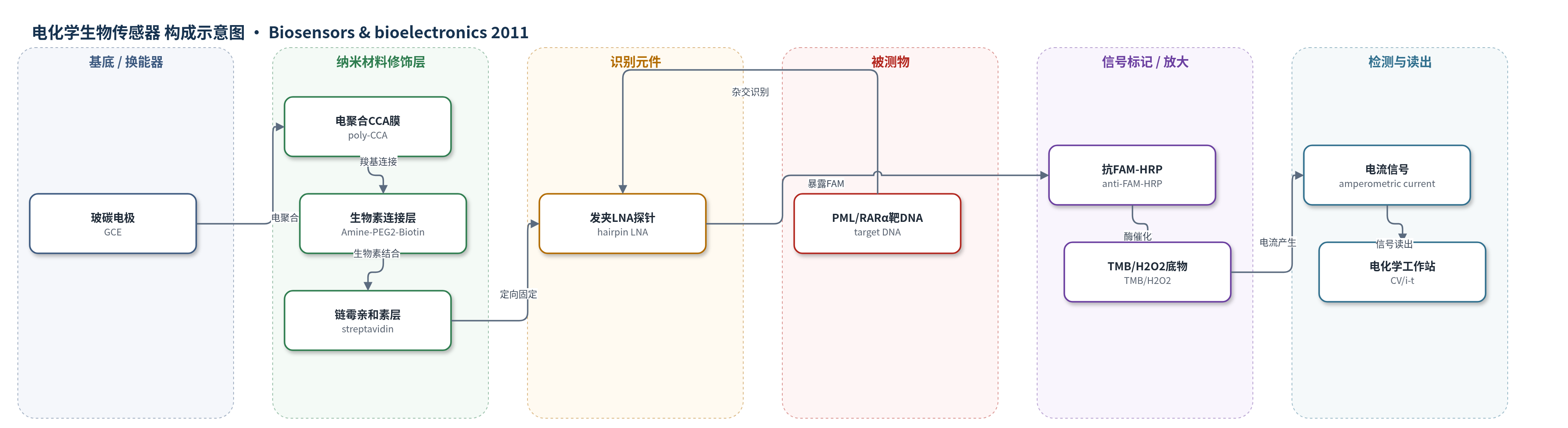
点击图片查看大图 · 依据论文自动绘制
传感器类型
电化学生物传感器
检测对象
PML/RARα融合基因(PML–RARα fusion gene);样品基质:人血清(20%、50%稀释)、PCR扩增产物(NB4细胞及真实APL样本)
检测原理
该传感器以发夹型LNA探针为识别元件。无靶标时,探针5′端生物素固定于链霉亲和素修饰电极,3′端FAM靠近电极,发夹茎区形成空间位阻,阻止抗FAM-HRP接近FAM。当PML/RARα靶DNA与LNA探针杂交后,发夹结构打开,FAM暴露并远离电极表面,抗FAM-HRP可结合FAM。HRP催化TMB与H2O2反应,生成电化学活性产物,在固定电位下产生还原电流。电流随靶DNA浓度增加而增大,呈对数响应。LNA提高杂交亲和力和单碱基错配区分能力,47℃杂交增强特异性,酶催化实现信号放大。
检测灵敏度
LOD: 83 fM;响应范围: 1 pM–100 nM(非线性对数响应,跨至少5个数量级)
效应效果
该传感器对单碱基错配具有良好选择性:10 nM互补靶信号1750 nA,背景141 nA,信号增益超过10倍;单碱基错配860 nA,互补信号至少为其2倍;三碱基错配370 nA,5、7碱基错配及非互补序列接近背景。在20%人血清中仍保持高选择性,50%血清中背景噪声小且10 nM靶信号基本不变。LOD为83 fM,优于此前线性捕获探针夹心传感器。真实PCR样品检测中,NB4细胞、阳性和阴性样本平均电流分别为1210 nA(RSD 7.02%)、1060 nA(RSD 6.14%)和192 nA(RSD 7.02%),与凝胶电泳结果一致,可用于APL早期诊断和监测。
传感器的构成
- 基底电极:玻碳电极(GCE),经氧化铝抛光,作为电化学换能器
- 修饰膜层:电聚合CCA膜(poly-CCA),提供羧基并降低背景
- 连接层:EDC/NHS活化羧基后连接EZ-Link Amine-PEG2-Biotin,乙醇胺-HCl封闭未反应位点
- 固定层:链霉亲和素(streptavidin)涂层,通过生物素–链霉亲和素桥定向固定探针
- 识别元件:发夹型锁核酸(hairpin LNA)探针,5′-生物素、3′-FAM双标记,识别PML/RARα靶DNA
- 封闭层:0.05% PEG 3350/PBS,减少非特异结合
- 信号标记物:抗FAM-HRP偶联物(anti-FAM-HRP),结合暴露FAM并催化底物反应
- 底物层:TMB/H2O2底物,HRP催化产生电化学活性产物,形成电流信号
中文摘要
本研究开发了一种酶放大电化学生物传感器,用于检测急性早幼粒细胞白血病(APL)中的早幼粒细胞白血病/维甲酸受体α(PML/RARα)融合基因。该传感器采用发夹型锁核酸(LNA)探针,双标记生物素和羧基荧光素(FAM)。探针通过生物素–链霉亲和素桥接固定于链霉亲和素修饰电极表面,FAM作为亲和标签用于结合辣根过氧化物酶(HRP)偶联物。无靶标时,发夹探针处于“闭合”状态,由于空间位阻屏蔽FAM,阻止体积较大的抗FAM-HRP偶联物接近。靶标结合后打开发夹结构,探针发生显著构象变化,使FAM远离电极表面,从而可被抗FAM-HRP识别并结合。靶标杂交事件通过酶催化放大的电化学电流信号灵敏转换。该传感器对单碱基错配具有优异特异性,在含人血清条件下可检测低至83 fM靶DNA,并可直接检测真实PCR样品,结果令人满意。
英文摘要
In this study, an enzyme-amplified electrochemical biosensor was developed for detection of the promyelocytic leukemia/retinoic acid receptor alpha (PML/RARα) fusion gene in acute promyelocytic leukemia (APL). This new sensor employs a hairpin locked nucleic acids (LNAs) probe dually labeled with biotin and carboxyfluorescein molecule (FAM). The probe is immobilized at a streptavidin-modified electrode surface via the biotin-streptavidin bridge, and FAM serves as an affinity tag for the peroxidase conjugate binding. Initially, the immobilized hairpin probe was in the "closed" state in the absence of the target, which shielded FAM from being approached by the bulky anti-FAM-HRP conjugate due to the steric effect. Target binding opens the hairpin structure of the probe, the probe undergoes a significant conformational change, forcing FAM away from the electrode. As a result, the FAM label becomes accessible by the anti-FAM-HRP, and the target hybridization event can be sensitively transduced via the enzymatically amplified electrochemical current signal. This new biosensor demonstrates its excellent specificity for single-base mismatch and able to detect as little as 83 fM target DNA even in the presence of human serum. We also employed this sensor to directly detect PCR real sample with satisfactory results.