组成图示
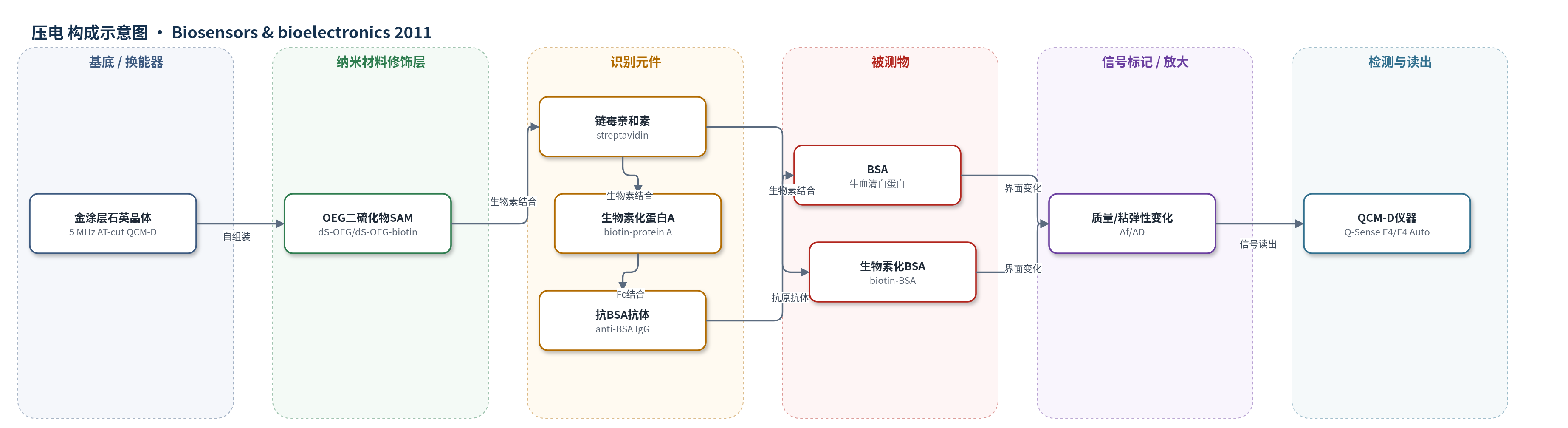
点击图片查看大图 · 依据论文自动绘制
传感器类型
压电(QCM)生物传感器
检测对象
生物素化生物分子(biotinylated biomolecules),具体检测示例:牛血清白蛋白(BSA)、生物素化牛血清白蛋白(biotin-BSA)、链霉亲和素(streptavidin);样品基质:PBS/HBS缓冲液、胎牛血清(FBS)
检测原理
该传感器利用生物素–链霉亲和素高亲和非共价结合实现生物素化生物分子的定向固定。金表面OEG二硫化物混合自组装单分子层中1%生物素末端提供锚点,OEG链形成抗非特异蛋白吸附背景。链霉亲和素结合表面生物素后暴露结合位点,可捕获生物素化蛋白A、生物素化BSA或生物素化抗体;anti-BSA再通过Fc段固定于生物素化蛋白A,特异性结合BSA。结合事件使界面质量增加并改变吸附层柔顺性,导致石英晶体谐振频率下降和耗散变化。QCM-D同时监测多次谐波的频率与耗散,信号随被测物结合量增大而增强,并可经10 mM NaOH再生重复使用。
检测灵敏度
原文未报告LOD、线性范围、灵敏度斜率或相关系数。
效应效果
该表面修饰抗非特异吸附能力强:新鲜生物素化传感器接触胎牛血清(FBS,30–45 mg/mL蛋白)仅产生0.24±1 Hz频率变化,而清洁金为-51±24 Hz;链霉亲和素层接触非生物素化BSA变化小于-1 Hz且可洗脱。储存稳定性主要受光照影响,冷暗保存8周几乎保留全部链霉亲和素结合活性,光照保存10天后IRRAS显示OEG结构明显降解。重复抗体–抗原实验中,BSA/anti-BSA经10 mM NaOH再生,5个循环重现性好,多数重复变化1–12%,总测量时间超过600 min。作者认为该通用生物素化表面可拓展QCM-D在蛋白相互作用、生物制药和药物筛选中的应用。
传感器的构成
- 基底/换能器:AT-cut 5 MHz石英晶体,溅射50 nm Cr粘附层和100 nm Au层,作为QCM-D压电换能器与金修饰基底
- 自组装单分子层:dS-OEG(末端-OH)与dS-OEG-biotin(末端biotin)混合OEG二硫化物SAM,1% biotin,提供抗非特异背景与生物素锚点
- 识别/固定元件:链霉亲和素(streptavidin),结合表面biotin形成单分子层并暴露biotin结合位点
- 识别/捕获元件:生物素化蛋白A(biotin-protein A),结合streptavidin并固定anti-BSA
- 识别元件:抗BSA IgG抗体(anti-BSA),通过Fc段结合biotin-protein A,特异性识别BSA
- 信号标记物:无外源标记物,直接以结合质量与界面粘弹性变化作为信号
- 信号读出:Q-Sense E4/E4 Auto QCM-D仪器,监测频率与耗散变化
中文摘要
表面敏感生物传感器技术快速发展,尤其向纳米器件发展,要求精确控制表面化学以获得可靠、可重复结果。本文提出一种表面修饰策略,使生物素化生物分子可固定于金涂层传感器晶体,用于带耗散监测的石英晶体微天平(QCM-D)传感。QCM-D 对界面纳米力学(粘弹性)性质敏感。该修饰基于金表面由末端羟基或生物素的寡乙二醇(OEG)二硫化物形成的混合自组装单分子层。含1%生物素二硫化物的混合物最适宜,可稳定固定链霉亲和素并进一步结合生物素化牛血清白蛋白(BSA)。OEG背景将非特异蛋白结合降至最低,即使在高蛋白浓度血清中。接触角、椭偏和红外光谱显示单分子层有序,OEG链主要呈螺旋构象,部分无定形。储存稳定性主要受光照影响,冷暗保存8周几乎保留全部链霉亲和素结合活性。该修饰还用于QCM-D中重复研究BSA与抗BSA(固定于生物素化蛋白A)的抗体–抗原相互作用,实验超过10 h并采用碱性再生,5个循环重现性好。此类通用表面修饰使QCM-D可用于多种生物传感应用,提供质量及吸附层结构信息。
英文摘要
The rapid development of surface sensitive biosensor technologies, especially towards nanoscale devices, requires increasing control of surface chemistry to provide reliable and reproducible results, but also to take full advantage of the sensing opportunities. Here, we present a surface modification strategy to allow biotinylated biomolecules to be immobilized to gold coated sensor crystals for quartz crystal microbalance with dissipation monitoring (QCM-D) sensing. The unique feature of QCM-D is its sensitivity to nanomechanical (viscoelastic) properties at the sensing interface. The surface modification was based on mixed monolayers of oligo(ethylene glycol) (OEG) disulfides, with terminal -OH or biotin groups, on gold. Mixtures containing 1% of the biotin disulfide were concluded to be the most appropriate based on the performance when streptavidin was immobilized to biotinylated sensors and the subsequent biotinylated bovine serum albumin (BSA) interaction was studied. The OEG background kept the unspecific protein binding to a minimum, even when subjected to serum solutions with a high protein concentration. Based on characterization by contact angle goniometry, ellipsometry, and infrared spectroscopy, the monolayers were shown to be well-ordered, with the OEG chains predominantly adopting a helical conformation but also partly an amorphous structure. Storage stability was concluded to depend mainly on light exposure while almost all streptavidin binding activity was retained when storing the sensors cold and dark for 8 weeks. The surface modification was also tested for repeated antibody-antigen interactions between BSA and anti-BSA (immobilized to biotinylated protein A) in QCM-D measurements lasting for >10h with intermediate basic regeneration. This proved an excellent stability of the coating and good reproducibility was obtained for 5 interaction cycles. With this kind of generic surface modification QCM-D can be used in a variety of biosensing applications to provide not only mass but also relevant information of the structural properties of adlayers.