组成图示
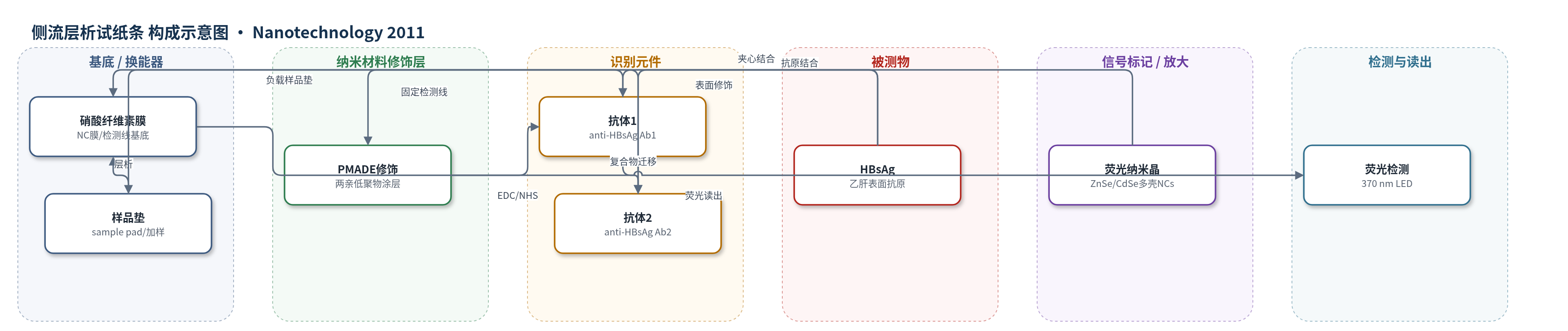
点击图片查看大图 · 依据论文自动绘制
传感器类型
侧流层析试纸条
检测对象
人乙肝表面抗原(HBsAg);样品基质:HBsAg标准溶液(磷酸盐缓冲液体系,未明确血清、尿液等临床基质)
检测原理
检测基于侧流免疫层析与荧光标记。样品中的HBsAg进入样品垫后,与负载在样品垫上的NCs-抗体1结合,形成NCs-抗体1-HBsAg复合物;复合物随层析液在硝酸纤维素膜上迁移至检测线,被固定于膜上的抗体2捕获,形成抗体1-HBsAg-抗体2夹心免疫复合物。NCs为水溶性ZnSe/CdSe/CdS/CdxZn1−xS/ZnS多壳纳米晶,表面PMADE修饰使其稳定分散于水相,并在370 nm LED激发下产生强可见荧光。检测线处荧光强度随HBsAg浓度增加而增强,从而实现定性或半定量检测。系统未使用酶催化放大,灵敏度主要依赖多壳纳米晶的高量子产率、长寿命荧光以及微孔膜对免疫复合物的捕获效率。
检测灵敏度
LOD: 0.05 ng ml−1
效应效果
该水溶性多壳纳米晶经相转移后量子产率仍高于70%,水溶液中6个月后仍保持初始值的90%以上;在pH 4–11中可稳定数月,pH 1下1 h损失约30%荧光,NaCl浓度低于0.8 M时未观察到聚集,PBS中约500 h后荧光趋于稳定,FWHM约32 nm。LFIA试纸条在空白样中无信号,0.05、0.5和5 ng mL−1 HBsAg均呈现随浓度增强的荧光,检测限达0.05 ng mL−1,作者认为与ELISA灵敏度相当。论文未报告RSD、实际样品回收率或选择性数据,但强调该纳米晶在含表面活性剂、聚合物、盐及封闭剂的层析体系中稳定,适合作为快速免疫检测的荧光标记。
传感器的构成
- 试纸条层析基底:硝酸纤维素膜(nitrocellulose membrane),承载检测线并实现样品侧向层析
- 样品垫:Millipore sample pad,经10 mM磷酸钠缓冲液(pH 7.4)、BSA 0.5%、Triton-X100 2%处理,用于加样并释放标记物
- 荧光纳米标记物:水溶性ZnSe/CdSe/CdS/CdxZn1−xS/ZnS核/多壳纳米晶(NCs),作为强荧光信号标记
- 表面修饰层:两亲性低聚物PMADE(polymaleic acid dodecanol ester)包覆NCs,实现水相分散与生物相容
- 识别元件:小鼠抗HBsAg单克隆抗体1(HBsAg antibody1)经EDC/NHS偶联至NCs;抗体2(HBsAg antibody2)固定于硝酸纤维素膜检测线
- 封闭/稳定剂:BSA用于封闭NCs-抗体偶联物及样品垫,Triton-X100用于样品垫润湿与稳定
- 吸收垫:Millipore absorbent pad,吸收样品液并维持层析流动
- 信号读出:370 nm LED荧光检测器,读取检测线荧光强度
中文摘要
本文报道了一种无磷合成路线,用于制备高发光反向I型ZnSe/CdSe核壳纳米晶及ZnSe/CdSe/CdS/CdxZn1−xS/ZnS核/多壳纳米晶。该低成本、绿色方法可在一锅反应中合成超过10 g高质量纳米晶。在ZnSe/CdSe核上外延生长CdS/CdxZn1−xS/ZnS多壳后,光致发光量子产率由28%提高到75%,稳定性同步增强。采用两亲性低聚物作为表面包覆剂进行相转移,使核/多壳纳米晶分散于水中,量子产率仍保持在70%以上。所得水溶性纳米晶在多种生理条件下具有极高稳定性。作者进一步以该水溶性纳米晶为荧光标记、硝酸纤维素膜为层析基质,构建了侧流免疫层析系统用于检测人乙肝表面抗原(HBsAg)。结果表明,该纳米晶是优良的荧光标记物,HBsAg检测灵敏度可达0.05 ng mL−1。
英文摘要
Highly photoluminescent (PL) reverse type-I ZnSe/CdSe nanocrystals (NCs) and ZnSe/CdSe/CdS/Cd(x)Zn(1 - x)S/ZnS core/multishell NCs were successfully synthesized by a phosphine-free method. By this low-cost, 'green' synthesis route, more than 10 g of high-quality ZnSe/CdSe/CdS/Cd(x)Zn(1 - x)S/ZnS NCs were synthesized in a large scale synthesis. After the overgrowth of a CdS/Cd(x)Zn(1 - x)S/ZnS multishell on ZnSe/CdSe cores, the PL quantum yields (QYs) increased from 28% to 75% along with the stability improvement. An amphiphilic oligomer was used as a surface coating agent to conduct a phase transfer experiment, core/multishell NCs were dissolved in water by such surface modification and the QYs were still kept above 70%. The as-prepared water dispersible ZnSe/CdSe/CdS/Cd(x)Zn(1 - x)S/ZnS core/multishell NCs not only have high fluorescence QYs but also are extremely stable in various physiological conditions. Furthermore, a biosensor system (lateral flow immunoassay system, LFIA) for the detection of human hepatitis B surface antigen (HBsAg) was developed by using this water-soluble core/multishell NCs as a fluorescent label and a nitrocellulose filter membrane for lateral flow. The result showed that such ZnSe/CdSe/CdS/Cd(x)Zn(1 - x)S/ZnS core/multishell NCs were excellent fluorescent labels to detect HBsAg. The sensitivity of HBsAg detection could reach as high as 0.05 ng ml( - 1).