组成图示
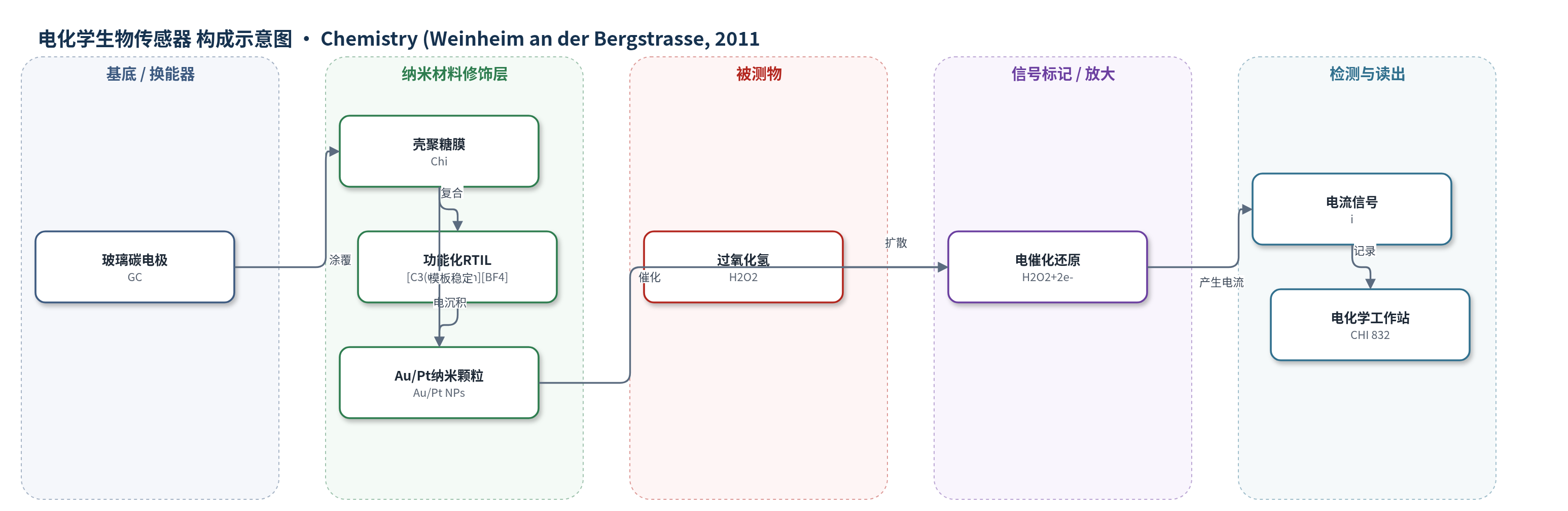
点击图片查看大图 · 依据论文自动绘制
传感器类型
电化学生物传感器
检测对象
过氧化氢(Hydrogen Peroxide, H2O2);样品基质:0.1 M磷酸盐缓冲液(PBS, pH 7.4)
检测原理
H2O2从PBS溶液扩散至Chi/RTIL–Au/Pt修饰电极表面,在-200 mV工作电位下被Au/Pt合金纳米颗粒直接电催化还原,反应可表示为H2O2+2e-→2OH-(pH 7.4)。Au/Pt合金中Au与Pt的协同效应提供本征电催化活性,小粒径合金纳米颗粒增大电活性面积;Chi/RTIL膜(尤其[C3(OH)2mim][BF4])具有较高离子电导率,可稳定纳米颗粒并促进电子转移,使[Fe(CN)6]3-/4-探针呈现可逆电子转移。随着H2O2浓度升高,单位时间内到达催化位点并被还原的H2O2分子数增加,稳态还原电流随之线性增大。该体系为非酶型,无独立生物识别元件,信号放大主要来自合金纳米颗粒的高电催化活性、大比表面积和离子液体导电膜。
检测灵敏度
LOD: 60 nM (S/N=3);线性范围: 0.1–12 μM (I [nA]=1.66C [μM]+3.36, R^2=0.994);5 μM–0.25 mM (I [nA]=0.91C [μM]+20.09, R^2=0.999);灵敏度: (3.36±1.02) nA μM^-1 和 (20.09±1.93) nA μM^-1
效应效果
该传感器在-200 mV下对H2O2响应快速,10 s内达到95%稳态电流。选择性方面,生理浓度0.2 mM抗坏血酸(AA)和10 mM多巴胺(DA)在H2O2存在下未产生可测电流,表明对主要电活性干扰物抗干扰能力强。重现性良好,对50 μM H2O2的安培电流RSD为2.21%(n=30)。稳定性方面,4°C储存两周后仍保留约86%初始活性。作者指出其检出限60 nM低于先前报道,具有宽线性范围、高灵敏度、快速响应和优异选择性,可作为非酶型H2O2生物传感器用于实际生物样品检测。
传感器的构成
- 基底/换能器电极:玻璃碳电极(GC),经抛光清洗后作为工作电极与电子传导基底。
- 模板/稳定化膜:壳聚糖(Chi)/功能化室温离子液体(RTIL)复合膜,如[C3(OH)2mim][BF4],提供柔性模板、稳定Au/Pt纳米颗粒并调节导电性。
- 纳米催化层:金-铂合金纳米颗粒(Au/Pt NPs),通过电沉积原位形成,尺寸2.8–84.7 nm,提供H2O2电催化还原活性位点。
- 识别/转化元件:无独立生物识别元件,Au/Pt合金纳米颗粒直接催化H2O2还原(非酶型第三代H2O2生物传感器)。
- 信号读出介质:0.1 M磷酸盐缓冲液(PBS, pH 7.4)作为支持电解质,H2O2扩散至电极表面发生还原。
- 电化学检测系统:三电极体系,铂丝对电极、饱和甘汞电极(SCE)参比电极、CHI 832电化学工作站,输出电流信号。
中文摘要
本研究合成了一系列含羟基、腈基、羧基和巯基等官能团的咪唑鎓室温离子液体(RTILs),并与氯离子、四氟硼酸根、六氟磷酸根和双(三氟甲磺酰)亚胺根等阴离子组合。将RTILs溶解于壳聚糖(Chi)中形成Chi/RTIL柔性模板,通过电沉积在玻璃碳电极表面原位制备Au/Pt合金纳米结构。SEM和AFM结果表明,Au/Pt纳米颗粒尺寸显著依赖Chi/RTIL结构,范围为2.8–84.7 nm。基于九种功能化RTIL构建了九种Chi/RTIL–Au/Pt生物传感器。以K3Fe(CN)6为探针的电化学研究显示,九种传感器均实现[Fe(CN)6]3-/4-可逆电子转移,但峰电流、峰电位差和电子转移速率因RTIL不同而显著不同。进一步研究揭示RTIL官能团明显影响H2O2还原行为,表明通过选择不同官能团RTIL可调节Chi/RTIL–Au/Pt纳米复合材料的电催化活性,适当阴阳离子组合可获得更高活性。Au/Pt纳米颗粒促进电子转移并具有本征催化活性,从而构建出高灵敏度、低检出限、快速响应和优异选择性的第三代H2O2生物传感器。
英文摘要
A series of room-temperature ionic liquids (RTILs) containing different functional groups such as hydroxyl, nitrile, carboxyl, and thiol attached to imidazolium cations, combined with various anions such as chloride [Cl], tetrafluoroborate [BF(4)], hexafluorophosphate [PF(6)], and bis[(trifluoromethyl)sulfonyl]imide [Tf(2)N], have been successfully synthesized. Dissolved in chitosan (Chi), the Chi/RTIL composites can be employed as flexible templates for the preparation of Au/Pt nanostructures. These Au/Pt nanostructures can be facilely deposited in situ on the surface of Chi/RTILs through electrodeposition. Scanning electron microscopy (SEM) and atomic force microscopy (AFM) results demonstrate that the alloy size is significantly dependent on the structure of the Chi/RTILs, with sizes ranging from 2.8 to 84.7 nm. Based upon the functionalized RTILs, nine Chi/RTIL-Au/Pt biosensors have been fabricated. First, the size-dependent electrochemistry of Chi/RTIL-Au/Pt was investigated using potassium ferricyanide as the probe. The reversible electron transfer of the Fe(CN)(6)(3-/4-) redox couple was realized for the nine biosensors, and the peak currents, as well as the peak-to-peak separations (ΔE(p)) and electron-transfer rates, differ greatly from each other because of the diversity of the RTILs. Further electrochemical research reveals that the functional groups of these RTILs exert an evident influence on the reduction behavior of H(2)O(2), which in turn illustrates that the electrocatalytic activity of Chi/RTIL-Au/Pt nanocomposites can be tuned by means of employing RTILs with different functional groups, and an appropriate combination of cations and anions may produce a higher activity. The facilitated electron transfer and the intrinsic catalytic activity of Au/Pt NPs provide a facile way to construct a third-generation H(2)O(2) biosensor with a high sensitivity, low detection limit, quick response time, and excellent selectivity.