组成图示
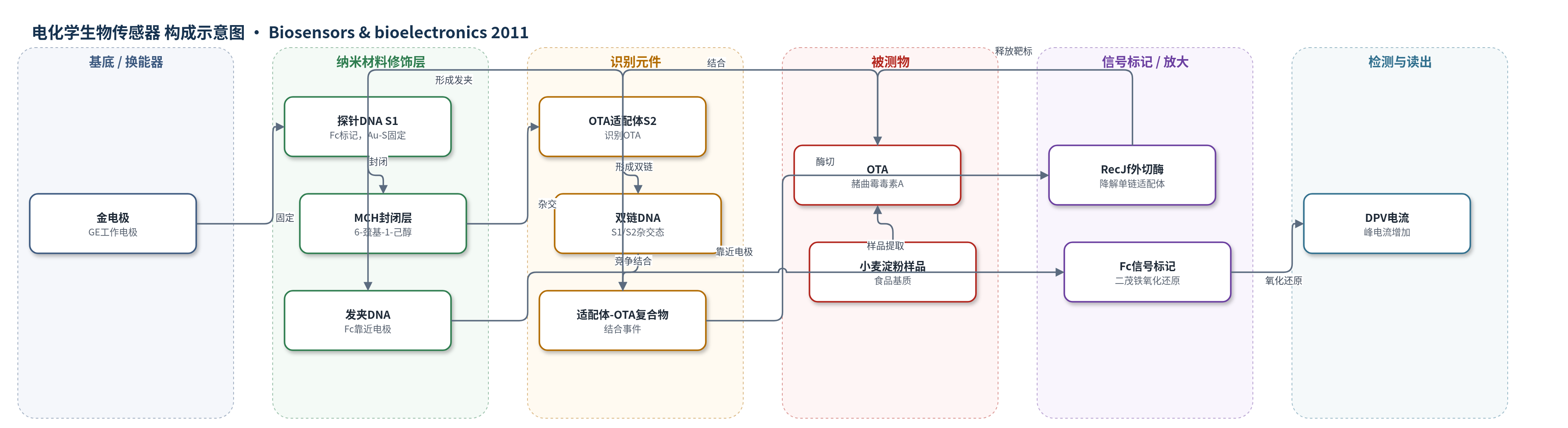
点击图片查看大图 · 依据论文自动绘制
传感器类型
电化学生物传感器
检测对象
赭曲霉毒素A(Ochratoxin A, OTA);样品基质:小麦淀粉(wheat starch)
检测原理
Fc标记探针S1经Au–S键固定于金电极,与OTA适配体S2杂交形成dsDNA,Fc远离电极,电子转移受阻,DPV信号低。加入OTA后,S2优先结合OTA形成aptamer-OTA复合物,从dsDNA中解离;S1两端互补序列在Mg2+下折叠为发夹,使Fc靠近金电极,电子转移加快,DPV峰电流增加。RecJf外切酶选择性降解复合物中的单链S2,释放OTA,使同一OTA分子可反复触发多个S2解离和S1发夹化,实现靶标循环放大。OTA浓度越高,发夹化S1越多,DPV电流越大。
检测灵敏度
LOD: 1.0 pg mL−1 (at 3σ);线性范围: 0.005–10.0 ng mL−1;线性方程: ΔI(nA)=1.666 C(ng mL−1)+5.298;R = 0.9990
效应效果
该传感器对OTA选择性良好:6.0 ng/mL OTA的DPV峰电流14.999 nA,10 ng/mL MC-LR、凝血酶、可卡因分别为1.952、1.927、1.699 nA,空白0.7477 nA。小麦淀粉未加标样品aptasensor为0.18±0.10 ng/mL、ELISA为0.21±0.08 ng/mL,正文报道0.36 ng/mL;加标回收率90.0%–108%。与已有OTA适配体传感器相比,线性范围0.005–10.0 ng/mL、LOD 1.0 pg/mL更优;未报告长期稳定性与RSD,作者认为方法简单、低成本、高灵敏,适用于食品检测。
传感器的构成
- 基底/换能器电极:金电极(GE, gold electrode),工作电极,经抛光和电化学清洗,提供电子转导界面
- 探针DNA修饰层:Fc标记探针DNA(S1, 5′-Fc–CCG...-(CH2)6-SH-3′),通过Au–S键固定于GE,5′端Fc为氧化还原信号标记
- 封闭剂:6-巯基-1-己醇(MCH, 6-mercapto-1-hexanol),去除非特异性吸附DNA并使探针取向利于杂交
- 识别元件:OTA适配体(S2, DNA aptamer),与S1杂交形成dsDNA,特异性结合OTA形成aptamer-OTA复合物
- 信号放大酶:RecJf外切酶(RecJf exonuclease),选择性降解aptamer-OTA复合物中的单链S2,释放OTA实现靶标循环
- 反应缓冲体系:1× NEBuffer 2(50 mM NaCl、10 mM Tris–HCl、10 mM MgCl2、1 mM DTT,pH 7.9),提供Mg2+和酶反应条件
- 检测读出体系:三电极体系(SCE参比电极、铂丝辅助电极),以DPV监测Fc氧化还原峰电流
中文摘要
本文报道了一种基于外切酶催化靶标循环的“信号开启”型电化学适配体传感器,用于小麦淀粉中赭曲霉毒素A(OTA)的超灵敏检测。传感器以金电极为基底,将二茂铁(Fc)标记的探针DNA(S1)通过Au–S键固定于电极表面,再与互补的OTA适配体(S2)杂交形成双链DNA,使Fc远离电极、电子转移受阻。加入OTA后,适配体优先与OTA结合形成适配体–OTA复合物,导致S2从双链中解离,同时S1在Mg2+存在下折叠为发夹结构,使Fc靠近金电极,DPV信号增强。RecJf外切酶选择性降解复合物中的单链适配体,释放OTA并实现靶标循环,从而放大信号。该传感器线性范围为0.005–10.0 ng/mL,检出限为1.0 pg/mL(3σ),并成功用于实际小麦淀粉样品检测,结果经ELISA验证。
英文摘要
A new "signal-on" aptasensor for ultrasensitive detection of Ochratoxin A (OTA) in wheat starch was developed based on exonuclease-catalyzed target recycling. To construct the aptasensor, a ferrocene (Fc) labeled probe DNA (S1) was immobilized on a gold electrode (GE) via Au-S bonding for the following hybridization with the complementary OTA aptamer, with the labeled Fc on S1 far from the GE surface. In the presence of analyte OTA, the formation of aptamer-OTA complex would result in not only the dissociation of aptamer from the double-strand DNA but also the transformation of the probe DNA into a hairpin structure. Subsequently, the OTA could be liberated from the aptamer-OTA complex for analyte recycling due to the employment of exonuclease, which is a single-stranded DNA specific exonuclease to selectively digest the appointed DNA (aptamer). Owing to the labeled Fc in close proximity to the electrode surface caused by the formation of the hairpin DNA and to the analyte recycling, differential pulse voltammetry (DPV) signal could be produced with enhanced signal amplification. Based on this strategy, an ultrasensitive aptasensor for the detection of OTA could be exhibited with a wide linear range of 0.005-10.0ngmL(-1) with a low detection limit (LOD) of 1.0pgmL(-1) OTA (at 3σ). The fabricated biosensor was then applied for the measurement of OTA in real wheat starch sample and validated by ELISA method.