组成图示
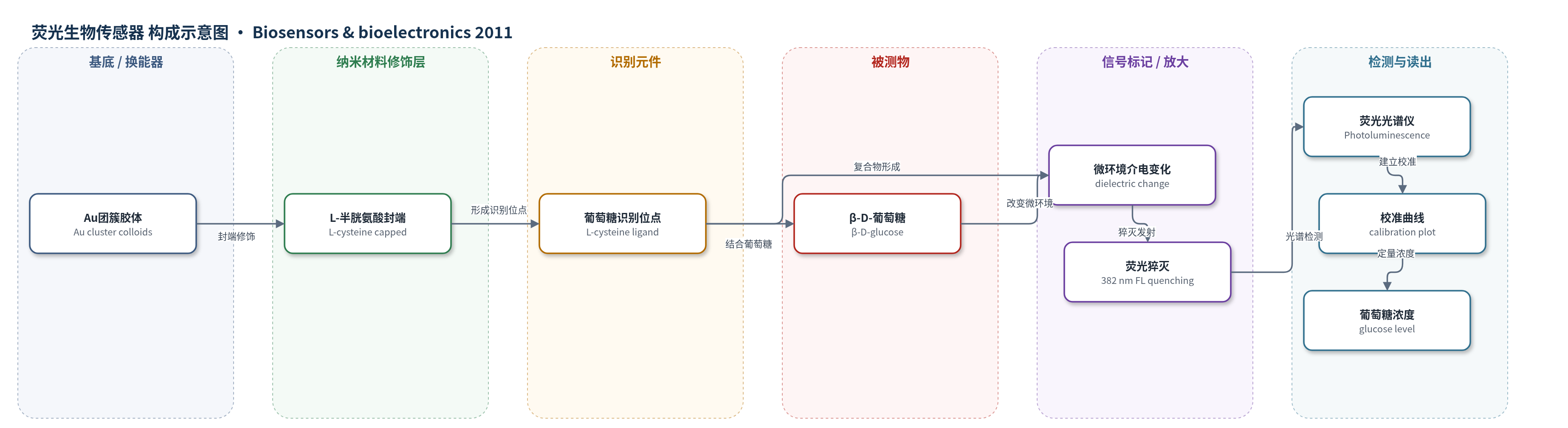
点击图片查看大图 · 依据论文自动绘制
传感器类型
荧光生物传感器
检测对象
β-D-葡萄糖(β-D-glucose);样品基质:人血清(human serum)
检测原理
L-半胱氨酸封端Au8纳米团簇胶体在250 nm激发下于382 nm产生强紫外荧光,源于HOMO-LUMO跃迁。β-D-葡萄糖与L-半胱氨酸配体相互作用,形成Au cluster–L-cysteine–β-D-glucose复合物;FTIR中586 cm−1环变形振动带位移并减弱,证实结合。葡萄糖结合改变Au团簇周围介电常数和折射率,引起动态荧光猝灭,峰位与峰形不变,仅强度下降。Stern–Volmer图线性表明猝灭随葡萄糖浓度增加。荧光强度变化ΔFL在2.5–25.0 mM范围内与葡萄糖浓度线性相关,经校准曲线定量。该过程无需酶、外部电源或FRET供受体,响应时间达纳秒至皮秒量级。
检测灵敏度
LOD: 0.25 mM(原文:glucose level as low as 0.25 mM ... can be detected);线性范围: 2.5–25.0 mM;灵敏度斜率: b = 0.01(y = 0.023 + 0.01x);r = 0.997
效应效果
该传感器抗干扰能力强,血清中抗坏血酸、尿酸、BSA、C-肽及麦芽糖、乳糖、果糖等单糖不干扰;Au团簇胶体至少稳定5个月,响应时间为纳秒至皮秒量级。对10份人血清(含糖尿病)样品测定,结果与当地医院病理数据可比,平均高约15%,血清线性回归r=0.996,剂量响应曲线r=-0.996。相比电化学葡萄糖传感器,无需酶和外部电源,校准范围更宽,分辨率更高,可检测低至0.25 mM葡萄糖,作者认为适用于糖尿病血清葡萄糖快速定量。
传感器的构成
- 基底/换能器:无固体电极基底,L-半胱氨酸封端Au纳米团簇胶体(L-cysteine capped Au cluster colloids, Au8 clusters)作为光学换能器,提供382 nm荧光发射
- 识别元件:L-半胱氨酸(L-cysteine)配体,与β-D-葡萄糖相互作用形成Au cluster–L-cysteine–β-D-glucose复合物
- 信号标记物:无外源标记物,Au团簇自身紫外荧光作为内源信号
- 样品基质:人血清(human serum),用于实际葡萄糖测定
- 检测仪器:荧光光谱仪(Photoluminescence setup, Hg–Xe lamp, monochromator, PMT),250 nm激发下监测382 nm荧光强度
中文摘要
报道了一种基于金纳米团簇(Au-cluster)紫外区荧光发射猝灭的葡萄糖生物传感器。该传感器对β-D-葡萄糖在2.5–25.0 mM范围内具有高灵敏度,Au团簇胶体荧光强度随β-D-葡萄糖浓度呈线性变化。傅里叶变换红外光谱(FTIR)证实β-D-葡萄糖与L-半胱氨酸封端的Au团簇胶体发生相互作用。抗坏血酸、尿酸、蛋白质和肽等血清中常见生物分子不会干扰葡萄糖测定,吸收和荧光发射测量均予以验证。通过荧光猝灭法测定人血清(含糖尿病患者)中的葡萄糖水平,结果与当地医院病理数据相当或更准确。此外,该传感器可在较宽范围内检测葡萄糖,响应时间达纳秒至皮秒量级,即Au团簇的发射寿命。
英文摘要
Fabrication of a glucose biosensor based on Au-cluster emission quenching in the UV region is reported. The glucose biosensor is highly sensitive to β-d-glucose in 2.5-25.0mM range as confirmed from a linear calibration plot between Au-cluster colloid emission intensity as a function of β-d-glucose concentration. The interaction of β-d-glucose with l-cysteine capped Au cluster colloids has been confirmed from their Fourier transformed infrared spectroscopy (FTIR) measurements. It has been found that the biomolecules present in the serum such as ascorbic and uric acids, proteins and peptides do not interfere and affect in glucose estimation as confirmed from their absorption and fluorescence (FL) emission measurements. Practical utility of this sensor based on FL quenching method has been demonstrated by estimating the glucose level in human serum that includes diabetes and the data were found to be comparable or more accurate than those of the pathological data obtained from a local hospital. In addition, this biosensor is useful to detect glucose level over a wide range with sensor response time of the order of nano to picoseconds that is emission lifetime of Au clusters.