组成图示
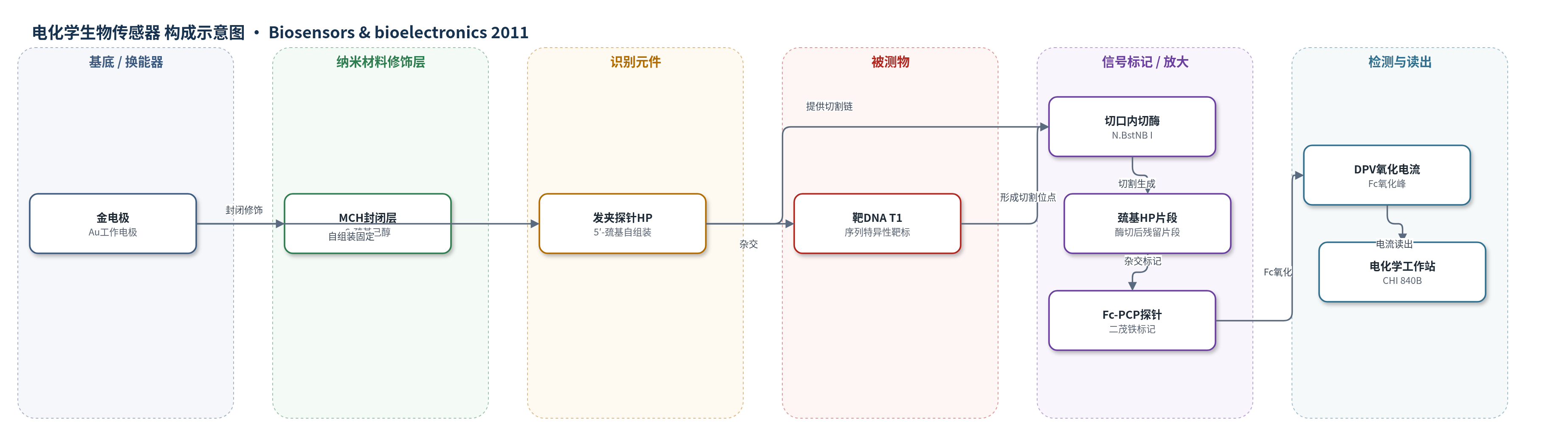
点击图片查看大图 · 依据论文自动绘制
传感器类型
电化学生物传感器
检测对象
靶DNA(target DNA, T1);样品基质:稀释人血浆(human blood plasma)
检测原理
金电极表面通过Au–S键固定5′-巯基发夹探针HP,MCH封闭非特异位点。靶DNA T1与HP识别区杂交后打开茎区,形成N.BstNB I完整识别位点。N.BstNB I仅切割双链中HP链,使靶DNA释放并可与另一完整HP结合,循环进行切割–解离–杂交,从而在电极表面累积多个巯基HP片段。随后3′-二茂铁标记部分互补探针Fc-PCP与这些片段杂交,将电化学活性二茂铁(Fc)引入界面。DPV检测Fc氧化电流,电流随靶DNA浓度增加而增大,实现signal-on定量检测。
检测灵敏度
LOD: 0.167 pM;线性范围: 5.0 × 10⁻¹³–5.0 × 10⁻⁸ M;斜率: 21.134(I = 21.134 log C + 46.166);R^2 = 0.9982
效应效果
该传感器对完全互补靶DNA T1(5 nM)产生明显Fc氧化电流,而对单碱基错配T2和非互补T3(均5 μM)信号很低,显示良好序列选择性和单碱基错配分辨能力。5 pM靶DNA三次重复RSD为1.72%,5个传感器检测5 nM靶DNA的RSD为4.3%。4 ℃保存21天后DPV峰电流保持87.4%(7天为91.2%)。在100倍稀释人血浆中加标检测,回收率为91.6%–92.2%,RSD为3.5%–4.7%。作者认为该策略无需酶、DNAzyme或纳米颗粒等放大标签,可避免假阳性,适合便携式低成本诊断装置。
传感器的构成
- 基底/换能器电极:金电极(Au),直径3 mm,经氧化铝抛光和电化学清洗,作为工作电极
- 识别元件:5′-巯基发夹探针(HP),通过Au–S键自组装固定,含靶DNA识别序列(5′-GAGTC-3′)和N.BstNB I切割位点
- 封闭剂:6-巯基己醇(MCH),封闭金表面非特异吸附位点
- 信号放大酶:切口内切酶(N.BstNB I),识别双链特定序列并切割HP链,实现靶DNA循环放大
- 信号标记物:3′-二茂铁标记部分互补探针(Fc-PCP),与巯基HP片段杂交引入电化学活性Fc
- 检测介质:10 mM PBS(pH 7.4)含0.1 M NaClO4,用于DPV检测Fc氧化电流
中文摘要
本文首次将信号开启(signal-on)策略与切口内切酶辅助电化学信号放大(NEAESA)相结合,开发了一种用于序列特异性DNA检测的新型高灵敏电化学生物传感器。5′端巯基修饰的发夹探针(HP)通过Au–S键固定于金电极表面,其包含靶DNA识别序列。HP修饰电极与靶DNA杂交形成双链后,加入切口内切酶N.BstNB I,对双链中的HP链进行切割。切割后,3′-二茂铁(Fc)标记的部分互补探针(Fc-PCP)与留在电极表面的巯基修饰HP片段杂交,从而产生电化学信号。该传感器对靶DNA的线性范围为5.0×10⁻¹³–5.0×10⁻⁸ M,检出限为0.167 pM。该策略无需酶、DNAzyme或纳米颗粒等放大标签,可减少假阳性,具有制备简单、操作方便、选择性好和灵敏度高等优点,有望集成于便携式低成本诊断装置。
英文摘要
Combining the advantages of signal-on strategy and nicking endonuclease assisted electrochemistry signal amplification (NEAESA), a new sensitive and signal-on electrochemical DNA biosensor for the sequence specific DNA detection based on NEAESA has been developed for the first time. A Hairpin-shape probe (HP), containing the target DNA recognition sequence, is thiol-modified at 5' end and immobilized on gold electrode via Au-S bonding. Subsequently, the HP modified electrode is hybridized with target DNA to form a duplex. Then the nicking endonuclease is added and nicks the HP strand in the duplex. After nicking, 3'-ferrocene (Fc)-labeled part complementary probe (Fc-PCP) is introduced on the electrode surface by hybridizing with the thiol-modified HP fragment, which results in the generation of electrochemical signal. Hence, the DNA biosensor is constructed successfully. The present DNA biosensor shows a wide linear range of 5.0×10(-13)-5.0×10(-8)M for detecting target DNA, with a low detection limit of 0.167pM. The proposed strategy does not require any amplifying labels (enzymes, DNAzymes, nanoparticles, etc.) for biorecognition events, which avoids false-positive results to occur frequently. Moreover, the strategy has the benefits of simple preparation, convenient operation, good selectivity, and high sensitivity. With the advantages mentioned above, this simple and sensitive strategy has the potential to be integrated in portable, low cost and simplified devices for diagnostic applications.