组成图示
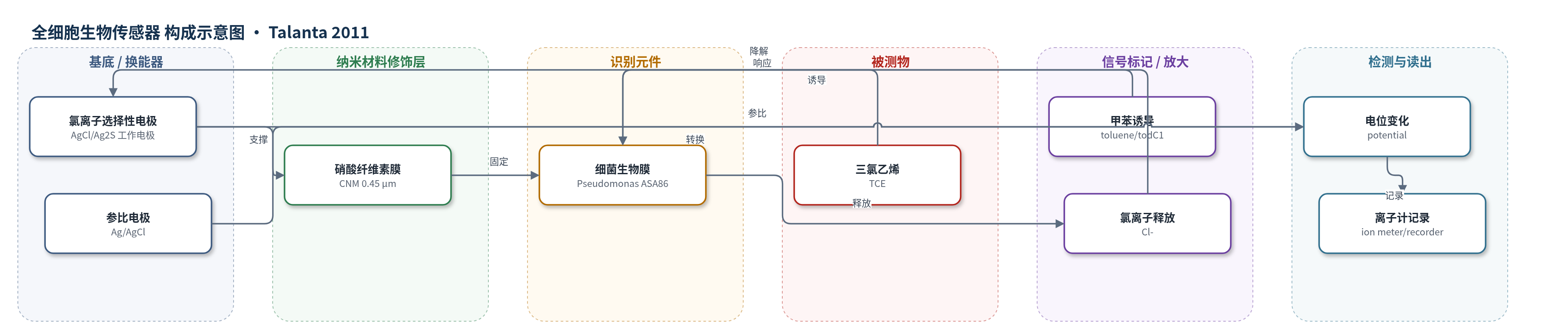
点击图片查看大图 · 依据论文自动绘制
传感器类型
全细胞生物传感器
检测对象
三氯乙烯(trichloroethylene, TCE),样品基质为环境水样、工业废水、地下水、饮用水
检测原理
该传感器以 Pseudomonas sp. ASA86 生物膜为识别元件,以氯离子选择性电极为换能器。反应体系中甲苯作为诱导底物,诱导细菌表达 toluene dioxygenase(todC1),使细菌在好氧条件下对 TCE 进行共代谢氧化。TCE 被逐步氧化/脱氯后释放氯离子(Cl-)。Cl- 扩散至 AgCl/Ag2S 膜工作电极,改变膜电位;Ag/AgCl 参比电极与离子计构成电位测量回路,记录仪输出电位差。TCE 浓度越高,降解产生的 Cl- 越多,电位变化越大,从而实现对 TCE 的间接定量。
检测灵敏度
LOD: 0.05 ppm TCE;线性范围: below 3 ppm TCE;RSD: 6.1 at 0.5 ppm TCE;响应时间: less than 10 min
效应效果
传感器在 TCE 低于 3 ppm 范围内线性响应,检测限 0.05 ppm,低于日本工业水和废水排放限值 0.3 ppm;在 0.5 ppm TCE 下相对标准偏差为 6.1,响应时间小于 10 min,储存于磷酸盐缓冲液中 2 天内响应稳定。作者指出其响应与 Pseudomonas aeruginosa JI104 微生物传感器相似,并优于 Pseudomonas fluorescens A506 传感器 0.2 ppm 的检测限。与传统气相色谱等需要溶剂萃取和浓缩前处理的方法相比,该传感器可简化样品前处理,适用于工业废水、地下水和饮用水中 TCE 的原位或在线监测;干扰研究尚待进一步开展。
传感器的构成
- 换能器工作电极:氯离子选择性电极(chloride ion selective electrode, CISE),AgCl/Ag2S 膜,检测 TCE 降解释放的 Cl- 并转换为电位信号
- 参比电极:Ag/AgCl 电极,提供稳定电位参考
- 支撑固定膜:硝酸纤维素膜(cellulose nitrate membrane, CNM,20 mm,0.45 μm),吸附并夹心固定细菌生物膜
- 识别元件:Pseudomonas sp. strain ASA86 生物膜(biofilm),在甲苯诱导下好氧共代谢降解 TCE
- 诱导共底物:甲苯(toluene),诱导 toluene dioxygenase(todC1)表达并驱动 TCE 共代谢
- 信号产物:氯离子(chloride ion, Cl-),TCE 生物降解过程中释放并被 CISE 识别
- 固定密封件:200 目尼龙网(nylon mesh)和 O 型圈(O-ring),固定生物膜于电极表面
- 读出装置:离子计(ion meter)和电子记录仪(electronic recorder, EPR-200A),记录电位变化
中文摘要
三氯乙烯(TCE)是一种有毒且难降解的地下水污染物。作者从不同环境中筛选 TCE 降解微生物,从含甲苯和色氨酸的选择性培养基中分别分离出假单胞菌 Pseudomonas sp. 菌株 ASA86 和伯克霍尔德菌 Burkholderia sp. 菌株 TAM17;这两种诱导底物对诱导 TCE 生物降解是必需的。在 1 mg/L TCE 条件下,ASA86 的半降解时间为 18 h,TAM17 为 7 d。基因鉴定显示,ASA86 中相关基因与 Pseudomonas putida F1 中编码甲苯双加氧酶的 todC1 相同,TAM17 中相关基因与 Burkholderia sp. PS12 中编码氯苯双加氧酶的 tecA1 相似。研究以 ASA86 为生物元件,在甲苯诱导和好氧条件下构建了新型 TCE 生物传感器。该传感器在 TCE 低于 3 ppm 范围内呈线性响应,检测限为 0.05 ppm,响应时间小于 10 min,并在 2 天内保持恒定响应,足以用于环境系统中 TCE 的监测。
英文摘要
Trichloroethylene (TCE) is a toxic, recalcitrant groundwater pollutant. TCE-degrading microorganisms were isolated from various environments. The aerobic bacteria isolated from toluene- and tryptophan-containing media were Pseudomonas sp. strain ASA86 and Burkholderia sp. strain TAM17, respectively; these are necessary for inducing TCE biodegradation in a selective medium. The half-degradation time of TCE to a concentration of 1mg/L was 18 h for strain ASA86 and 7 days for strain TAM17. While identifying toluene/TCE degradation genes, we found that in strain ASA86, the gene was the same as the todC1 gene product encoding toluene dioxygenase identified in Pseudomonas putida F1, and that in strain TAM17, the gene was similar to the tecA1 gene product encoding chlorobenzene dioxygenase identified in Burkholderia sp. PS12. A novel TCE biosensor was developed using strain ASA86 as the inducer of toluene under aerobic conditions. The TCE biosensor exhibited a linear relationship below 3 ppm TCE. Detection limit of the biosensor was 0.05 ppm TCE. The response time of the biosensor was less than 10 min. The biosensor response displayed a constant level during a 2 day period. The TCE biosensor displayed sufficient sensitivity for monitoring TCE in environmental systems.