组成图示
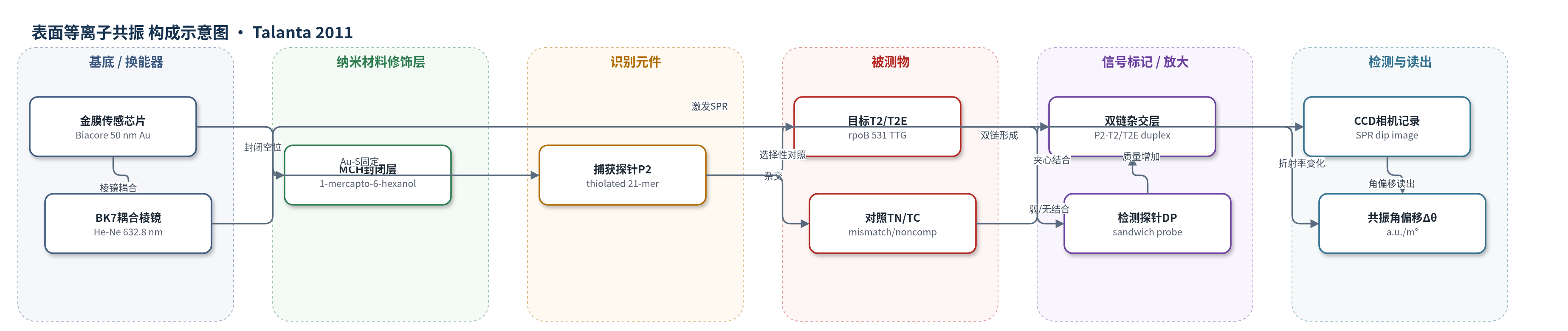
点击图片查看大图 · 依据论文自动绘制
传感器类型
表面等离子共振(SPR)生物传感器
检测对象
结核分枝杆菌(Mycobacterium tuberculosis)rpoB 基因第531密码子突变(TCG→TTG)寡核苷酸序列(T2/T2E)及正常/错配对照序列(TN/TC);样品基质:寡核苷酸溶液/2×SSC缓冲液
检测原理
传感器以金膜 SPR 芯片为换能器,硫醇化捕获探针 P2 通过 Au-S 键固定于金表面,MCH 封闭非特异位点。当含 rpoB 531 突变序列的目标 T2 或扩展目标 T2E 流过传感池时,与 P2 互补杂交,使金表面附近质量增加,引起约300 nm 范围内折射率变化。SPR 激发条件对折射率敏感,导致 p 偏振反射光在共振角处强度下降,CCD 记录共振角偏移。T2E 暴露的额外序列可再与检测探针 DP 杂交,形成夹心结构,进一步增加表面质量,实现信号放大。完全互补序列响应最大,单碱基错配响应降低,非互补序列无响应,从而实现序列特异性检测。
检测灵敏度
LOD: 10 nM(T2);LOD: 5 nM(T2E);线性范围: up to 200 nM(T2);灵敏度斜率: 0.20 m°/nM;R^2 = 0.973
效应效果
该SPR传感器对完全互补T2响应最高,单碱基错配TN响应略低,非互补TC无响应,选择性良好。杂交后洗涤信号基本不降,双链稳定。8 M尿素再生,每天5–6次、连续两周无明显衰减,芯片至少可重复使用50次以上。P2表面密度约180 ng/cm^2(28 pmol/cm^2,1.7×10^13分子/cm^2),最大T2响应约25 a.u.(66 m°),对应55 ng/cm^2(8.5 pmol/cm^2,5×10^12分子/cm^2),杂交效率约30%。夹心格式使T2E检测限降至5 nM,有望亚纳摩尔检测。作者认为可用于实时无标记检测利福平耐药结核rpoB突变,并集成阵列评估耐药谱。
传感器的构成
- 基底/换能器:Biacore 商业芯片(50 nm 金薄膜)与 BK7 玻璃耦合棱镜,用于激发和耦合表面等离子体
- 识别元件:5′端硫醇修饰(6亚甲基间隔臂)的21-mer捕获探针 P2(ACCCACAAGCGCCGACTGTTG),通过 Au-S 键固定于金表面并识别 rpoB 531 突变序列
- 封闭剂:1 mM 1-巯基-6-己醇(MCH)水溶液,封闭金表面未占据位点,减少非特异吸附并提高杂交效率
- 信号放大元件:检测探针 DP(ACTGAGTGACTGACTGACTG),与扩展目标 T2E 暴露的额外序列杂交,形成夹心结构并增加表面质量
- 运行/固定缓冲液:0.5 M KH2PO4(pH 3.8)用于 P2 固定;2×SSC(30 mM Na citrate、300 mM NaCl、pH 7)用于杂交运行
- 读出系统:10 mW He-Ne 激光(632.8 nm)、偏振器、旋转扩散盘、透镜和 CCD 相机,记录反射光强度与 SPR 角偏移
中文摘要
本文报道了一种基于表面等离子共振(SPR)的生物传感器系统,用于检测结核分枝杆菌(Mycobacterium tuberculosis)正常和突变 rpoB 基因相关寡核苷酸序列。通过在金传感表面固定含硫醇修饰的捕获探针 P2,构建生物选择性识别层;该探针包含 rpoB 基因第531密码子 TCG→TTG 突变,该突变与利福平耐药相关。固定探针 P2 与互补目标 T2 杂交产生最高传感器响应,含单碱基错配的正常基因序列寡核苷酸 TN 响应略低,非互补寡核苷酸 TC 无响应。P2–T2 杂交效率约为30%(5×10^12 分子/cm^2),T2 最低检测限为10 nM。由 T2 序列和额外24个核苷酸组成的扩展序列 T2E 可产生更明显响应,至少5 nM T2E 可被检测。在 P2–T2E 杂交后注入与 T2E 自由额外部分互补的寡核苷酸,可产生显著附加 SPR 响应,表明夹心杂交格式可进一步提高灵敏度并降低检测限。实验表面杂交结果与溶液条件下计算的热力学参数一致。该方法可作为实时、无标记诊断耐药结核病的生物传感器基础。
英文摘要
Oligonucleotide sequences related to the normal and mutated rpoB genes of Mycobacterium tuberculosis are detected using a surface plasmon resonance (SPR) biosensor system. A bioselective element was prepared by immobilizing the thiol-modified oligonucleotides of the selected sequence (the capture probe P2) that contains the mutated TCG→TTG codon 531 (evoking drug resistance) of the rpoB gene of M. tuberculosis on a gold sensor surface. Specific hybridization between immobilized probe P2 and complementary target T2 gave the highest sensor response, single-base mismatched oligonucleotide TN (corresponding to the normal gene sequence) produced somewhat smaller response and no response was observed at injection of noncomplementary oligonucleotide TC. The P2-T2 hybridization efficiency is calculated ca. 30% (5 × 10(12) molecules cm(-2)), and the lowest detection limit of T2 was 10nM. An extended T2E oligonucleotide sequence consisting of T2 sequence and additional 24 nucleotides was shown to cause more pronounced sensor response (at least 5 nM T2E was easily detected). Injection into the sensor cell of the oligonucleotides complementary to the free additional part of T2E after P2-T2E hybridization gave a significant additional SPR response, thus showing that the sandwich hybridization format further improves the sensor sensitivity and decreases the lowest detection limit. The experimental results on surface hybridization between the studied oligonucleotides were in good agreement with thermodynamic parameters of the hybridization calculated for solution conditions. The described approach could be proposed as a basis for creating a biosensor for real-time and label-free diagnostics of drug resistant tuberculosis.