组成图示
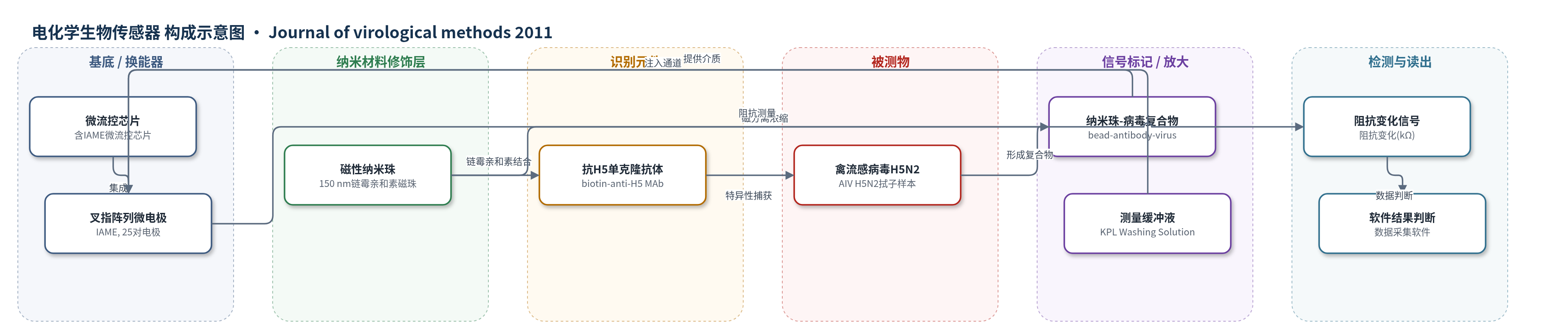
点击图片查看大图 · 依据论文自动绘制
传感器类型
电化学生物传感器
检测对象
禽流感病毒(avian influenza virus, AIV,H5N2亚型);样品基质:鸡气管拭子和泄殖腔拭子样本(病毒运输培养基)
检测原理
该传感器为无标记电化学阻抗免疫检测。链霉亲和素磁性纳米珠表面通过生物素-链霉亲和素结合固定抗H5单克隆抗体;样品中AIV H5N2与抗体特异性结合,形成纳米珠-抗体-病毒复合物。外加磁场将复合物从拭子液中分离并浓缩,洗涤后重悬于KPL测量液。复合物注入含叉指阵列微电极的微流控通道,病毒-纳米珠复合物改变电极-溶液界面的双电层/电荷转移阻抗,使阻抗变化随病毒浓度增加而增大。仪器自动记录阻抗变化,以6 kΩ为检测限、8 kΩ为阳性阈值进行判断。磁分离浓缩提高低浓度样本信号。
检测灵敏度
LOD: 1 × 10^2.2 ELD50/ml;信号检测限: 6 kΩ;阳性阈值: 8 kΩ;线性范围: 1 × 10^1.2 ELD50/ml–1 × 10^5.2 ELD50/ml;相关方程: y = 0.49x + 32.87 (R^2 = 0.95)
效应效果
该传感器在59份鸡拭子样本(35份气管、24份泄殖腔)中与rRT-PCR和病毒培养比较。以病毒培养为金标准,气管拭子中阻抗生物传感器灵敏度100%、特异性64%、PPV 81%、NPV 100%;rRT-PCR均为100%。泄殖腔拭子中阻抗生物传感器灵敏度55%、特异性100%、PPV 100%、NPV 72%;rRT-PCR灵敏度81%、特异性69%、PPV 69%、NPV 81%。Dot-ELISA显示抗H5 MAb不与新城疫病毒及H7N2、H9N2、H4N2交叉反应,对H5N2结合最强。检测时间30–60 min,微流控芯片可连续使用至阳性样本出现。作者认为其便携、操作简便,适合现场快速筛查,但不能区分活病毒与死病毒。
传感器的构成
- 基底/换能器电极:微流控芯片内叉指阵列微电极(interdigitated array microelectrode, IAME),25对电极指(10 μm×250 μm),用于阻抗测量
- 微流控通道:深度35 μm的流道,用于输送样品和测量液至电极表面
- 纳米材料层:150 nm链霉亲和素包被磁性微珠(streptavidin-coated magnetic beads),作为可磁分离的捕获载体
- 识别元件:生物素标记的抗H5单克隆抗体(biotin-labeled anti-H5 MAb),通过链霉亲和素-生物素结合于磁性纳米珠,特异性结合AIV H5
- 磁分离模块:自研磁铁/磁分离器(magnetic separator),用于保留纳米珠-抗体-病毒复合物并洗涤去除杂质
- 测量介质:KPL Washing Solution稀释1:200,000的测量液(measuring solution),用于复合物重悬和阻抗测量
- 信号标记物:无标记阻抗检测;优化实验中使用量子点(QDs)荧光标记目标AIV以验证抗体-抗原结合
- 信号读出:笔记本电脑与数据采集软件(laptop with data acquisition software),自动记录阻抗变化并判断阳性/阴性
中文摘要
当前禽流感病毒(AIV)检测主要依赖病毒培养和逆转录实时PCR(rRT-PCR),前者耗时长,后者需专业实验室和训练人员,亟需适合现场或床旁使用的快速、稳健、可靠方法。本研究评估一种新开发便携式阻抗生物传感器,并与rRT-PCR和病毒培养比较,用于检测实验感染H5N2 AIV鸡的气管和泄殖腔拭子样本。该传感器结合包被AIV亚型特异性抗体的磁性纳米珠,用于捕获、分离和浓缩目标病毒,以及带叉指阵列微电极的微流控芯片,用于转移和检测目标病毒,并在缓冲液中测量生物纳米珠-病毒复合物的阻抗。对59份拭子样本的比较显示,阻抗生物传感器在灵敏度和特异性方面与rRT-PCR相当,检测时间少于1 h。
英文摘要
Current methods for detection of avian influenza virus (AIV) based on virus culture and RT-PCR are well established, but they are either time consuming or require specialized laboratory facilities and highly trained technicians. A simple, rapid, robust, and reliable test, suitable for use in the field or at the patient's bedside, is urgently needed. In this study, the performance of a newly developed portable impedance biosensor was evaluated by comparison with real-time reverse transcriptase PCR (rRT-PCR) and virus culture for detection of AIV in tracheal and cloacal swab samples collected from experimentally H5N2 AIV infected chickens. The impedance biosensor system was based on a combination of magnetic nanobeads, which were coated with AIV subtype-specific antibody for capture (separation and concentration) of a target virus, and a microfluidic chip with an interdigitated array microelectrode for transfer and detection of target virus, and impedance measurement of the bio-nanobeads and AI virus complexes in a buffer solution. A comparison of results obtained from 59 swab samples using virus culture, impedance biosensor and rRT-PCR methods showed that the impedance biosensor technique was comparable in sensitivity and specificity to rRT-PCR. Detection time for the impedance biosensor is less than 1h.