组成图示
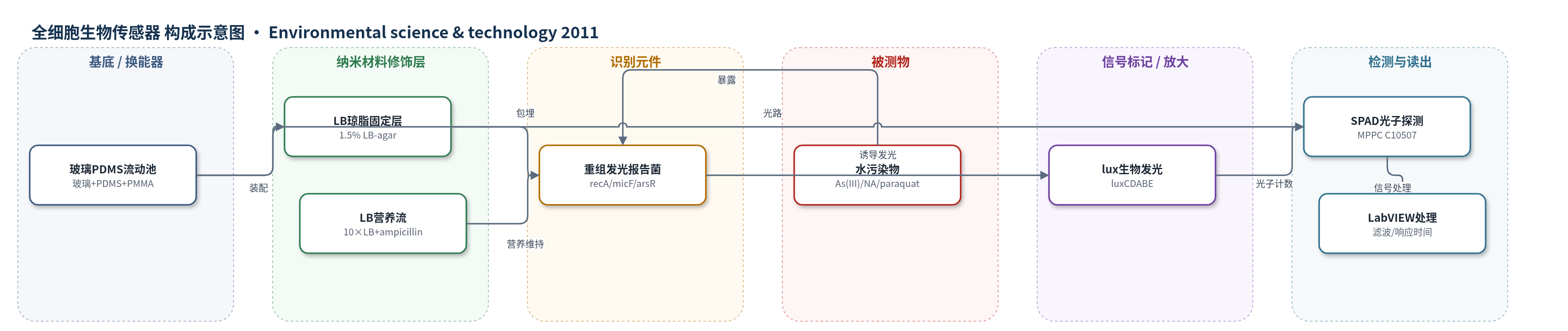
点击图片查看大图 · 依据论文自动绘制
传感器类型
全细胞生物传感器
检测对象
三价砷(As(III))、三价锑(Sb(III))、萘啶酸(nalidixic acid, NA)、百草枯(paraquat, MV)、甲萘醌(menadione)、丝裂霉素C(mitomycin C)、工业废水(industrial wastewater, IWW);样品基质为自来水加标水、实验室溶液及工业废水
检测原理
污染物随水流进入流动池后,与琼脂固定层中的重组报告菌接触。DNA损伤类物质激活recA启动子,氧化应激物质激活micF启动子,重金属激活arsR启动子,组成型CP38启动子持续表达作为对照。启动子诱导luxCDABE操纵子转录,荧光素酶luxAB催化底物氧化并产生光子,luxCDE维持底物再生,因此光强随污染物诱导程度和浓度升高而增强。SPAD以扫描方式计数光子,软件经低通、中值与均值滤波后,以基线偏移阈值确定响应时间。多菌株响应模式用于区分污染物类别,无需外源标记或化学放大。
检测灵敏度
原文未报告LOD、线性范围、灵敏度斜率或R^2。
效应效果
装置连续运行4–10天,2 h加标脉冲均在0.5–2.5 h内响应:As(III) 60–72 min,NA 80 min,paraquat 162 min,混合物79–129 min,工业废水92 min。最大响应比为As(III) 70、NA 80、paraquat 100。As/Sb主要激活arsR,paraquat/menadione主要激活micF,mitomycin C主要激活recA。正、负和CP38对照可识别高毒性“灯灭”事件。实验间SEM≤20%。作者认为可作水污染早期预警。
传感器的构成
- 流动池基底:玻璃层、聚二甲基硅氧烷(PDMS)芯片与聚甲基丙烯酸甲酯(PMMA)盖板,构成3×4圆柱孔和蛇形流道
- 固定层:1.5% LB琼脂(LB-agar)包埋报告菌,形成一次性生物芯片并限制菌体扩散
- 识别元件:重组大肠杆菌(E. coli)报告菌,携带recA、micF、arsR或CP38启动子-luxCDABE融合,分别响应DNA损伤、氧化应激、重金属和组成型对照
- 信号标记物:细菌自身luxCDABE生物发光系统(luxAB荧光素酶与luxCDE脂肪酸还原酶复合物),无需外源底物
- 营养维持层:10倍浓缩LB培养基加氨苄西林(ampicillin),以低流速汇入,维持菌代谢活性
- 样品流路:多通道蠕动泵(Watson-Marlow 504S、Gilson Minipuls 3)输送自来水、加标水或工业废水,40°C加热管保温
- 读出层:单光子雪崩二极管(SPAD,MPPC C10507-11-100U)经步进电机扫描,LabVIEW记录光子计数并计算响应时间
中文摘要
本文报道一种用于在线连续水毒性监测的流动式生物传感器。该装置核心为一次性模块化生物芯片,芯片内固定有琼脂包埋的发光重组报告菌,其响应由单光子雪崩二极管(SPAD)探测器探测。为验证性能,作者将芯片装载可诱导和组成型报告菌株,并在连续水流中运行最长10天。期间以2小时脉冲方式加入含不同类别潜在水污染物模型化合物的加标水,以及一份工业废水样品。报告菌面板在0.5–2.5小时内检测到所有模拟污染事件,且响应模式可指示污染物化学性质。作者认为该设计可集成到未来水安全与安保网络中,作为针对意外或人为有毒化学物质污染水的早期预警系统。
英文摘要
We describe a flow-through biosensor for online continuous water toxicity monitoring. At the heart of the device are disposable modular biochips incorporating agar-immobilized bioluminescent recombinant reporter bacteria, the responses of which are probed by single-photon avalanche diode detectors. To demonstrate the biosensor capabilities, we equipped it with biochips harboring both inducible and constitutive reporter strains and exposed it to a continuous water flow for up to 10 days. During these periods we challenged the biosensor with 2-h pulses of water spiked with model compounds representing different classes of potential water pollutants, as well as with a sample of industrial wastewater. The biosensor reporter panel detected all simulated contamination events within 0.5-2.5 h, and its response was indicative of the nature of the contaminating chemicals. We believe that a biosensor of the proposed design can be integrated into future water safety and security networks, as part of an early warning system against accidental or intentional water pollution by toxic chemicals.