组成图示
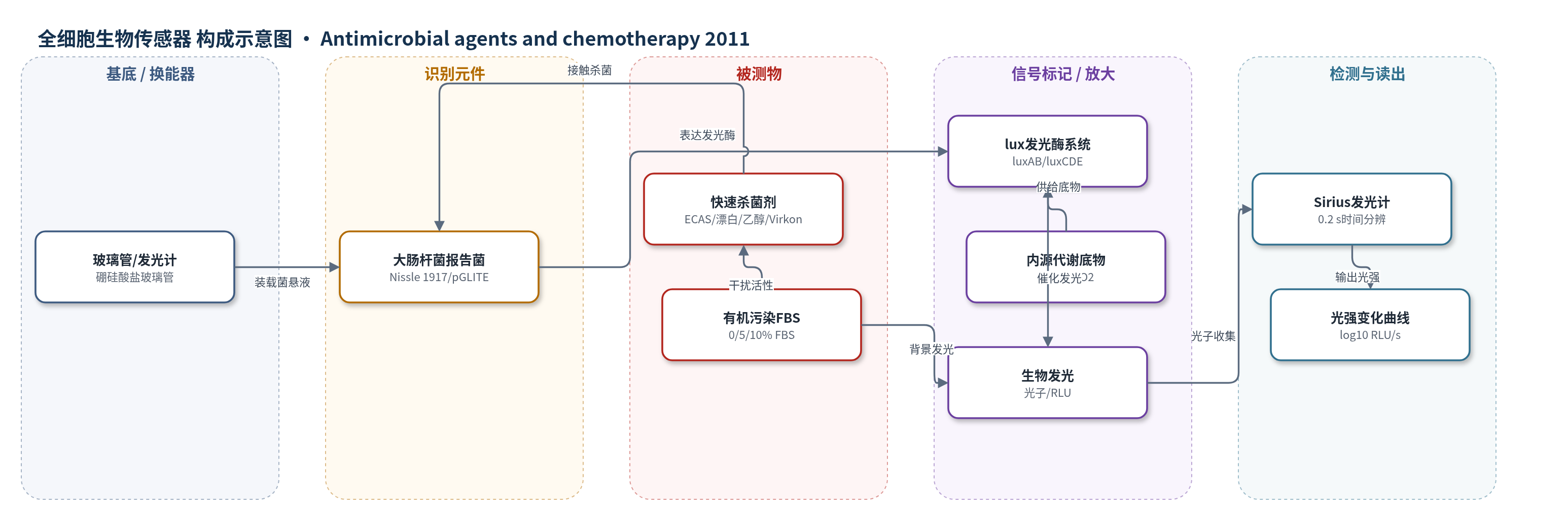
点击图片查看大图 · 依据论文自动绘制
传感器类型
全细胞生物传感器
检测对象
快速杀菌剂效力(fast-acting biocides: ECAS、漂白剂/次氯酸钠 sodium hypochlorite、Virkon、乙醇 ethanol);样品基质:Ringer's solution 及 0/5/10% 胎牛血清(FBS)模拟有机污染
检测原理
该检测以表达 P. luminescens luxCDABE 操纵子的大肠杆菌 Nissle 1917/pGLITE 为全细胞报告菌。细菌在 Ringer's solution 中维持代谢,luxCDE 合成内源荧光素,luxAB 荧光素酶催化 FMNH2、O2 与长链脂肪醛的氧化反应,产生与代谢活性成正比的光子。快速杀菌剂加入后,通过氧化蛋白、损伤膜或抑制代谢使 luciferase 活性下降,光强随时间降低;杀菌剂浓度越高、活性越强,log10 RLU/s 下降速率越大。FBS 有机污染可消耗活性氯等氧化物种,降低杀菌剂效力,并与部分杀菌剂发生发光反应形成背景。Sirius 发光计以 0.2 s 间隔采集光强,从而在毫秒级时间尺度反映初始杀灭速率。
检测灵敏度
原文未报告LOD、线性范围、灵敏度斜率或相关系数。
效应效果
该体系在2 s内以0.2 s间隔获得11个数据点,动态范围约5个数量级,n=12并报告标准差。无有机污染时,80% ECAS光强下降最快(-2.336±0.093 log10 RLU/s),10% ECAS为-1.632±0.263;但10% FBS下ECAS降至-0.165±0.051,显示强有机污染抑制。80%乙醇在10% FBS中仍达-2.166±0.188,优于其他杀菌剂。漂白剂与Virkon在匹配浓度下趋势相近;1%乙醇和1% Virkon无可测效应。Virkon空白背景可升高>100倍并维持约10倍,提示需设试剂空白。与传统计数法相比,该方法可实时比较快速杀菌剂初始效力并评估有机污染影响。
传感器的构成
- 检测容器/换能器:硼硅酸盐玻璃管(12×75 mm)与 Sirius 管式发光计,承载样品并收集光子
- 全细胞识别/报告元件:重组大肠杆菌 Nissle 1917/pGLITE,表达 P. luminescens luxCDABE 操纵子,作为代谢活性报告菌
- 发光酶系统:luxAB 荧光素酶,催化还原型黄素单核苷酸(FMNH2)氧化并产生光
- 内源底物合成系统:luxCDE 编码荧光素合成酶,使菌无需外源底物即可持续发光
- 电子供体/代谢耦合:FMNH2 与 O2,光强反映细菌代谢和存活状态
- 样品基质/干扰物:Ringer's solution 及 0/5/10% 胎牛血清(FBS),模拟清洁与有机污染条件
中文摘要
传统微生物学方法可提供杀菌剂杀灭速率和程度的可靠数据,但对快速杀菌剂在极短时间域内的初始杀灭速率信息有限。本研究描述了一种表达发光杆菌(Photorhabdus luminescens)lux 操纵子的重组大肠杆菌全细胞生物传感器。由于细菌发光直接与其代谢活性相关,通过监测光输出即可评估快速杀菌剂的作用。在存在有机污染条件下,分别测试电化学活化溶液(ECAS)、漂白剂、Virkon 和乙醇三种浓度(1%、10%、80%)的效果。2 秒时间过程显示,无有机负荷时 80% ECAS 使光输出下降最大,但受有机负荷强烈抑制;80% 乙醇在存在有机污染时优于所有受试杀菌剂;漂白剂与 Virkon 在相同浓度下产生相近的生物发光下降。该检测还可快速评估有机污染的影响。利用发光细菌作为全细胞生物报告菌,可在应用后毫秒级时间尺度内评估快速杀菌剂的相对效力,并可在短时间或延长时间域内研究其活性,以确认代谢抑制是否完全,进而有助于阐明其作用机制。
英文摘要
Traditional microbiological techniques are used to provide reliable data on the rate and extent of kill for a range of biocides. However, such techniques provide very limited data regarding the initial rate of kill of fast-acting biocides over very short time domains. This study describes the application of a recombinant strain of Escherichia coli expressing the Photorhabdus luminescens lux operon as a whole-cell biosensor. Light emission is linked directly to bacterial metabolism; therefore, by monitoring light output, the impact of fast-acting biocides can be assessed. Electrochemically activated solutions (ECASs), bleach, Virkon, and ethanol were assessed at three concentrations (1%, 10%, 80%) in the presence of organic soiling. Over a 2-s time course, 80% ECAS produced the greatest reduction in light output in the absence of organic load but was strongly inhibited by its presence. Eighty percent ethanol outperformed all tested biocides in the presence of organic soil. Bleach and Virkon produced similar reductions in bioluminescence at matched concentrations within the time course of the assay. It was also demonstrated that the assay can be used to rapidly assess the impact of organic soiling. The use of bioluminescent bacteria as whole-cell bioreporters allows assessment of the relative efficacies of fast-acting biocides within milliseconds of application. The assay can be used to investigate activity over short or extended time domains to confirm complete metabolic inhibition of the bioreporter. Moreover, the assay may enable further elucidation of their mechanism of action by allowing the investigation of activity over time domains precluded by traditional microbiology.