组成图示
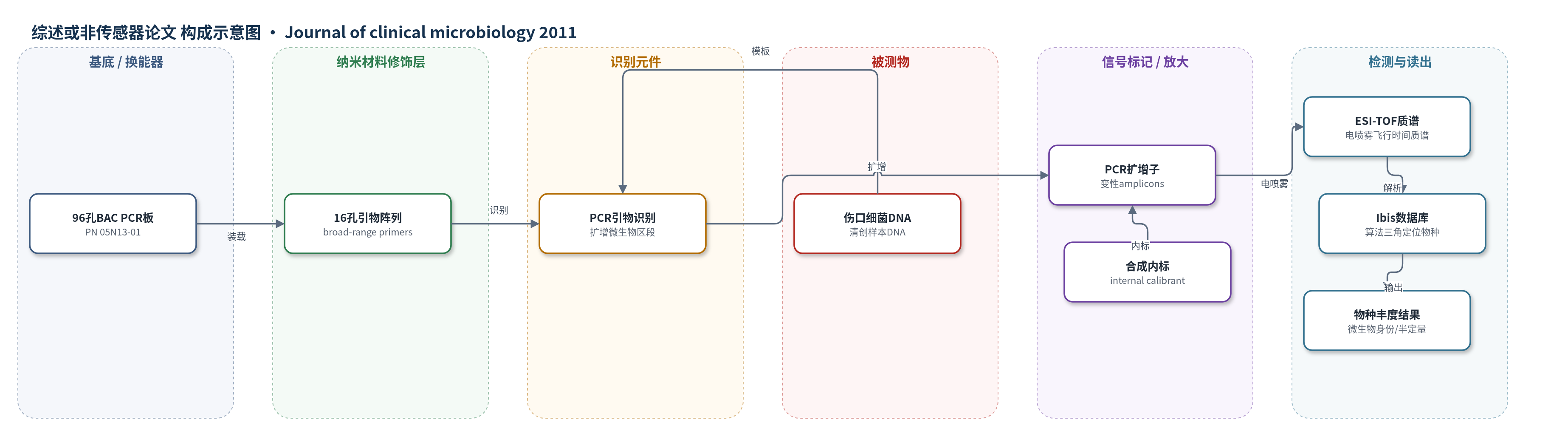
点击图片查看大图 · 依据论文自动绘制
传感器类型
综述或非传感器论文
检测对象
细菌群落(bacterial communities/microbiome)、葡萄球菌属(Staphylococcus)、链球菌属(Streptococcus)、肠杆菌属(Enterobacter)、假单胞菌属(Pseudomonas)、拟杆菌属(Bacteroides);样品基质:下肢静脉功能不全溃疡清创组织(wound debridement tissue)
检测原理
Ibis T5000以多对广谱PCR引物识别并扩增伤口清创样本中不同细菌的基因组/16S区段,PCR实现模板指数放大;反应孔中加入合成核酸内标,用于校正PCR抑制并半定量模板量。扩增子经脱盐后变性,进入高性能电喷雾电离飞行时间质谱(ESI-TOF MS),按分子量/飞行时间检测,推断各扩增子的碱基组成。系统整合多引物碱基组成,与Ibis数据库三角定位微生物身份;质谱峰强度及内标比值随目标菌DNA模板量增加而增强,从而给出相对丰度。该方法可半定量识别占群落约3%以上的微生物。
检测灵敏度
原文未报告LOD、线性范围、灵敏度斜率或R^2;仅报告Ibis可推断占微生物群落≥3%的物种,焦磷酸测序可推断占0.02%的物种。
效应效果
研究纳入10例患者、14份样本。焦磷酸测序在门至种水平识别类群数均多于Ibis和传统培养,物种总数55对29对8,平均8.78对3.29对1。未愈合伤口丰度/多样性显著更高:OTU3% 479对119(P=0.036),Shannon3% 5.21对3.82(P=0.022),ACE3% 603对145(P=0.043)。Ibis与传统培养未显示愈合差异。Ibis与焦磷酸测序对链球菌、拟杆菌及肠杆菌、奈瑟菌、沙雷菌、莫拉菌一致;焦磷酸测序阳性/Ibis阴性约为反向3倍。作者认为焦磷酸测序更适合深度微生物组分析,Ibis适合快速高通量筛查。
传感器的构成
- 反应载体:96孔细菌人工染色体(BAC)检测PCR板(PN 05N13-01,Abbott Molecular),承载16个检测孔并容纳样本DNA。
- 识别元件:16组广谱细菌PCR引物(broad-range primer set),分别扩增不同微生物基因组区段以实现物种识别。
- 内标校准物:合成核酸模板(internal calibrant),加入每个反应孔,控制PCR抑制/假阴性并支持半定量。
- 信号标记物:PCR扩增子(amplicons),经变性后作为ESI-TOF MS分析对象,其分子量反映碱基组成。
- 换能读出:高性能电喷雾电离飞行时间质谱(ESI-TOF MS),将扩增子电离并按飞行时间/质量检测,生成质谱信号。
- 数据分析层:Ibis专有算法与已知微生物数据库,整合多引物碱基组成三角定位微生物身份并估计相对丰度。
中文摘要
微生物感染会延缓伤口愈合,但伤口微生物组组成对愈合参数的影响尚不清楚。为深入了解慢性伤口中的细菌群落,作者对10例下肢静脉功能不全溃疡患者的清创样本进行了分析,采用传统厌氧和需氧细菌培养、Ibis T5000通用生物传感器以及16S 454 FLX钛系列焦磷酸测序。患者均接受至少6个月临床随访,其中5例伤口在6个月内愈合。焦磷酸测序结果显示,6个月未愈合伤口的细菌丰度和多样性显著更高;未愈合伤口中放线菌目(Actinomycetales)比例升高,而6个月随访时愈合伤口中假单胞菌科(Pseudomonadaceae)比例升高。基线伤口面积、病程以及Ibis或传统培养分析均未显示愈合与未愈合伤口之间存在显著差异。因此,焦磷酸测序识别出6个月未愈合伤口的独特基线微生物特征,有助于理解慢性伤口微生物组的特殊性。
英文摘要
Microbial infections delay wound healing, but the effect of the composition of the wound microbiome on healing parameters is unknown. To better understand bacterial communities in chronic wounds, we analyzed debridement samples from lower-extremity venous insufficiency ulcers using the following: conventional anaerobic and aerobic bacterial cultures; the Ibis T5000 universal biosensor (Abbott Molecular); and 16S 454 FLX titanium series pyrosequencing (Roche). Wound debridement samples were obtained from 10 patients monitored clinically for at least 6 months, at which point 5 of the 10 sampled wounds had healed. Pyrosequencing data revealed significantly higher bacterial abundance and diversity in wounds that had not healed at 6 months. Additionally, Actinomycetales was increased in wounds that had not healed, and Pseudomonadaceae was increased in wounds that had healed by the 6-month follow-up. Baseline wound surface area, duration, or analysis by Ibis or conventional culture did not reveal significant differences between wounds that healed after 6 months and those that did not. Thus, pyrosequencing identified distinctive baseline characteristics of wounds that did not heal by the 6-month follow-up, furthering our understanding of potentially unique microbiome characteristics of chronic wounds.