组成图示
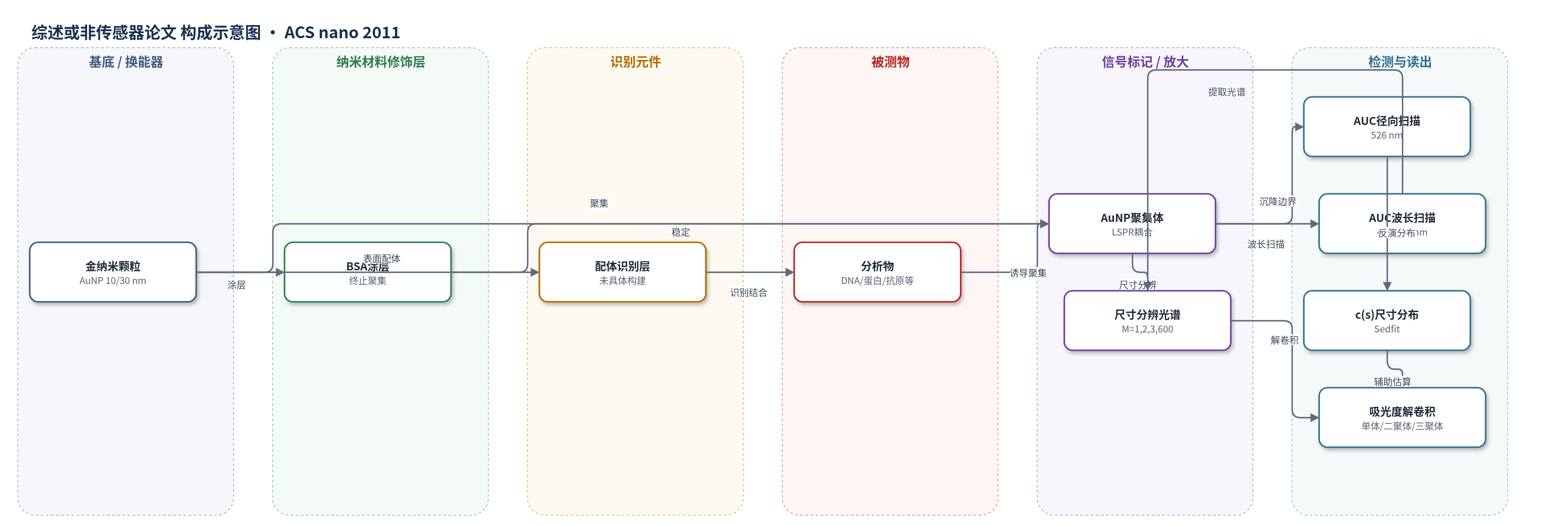
点击图片查看大图 · 依据论文自动绘制
传感器类型
综述或非传感器论文
检测对象
金纳米颗粒聚集体尺寸分布与 LSPR 吸光度(AuNP agglomerate size distribution and LSPR absorbance);样品基质:去离子水、DMEM 细胞培养基(含1% BSA)
检测原理
AUC 在离心场中按沉降系数对 AuNP 聚集体进行空间分离,沉降系数随颗粒密度和尺寸增大。径向扫描在 526 nm 监测沉降边界随时间移动,经 c(s) 反演得到沉降系数分布,再结合 BSA 涂层密度与分形维度换算为水合直径和颗粒数分布。波长扫描在固定半径连续记录 450–800 nm 吸光度,利用时间导数提取不同尺寸聚集体的 LSPR 光谱。聚集体中 AuNP 间等离子体耦合使 526 nm 峰降低,并产生红移峰;红移峰随尺寸增大向约710 nm移动。基于单体、二聚体、三聚体光谱可对总吸光度线性解卷积,估算小聚集体比例。
检测灵敏度
—
效应效果
作者将 AUC 与 DLS-DLCA、AFM、TEM 对比,发现 AUC 可分辨单体、二聚体和三聚体,并测量至约600个颗粒的聚集体;AUC 尺寸分布通常比 DLS-DLCA 预测更宽。聚集1 s 样品经总吸光度解卷积估算的单体、二聚体、三聚体比例与 AUC 实测差异小于6%;聚集2 s 时明显高估尺寸。沉降系数可预测重力沉降:30 nm AuNP 聚集2 min 样品中位尺寸370 nm,沉降速率约0.70 cm/day,20%质量慢于0.35 cm/day或快于1.5 cm/day。作者认为可用于纳米毒性沉降预测和 LSPR/SERS 比色传感器设计。
传感器的构成
- 整体结构:无固定基底,溶液相金纳米颗粒(AuNP)聚集体作为 LSPR 吸光换能元件
- 纳米材料修饰层:牛血清白蛋白(BSA)涂层,终止聚集并稳定聚集体
- 识别元件:未构建具体识别元件;文中仅提及 DNA-DNA、适配体-蛋白、抗体-抗原、凝集素-糖结合等配体可控制聚集
- 信号标记物:无外源标记物,AuNP 聚集体间 LSPR 耦合引起吸光度变化
- 读出装置:分析超速离心(AUC)径向扫描与波长扫描,配合 UV-Vis 吸光度检测
中文摘要
本文报道了利用分析超速离心(AUC)原位表征生物介质中纳米颗粒(NP)聚集体的两项关键性质:聚集体尺寸分布和不同尺寸金纳米颗粒(AuNP)聚集体的局域表面等离子体共振(LSPR)吸光度光谱。作者建立了由沉降系数分布计算水合直径分布的理论框架,测量了单体、二聚体、三聚体及最多约600个颗粒的聚集体沉降速率。结果显示,AUC 获得的尺寸分布通常比动态光散射(DLS)结合扩散受限胶体聚集(DLCA)理论估计的分布更宽。沉降系数还可用于预测聚集体在重力下的沉降速率,为纳米毒性研究提供依据。此外,作者计算了单体至约600颗粒聚集体的吸光度光谱,并验证了利用这些光谱对未知样品总吸光度进行解卷积、估算小聚集体中单体、二聚体和三聚体比例的方法。
英文摘要
Agglomeration of nanoparticles during measurements in relevant biological and environmental media is a frequent problem in nanomaterial property characterization. The primary problem is typically that any changes to the size distribution can dramatically affect the potential nanotoxicity or other size-determined properties, such as the absorbance signal in a biosensor measurement. Herein we demonstrate analytical ultracentrifugation (AUC) as a powerful method for measuring two critical characteristics of nanoparticle (NP) agglomerates in situ in biological media: the NP agglomerate size distribution, and the localized surface plasmon resonance (LSPR) absorbance spectrum of precise sizes of gold NP agglomerates. To characterize the size distribution, we present a theoretical framework for calculating the hydrodynamic diameter distribution of NP agglomerates from their sedimentation coefficient distribution. We measure sedimentation rates for monomers, dimers, and trimers, as well as for larger agglomerates with up to 600 NPs. The AUC size distributions were found generally to be broader than the size distributions estimated from dynamic light scattering and diffusion-limited colloidal aggregation theory, an alternative bulk measurement method that relies on several assumptions. In addition, the measured sedimentation coefficients can be used in nanotoxicity studies to predict how quickly the agglomerates sediment out of solution under normal gravitational forces, such as in the environment. We also calculate the absorbance spectra for monomer, dimer, trimer, and larger gold NP agglomerates up to 600 NPs, to enable a better understanding of LSPR biosensors. Finally, we validate a new method that uses these spectra to deconvolute the net absorbance spectrum of an unknown bulk sample and approximate the proportions of monomers, dimers, and trimers in a polydisperse sample of small agglomerates, so that every sample does not need to be measured by AUC. These results demonstrate the potential utility of AUC to characterize NP agglomeration and sedimentation for nanotoxicity and biosensor studies, as well as to characterize NP agglomerate size and absorbance to improve LSPR and surface-enhanced Raman spectroscopy based biosensors.