组成图示
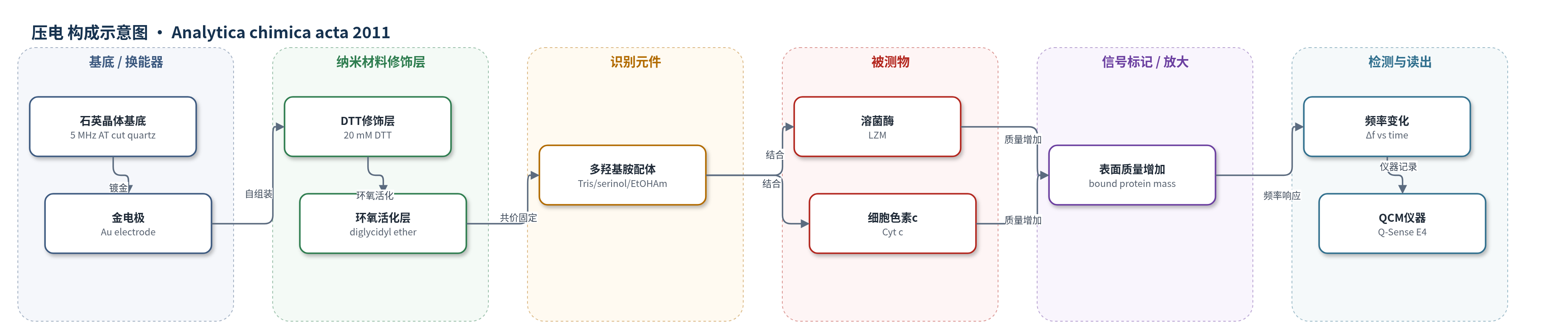
点击图片查看大图 · 依据论文自动绘制
传感器类型
压电(QCM)生物传感器
检测对象
溶菌酶(lysozyme, LZM)、细胞色素 c(cytochrome c, Cyt c)及非特异蛋白(肌红蛋白 Myo、人血清白蛋白 HSA、鸡 IgG、胰蛋白酶、核糖核酸酶 A RNase A),样品基质为 PBS/NaCl 缓冲液蛋白溶液(0.5 mg/mL)
检测原理
QCM 芯片金表面经 DTT 和环氧活化后共价固定 Tris、serinol 或 ethanolamine 多羟基胺配体。蛋白溶液经流动池注入时,LZM 或 Cyt c 与固定配体发生弱亲和特异性结合,使晶体表面质量增加;依据 QCM 质量-频率响应,谐振频率随结合蛋白量增加而下降。由于表观解离常数在 10^-4 M 量级,结合复合物在等度 PBS/NaCl 缓冲液中可快速自解离,频率恢复基线。非特异蛋白不结合,频率保持基线。信号大小反映结合蛋白量,可用于快速筛选配体-蛋白相互作用。
检测灵敏度
—
效应效果
QCM 筛选仅 LZM 和 Cyt c 结合,其他蛋白无响应。前沿分析:Tris 柱 KD,Cyt c=5.5×10^-4 M、KD,LZM=0.65×10^-4 M;serinol 2.4×10^-4、1.5×10^-4 M;ethanolamine 4.4×10^-4、2.7×10^-4 M。混合蛋白分离:Tris 柱 Rs=1.53 基线分离,serinol、ethanolamine 为 0.96、1.41,10 min 完成,300 mM NaCl 洗脱。Tris 柱 RSD:保留时间 0.4%/0.1%,峰面积 2.4%/2.2%;12 个月后 Rs=1.48,降 3%。小分子配体低成本、稳定,适合多蛋白单柱分离。
传感器的构成
- 基底/换能器:5 MHz AT 切石英晶体,双面金电极(测量面 13 mm、空气面 5.5 mm),提供压电换能与频率读出
- 自组装/活化层:20 mM DTT 乙醇溶液修饰金表面 24 h,提供反应位点并降低非特异吸附
- 环氧活化层:1,4-丁二醇二缩水甘油醚(1,4-butanediol diglycidyl ether)在 0.1 M Na2CO3/NaBH4 中反应,引入环氧基团用于共价固定配体
- 识别/配体层:Tris-HCl、serinol-HCl 或 ethanolamine-HCl(1.0 M, pH 8.5)共价固定,作为弱亲和识别元件
- 封闭层:相应配体-HCl 缓冲液封闭残余反应位点,减少非特异吸附
- 被测物:LZM、Cyt c 等蛋白溶液(50 mM PBS/100 mM NaCl, pH 7.0),与固定配体结合
- 读出:Q-Sense E4 QCM 系统记录频率-时间曲线,结合引起频率下降
中文摘要
本研究利用石英晶体微天平(QCM)生物传感器对多种多羟基胺小分子(三羟甲基氨基甲烷 Tris、丝氨酸醇 serinol、乙醇胺 ethanolamine)进行快速筛选,发现它们可作为弱亲和配体与溶菌酶(LZM)和细胞色素 c(Cyt c)发生特异性识别。基于该识别作用,作者分别将三种多羟基胺固定于硅胶微球制备弱亲和色谱柱,用于两种蛋白的分离。前沿分析表明配体-蛋白复合物的表观解离常数均在 10^-4 M 量级,属于弱亲和相互作用。在单次进样-洗脱循环中,三种配体修饰柱均能将 LZM 和 Cyt c 作为延迟峰与非特异性蛋白及彼此分离;其中 Tris 修饰柱实现基线分离,并表现出良好的重复性和长期稳定性。该“QCM 筛选配体 + 弱亲和色谱分离”策略有望拓展弱亲和配体种类,发展低成本、可多目标蛋白分离纯化的亲和方法。
英文摘要
Multi-hydroxyl amines including tris(hydroxymethyl)aminomethane (Tris), serinol and ethanolamine were selected as weak affinity ligands using a rapid screening by quartz crystal microbalance (QCM) biosensor. Based on the specific recognition between the ligands and two proteins, lysozyme (LZM) and cytochrome c (Cyt c), a weak affinity chromatography method was developed for specific separation of the two proteins. The frontal analysis results showed that the apparent dissociation constants (K(D)) of ligand-protein complexes were all in the order of weak affinity (10(-4) M). By weak affinity columns modified with the three multi-hydroxyl amines individually, LZM and Cyt c were baseline separated as retarded peaks from non-specific protein and each other in a single cycle of loading and eluting. Moreover, the Tris-modified column typically showed the satisfactory repeatability and stability as a new type of weak affinity columns. The present strategy composed of QCM selecting and affinity chromatography separating was promising to extend the variety of weak affinity ligands and develop inexpensive specific affinity methods for separation and purification of multiple proteins on one single column.