组成图示
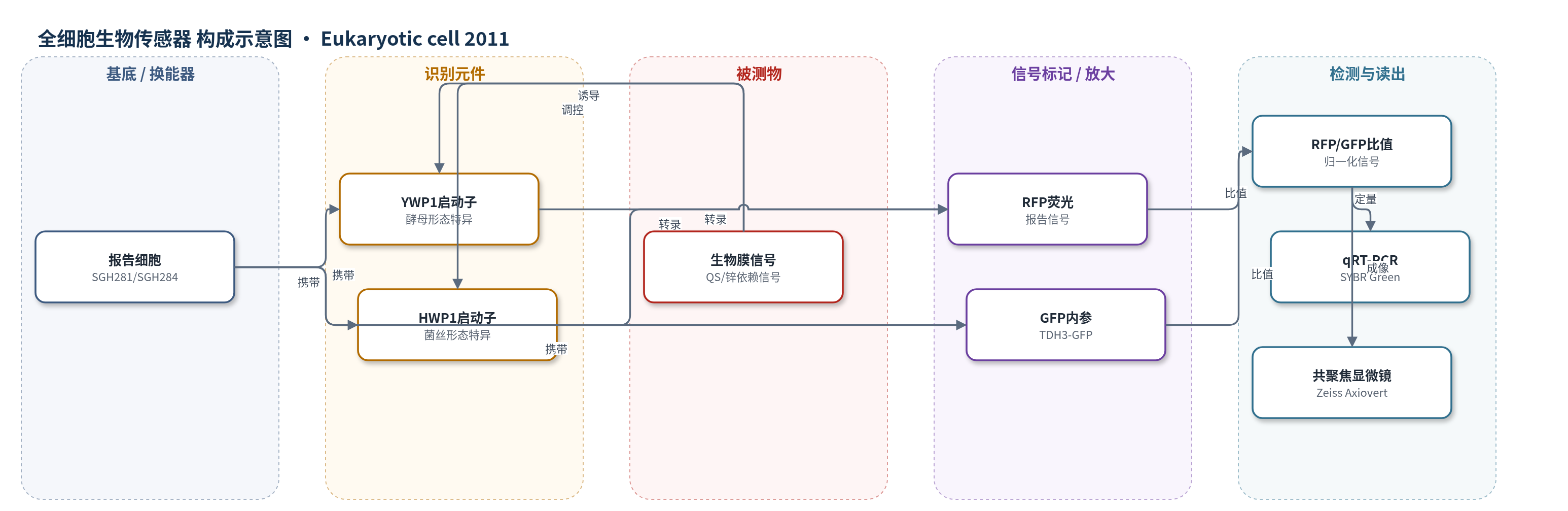
点击图片查看大图 · 依据论文自动绘制
传感器类型
全细胞生物传感器
检测对象
酵母形态调控信号(YWP1-responsive signal)、菌丝形态调控信号(HWP1-responsive signal)、法尼醇(farnesol)等群体感应分子(QS molecules);样品基质:Candida albicans 混合生物膜及生物膜上清
检测原理
该全细胞生物传感器以白念珠菌报告菌株为识别与换能单元。菌株中酵母特异性YWP1启动子或菌丝特异性HWP1启动子驱动RFP表达,组成型TDH3启动子驱动GFP作为内参。将报告细胞接种到不同白念珠菌生物膜后,生物膜分泌的可扩散细胞间信号分子(如法尼醇及锌依赖未知信号)进入报告细胞,改变YWP1或HWP1启动子活性,从而调节RFP转录和荧光强度;GFP表达保持相对稳定,RFP/GFP比值随被测信号强度变化。信号通过qRT-PCR检测RFP/GFP mRNA或共聚焦显微镜检测RFP/GFP荧光比值读出。该过程无化学放大,依赖启动子转录调控和荧光蛋白表达。
检测灵敏度
—
效应效果
报告菌株在酵母和菌丝条件下呈现预期选择性,75和200 μM法尼醇可抑制菌丝报告并促进酵母报告。混合生物膜中,zap1Δ/Δ使YWP1-RFP mRNA较互补株和野生型升高约2倍(P=0.0074、0.0028),共聚焦成像一致;HWP1-RFP无显著差异。ZRT2过表达将YWP1-RFP恢复至野生型水平(P=0.003)。GC-MS显示zap1Δ/Δ生物膜法尼醇产量显著低于野生型(P=0.0001),ZRT2过表达不改变已知QS分子。作者认为该全细胞报告系统可独立于突变体形态采样生物膜微环境,揭示Zap1/锌依赖细胞间信号。
传感器的构成
- 细胞基底/报告细胞:Candida albicans 野生型报告菌株 SGH281(YWP1-RFP)或 SGH284(HWP1-RFP),作为全细胞识别与信号转导单元
- 识别元件:酵母特异性 YWP1 启动子/5' 区或菌丝特异性 HWP1 启动子/5' 区,响应生物膜微环境中的形态信号
- 信号标记物:RFP(红色荧光蛋白),融合于 YWP1 或 HWP1 启动子下游,作为荧光报告信号
- 内参/归一化元件:TDH3 启动子驱动的 GFP(绿色荧光蛋白),用于 RFP/GFP 比值归一化
- 读出系统:qRT-PCR(SYBR Green、iCycler iQ)和共聚焦显微镜(Zeiss Axiovert 200)检测 RFP/GFP 转录或荧光比值
中文摘要
白念珠菌生物膜同时包含酵母细胞和菌丝。既往研究表明,锌调节因子Zap1缺失突变体(zap1Δ/Δ)生物膜中酵母细胞积累增加,这种酵母-菌丝平衡改变可能源于细胞内部调控变化,也可能源于可扩散群体感应(QS)分子产生受影响。本研究构建了表达酵母特异性YWP1-RFP或菌丝特异性HWP1-RFP,并携带组成型TDH3-GFP归一化标准的生物传感器报告菌株。将这些报告菌株接种到生物膜中,可对周围生物膜微环境进行生物活性检测。zap1Δ/Δ生物膜可诱导野生型报告菌株中酵母特异性YWP1-RFP报告基因表达,qRT-PCR和共聚焦显微镜均证实该诱导。通过过表达锌转运体基因ZRT2修复zap1Δ/Δ的锌摄取缺陷后,YWP1-RFP诱导被逆转。气相色谱-质谱(GC-MS)检测已知有机QS分子显示,zap1Δ/Δ突变体积累的法尼醇显著低于野生型或互补株,而ZRT2过表达不影响法尼醇积累。法尼醇是已知的菌丝形成抑制剂,因此zap1Δ/Δ生物膜中法尼醇降低出乎意料。结果提示Zap1和锌依赖信号影响酵母-菌丝平衡,并在zap1Δ/Δ生物膜的低法尼醇环境中发挥作用;同时表明Zap1是法尼醇积累的正向调节因子。
英文摘要
Biofilms of Candida albicans include both yeast cells and hyphae. Prior studies indicated that a zap1Δ/Δ mutant, defective in zinc regulator Zap1, has increased accumulation of yeast cells in biofilms. This altered yeast-hypha balance may arise from internal regulatory alterations or from an effect on the production of diffusible quorum-sensing (QS) molecules. Here, we develop biosensor reporter strains that express yeast-specific YWP1-RFP or hypha-specific HWP1-RFP, along with a constitutive TDH3-GFP normalization standard. Seeding these biosensor strains into biofilms allows a biological activity assay of the surrounding biofilm milieu. A zap1Δ/Δ biofilm induces the yeast-specific YWP1-RFP reporter in a wild-type biosensor strain, as determined by both quantitative reverse transcription-PCR (qRT-PCR) gene expression measurements and confocal microscopy. Remediation of the zap1Δ/Δ zinc uptake defect through zinc transporter gene ZRT2 overexpression reverses induction of the yeast-specific YWP1-RFP reporter. Gas chromatography-mass spectrometry (GC-MS) measurements of known organic QS molecules show that the zap1Δ/Δ mutant accumulates significantly less farnesol than wild-type or complemented strains and that ZRT2 overexpression does not affect farnesol accumulation. Farnesol is a well-characterized inhibitor of hypha formation; hence, a reduction in farnesol levels in zap1Δ/Δ biofilms is unexpected. Our findings argue that a Zap1- and zinc-dependent signal affects the yeast-hypha balance and that it is operative in the low-farnesol environment of the zap1Δ/Δ biofilm. In addition, our results indicate that Zap1 is a positive regulator of farnesol accumulation.