组成图示
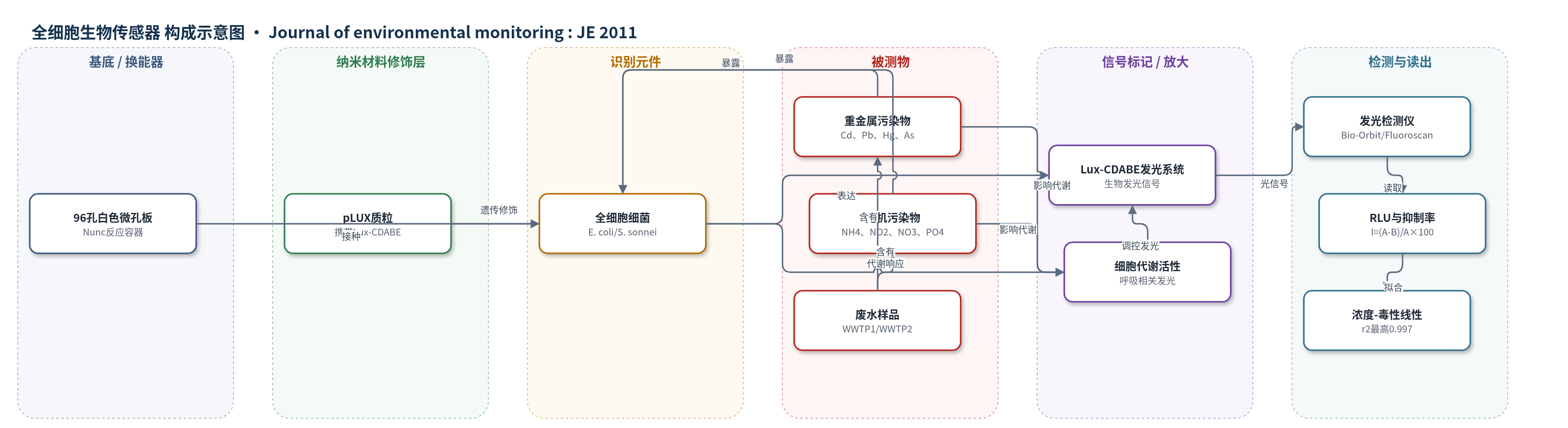
点击图片查看大图 · 依据论文自动绘制
传感器类型
全细胞生物传感器
检测对象
镉(Cd)、铅(Pb)、汞(Hg)、砷(As)、铵(NH4+)、亚硝酸盐(NO2-)、硝酸盐(NO3-)、磷酸盐(PO4^3-);样品基质:污水处理厂进水/出水废水(wastewater influent/effluent)
检测原理
该传感器以携带 pLUX 质粒的 E. coli 或 S. sonnei 全细胞作为识别与换能单元。pLUX 质粒携带 Lux-CDABE 操纵子,在菌体内表达细菌荧光素酶系统,其生物发光强度与细胞呼吸和代谢活性直接相关。当废水或标准溶液中的重金属(Cd、Pb、Hg、As)和无机污染物(NH4+、NO2-、NO3-、PO4^3-)与菌体接触时,污染物进入细胞或干扰其代谢过程:低浓度可产生刺激效应,高浓度则抑制细胞活性,使发光强度发生可测变化。检测时以无污染物对照的发光值 A 和含污染物样品发光值 B 计算抑制率 I=(A-B)/A×100,并用发光仪读取相对发光单位 RLU。在特定浓度范围内,发光变化或抑制率与污染物浓度呈线性相关,从而实现对废水中污染物浓度和毒性的快速估算。
检测灵敏度
线性范围: Cd 至 60 mg L−1(原文仅提及镉);相关系数与斜率: S. sonnei Cd r2=0.988、斜率=63.00 % bioluminescence per mg L−1;Pb r2=0.964、斜率=1.395;Hg r2=0.995、斜率=129.00;As r2=0.954、斜率=30.99;NH4 r2=0.997、斜率=15 060;NO2 r2=0.965、斜率=837.5;NO3 r2=0.874、斜率=2862;PO4 r2=0.881、斜率=318.5。E. coli Cd r2=0.824、斜率=1.599;Pb r2=0.935、斜率=5.103;Hg r2=0.909、斜率=186.8;As r2=0.944、斜率=29.63;NH4 r2=0.944、斜率=92.14;NO2 r2=0.901、斜率=4616;NO3 r2=0.981、斜率=98.32;PO4 r2=0.984、斜率=870.8。
效应效果
与 Daphnia magna 相比,细菌传感器对 WWTP1 进水毒性响应为 72–100%、38–100%、0–86%,对 WWTP2 进水 E. coli 最高 90%;S. sonnei 对出水毒性 0–49%,而 Daphnia 进水/出水死亡率 60–100%、15–95%,总体更敏感。生物传感器响应与 BOD、COD 无显著相关,反映生物可利用毒性。对单一污染物,发光与浓度线性相关,r2 最高 0.995 和 0.997,可估算浓度。原文未报告 RSD、回收率、长期稳定性或选择性实验。作者认为其简单、快速、低成本,适合现场监测,但需组合多种毒性试验。
传感器的构成
- 识别/换能元件:重组大肠杆菌(E. coli)或志贺氏菌(S. sonnei)全细胞,作为毒性识别与代谢响应元件
- 信号基因元件:pLUX 质粒携带 Lux-CDABE 操纵子,编码细菌荧光素酶系统并产生生物发光
- 培养维持层:LB 培养基(LB broth/agar)与氨苄青霉素(Amp),用于菌体生长和质粒维持
- 样品反应容器:白色圆底 96 孔微孔板(Nunc, Thermo-Labsystems),用于菌体与废水/污染物接触
- 重悬/稀释介质:0.1 M KCl 用于菌体重悬;废水、重金属和无机化合物稀释液作为样品基质
- 信号读出装置:Bio-Orbit 1254 luminometer 或 Fluoroscan Ascent FL,读取相对发光单位(RLU)
中文摘要
随着废水排放中潜在有害污染物不断增加,迫切需要快速、低成本的分析技术对污水处理效果进行广泛监测。本研究将基于细菌的生物传感器与传统大型溞(Daphnia magna)试验、化学需氧量(COD)、生化需氧量(BOD)测试以及化学分析方法进行比较,用于监测废水毒性。利用志贺氏菌(S. sonnei)和大肠杆菌(E. coli)构建的细菌生物传感器对废水样品的毒性表现出敏感性。在水样中,随着重金属和无机污染物浓度升高,生物发光呈线性变化,相关系数(r2)分别高达0.995和0.997。生物传感器毒性响应与BOD和COD测试结果之间未观察到显著相关。这些细菌生物传感器可为废水质量提供快速、灵敏且低成本的检测替代方案。然而,不同体系间灵敏度的差异提示,可能需要组合多种毒性试验,才能对废水样品进行真实的生态毒理学评估。
英文摘要
The increasing number of potentially harmful pollutants in the wastewater effluent discharge necessitates the need for the development of fast and cost effective analytical techniques for extensive monitoring programmes to assess the effectiveness of the treatment process. This study compared the use of bacterial biosensors to the conventional Daphnia magna assay, Chemical Oxygen Demand (COD) and Biochemical Oxygen Demand (BOD) tests as well as chemical analysis, for monitoring the toxicity of wastewater. The bacterial biosensors constructed in this study, using S. sonnei and E. coli, were found to be sensitive to the toxicity of the wastewater effluents. A linear increase in bioluminescence with increasing concentration of heavy metals and inorganic pollutants in water was observed, with a correlation coefficient (r(2)) as high as 0.995 and 0.997, respectively. No notable correlation between biosensor toxicity and BOD and COD test results was observed. These bacterial biosensors could provide appropriate alternatives for a rapid, sensitive and cost effective detection of wastewater quality. However, the differences in sensitivity obtained for the different systems suggest that the use of a battery of toxicity assays may be required to provide a real ecotoxicological assessment of wastewater samples.