组成图示
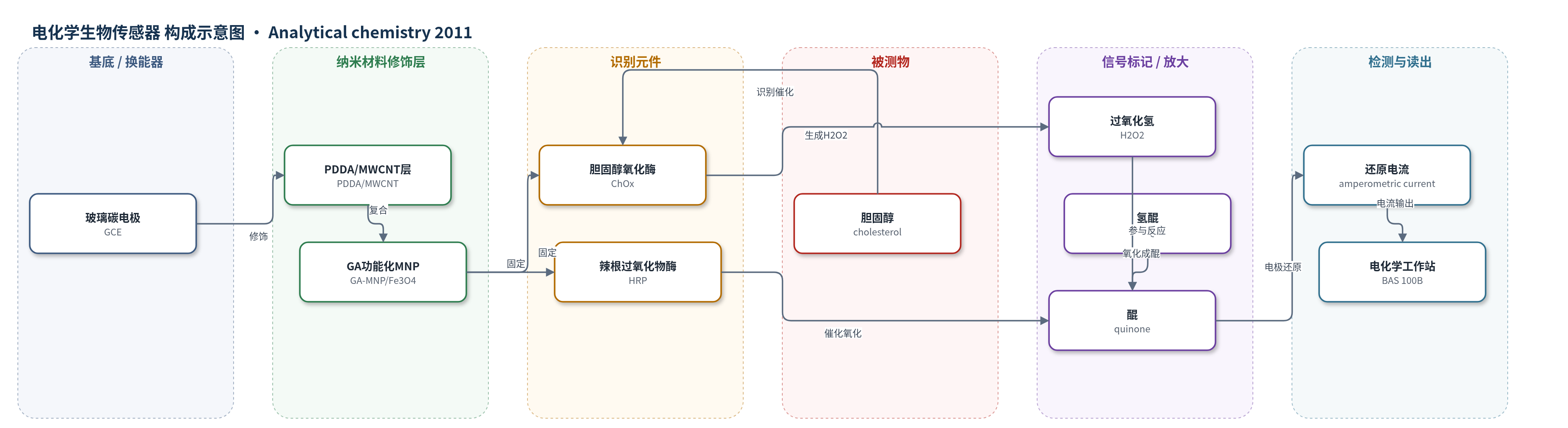
点击图片查看大图 · 依据论文自动绘制
传感器类型
电化学生物传感器
检测对象
胆固醇(cholesterol);样品基质:人血清(human serum,加标)、磷酸盐缓冲液(PBS)
检测原理
胆固醇在胆固醇氧化酶(ChOx)催化下氧化,生成过氧化氢(H2O2)。辣根过氧化物酶(HRP)在氢醌(HQ)存在下催化 H2O2 氧化 HQ 为醌,醌随后在玻璃碳电极(GCE)表面于 -0.05 V 被电化学还原,产生与胆固醇浓度成正比的稳态电流。PDDA/MWCNT 修饰层提供导电通道并加速电子转移,GA 功能化 Fe3O4 磁性纳米颗粒提供高负载酶固定位点,改善酶微环境并降低 H2O2 还原电位,从而减少干扰和 H2O2 积累导致的 ChOx 失活。双酶级联反应与纳米复合界面高酶负载共同实现信号放大。
检测灵敏度
LOD: 0.85 μM;线性范围: 0.01–0.95 mM;灵敏度斜率: 25.4 μA/mM;相关系数: r = 0.996
效应效果
在 -0.05 V 低电位检测,可减少血清中抗坏血酸、尿酸等干扰。重复性 RSD 5.8%,重现性 RSD 8.2%,单电极至少 14 天稳定。人血清加标 2.0、5.0、7.0 mM 胆固醇回收率分别为 101.0%、100.2%、103.3%,RSD 为 5.5%、4.3%、3.3%。与文献相比,LOD 0.85 μM 比某些设计低 35 倍,线性范围更宽;斜率 25.4 μA/mM 高于 PPD(PDDA/ChOx)n/MWCNT/AuE(0.175 μA/mM)。表观 Km 1.57 mM 低于 PPD 设计 7.17 mM。作者认为该平台可推广至多酶生物传感器。
传感器的构成
- 基底电极:玻璃碳电极(GCE),作为工作电极和电子传导基底
- 碳纳米管修饰层:羧基化多壁碳纳米管(MWCNTs)经聚二烯丙基二甲基氯化铵(PDDA)静电包覆形成 PDDA/MWCNT,增强导电性、电子转移和界面稳定性
- 磁性纳米颗粒复合层:氨基硅烷(APTES)包覆的 Fe3O4 磁性纳米颗粒(Fe3O4/APTES MNPs)经戊二醛(GA)功能化,提供酶固定位点并辅助组装
- 识别/催化元件:胆固醇氧化酶(ChOx)与辣根过氧化物酶(HRP)共固定于 GA-MNP/PDDA/MWCNT 表面,分别催化胆固醇氧化和 H2O2 还原
- 氧化还原介质(电子供体):氢醌(HQ)在溶液中作为电子传递介质,被 HRP 催化氧化为醌,醌在电极上还原产生电流
中文摘要
本文报道了一种新型生物传感电极表面的设计,将戊二醛(GA)功能化的磁性铁氧体纳米颗粒(MNPs)与聚二烯丙基二甲基氯化铵(PDDA)包覆的多壁碳纳米管(MWCNTs)结合,用于构建高性能多酶生物传感器。在固定酶之前,先将羧基化 MWCNTs 与带正电的 PDDA 静电包覆,再与 GA 功能化 MNPs 相互作用,形成 GA-MNP/PDDA/MWCNT 纳米共轭物,并通过扫描电子显微镜和电化学方法表征。该平台用于构建胆固醇双酶生物传感器,共固定胆固醇氧化酶(ChOx)和辣根过氧化物酶(HRP),并以氢醌(HQ)为氧化还原介质。通过优化制备和分析变量,在 -0.05 V 下获得胆固醇 0.01–0.95 mM 的线性校准曲线,检出限为 0.85 μM,表观 Michaelis–Menten 常数为 1.57 mM。人血清加标胆固醇的回收率为 100%–103%。
英文摘要
The design of a novel biosensing electrode surface, combining the advantages of magnetic ferrite nanoparticles (MNPs) functionalized with glutaraldehyde (GA) and poly(diallyldimethylammonium chloride) (PDDA)-coated multiwalled carbon nanotubes (MWCNTs) as platforms for the construction of high-performance multienzyme biosensors, is reported in this work. Before the immobilization of enzymes, GA-MNP/PDDA/MWCNT composites were prepared by wrapping of carboxylated MWCNTs with positively charged PDDA and interaction with GA-functionalized MNPs. The nanoconjugates were characterized by scanning electron microscopy (SEM) and electrochemistry. The electrode platform was used to construct a bienzyme biosensor for the determination of cholesterol, which implied coimmobilization of cholesterol oxidase (ChOx) and peroxidase (HRP) and the use of hydroquinone as redox mediator. Optimization of all variables involved in the preparation and analytical performance of the bienzyme electrode was accomplished. At an applied potential of -0.05 V, a linear calibration graph for cholesterol was obtained in the 0.01-0.95 mM concentration range. The detection limit (0.85 μM), the apparent Michaelis-Menten constant (1.57 mM), the stability of the biosensor, and the calculated activation energy can be advantageously compared with the analytical characteristics of other CNT-based cholesterol biosensors reported in the literature. Analysis of human serum spiked with cholesterol at different concentration levels yielded recoveries between 100% and 103%