组成图示
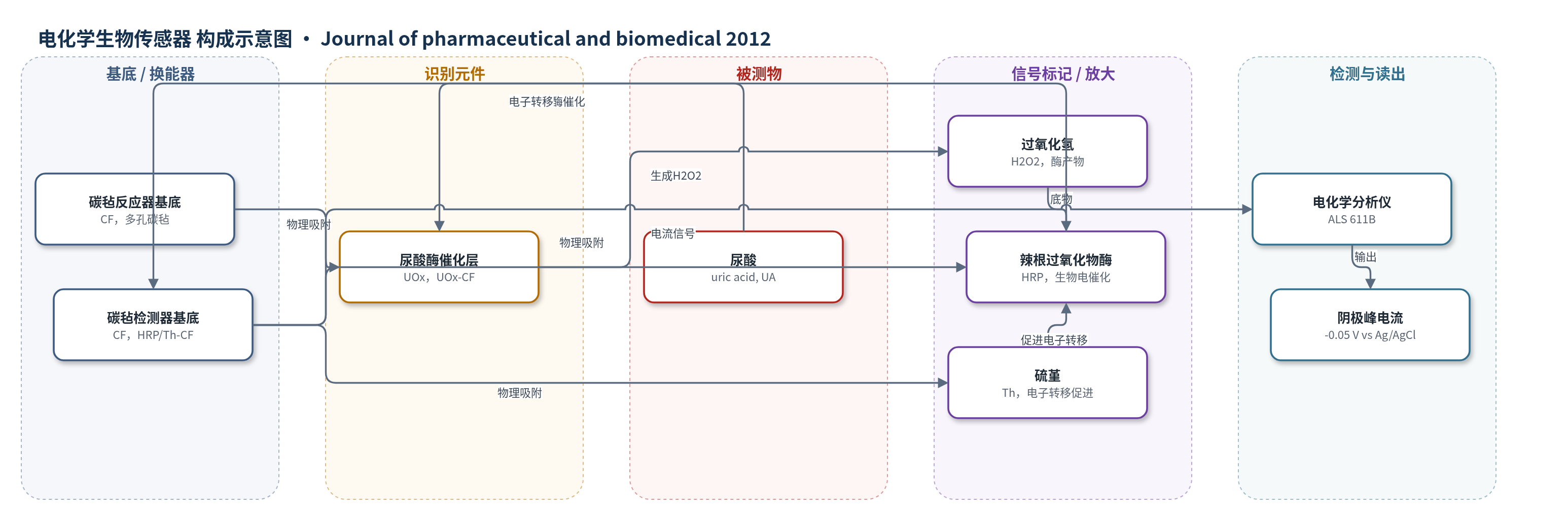
点击图片查看大图 · 依据论文自动绘制
传感器类型
电化学生物传感器
检测对象
尿酸(uric acid, UA);样品基质:人血清(human serum)、人尿液(human urine),分别稀释100倍和1000倍后检测
检测原理
尿酸随载液进入UOx-CF反应器后,被物理吸附的尿酸酶(UOx)特异性催化氧化,同时消耗溶解氧并生成尿囊素和过氧化氢(H2O2)。H2O2随流动相进入HRP/Th-CF检测器,在-0.05 V(vs Ag/AgCl)下被辣根过氧化物酶(HRP)生物电催化还原;HRP中间体(Compound I/II)与碳毡(CF)表面发生直接电子转移,硫堇(Th)共吸附促进电子传递,从而产生与H2O2浓度相关的阴极峰电流。由于UOx对尿酸高特异性,且低电位避免抗坏血酸直接氧化,信号主要反映尿酸浓度。多孔CF提供大有效面积和低扩散阻力,提高传质与电流响应。
检测灵敏度
LOD: 0.18 μM;线性范围: 0.3–20 μM;灵敏度: 0.25 μA/μM;R^2 = 0.9968
效应效果
该传感器对尿酸具有良好选择性,检测电位-0.05 V可避免抗坏血酸直接电化学氧化干扰。重复进样10 μM尿酸15次响应稳定,RSD 0.55%(n=10);不同批次UOx-CF日内RSD 3.2%(n=3),日间RSD 4.84%(n=4);HRP/Th-CF制备RSD 5.7%(n=3)。UOx-CF 4℃保存3天和7天后活性分别保持约81%和63%。人血清和尿液分别稀释100和1000倍后测定,结果与Urate-C酶法分光光度法一致,如血清A 0.23±0.007 mM(RSD 3.23%)对比0.20 mM,尿液A 3.3±0.06 mM(RSD 1.89%)对比3.1 mM。作者认为其适合临床体液尿酸在线/高通量分析。
传感器的构成
- 反应器基底:碳毡(CF,GF-20-3F,聚丙烯腈2000 ℃热解,孔隙率>90%),作为高孔隙三维微电极集流体,承载UOx并允许载流通过
- 识别/催化元件:尿酸酶(UOx,urate oxidase,EC 1.7.3.3,Candida sp.),物理吸附于CF形成UOx-CF柱式反应器,催化尿酸氧化生成H2O2
- 检测器基底:碳毡(CF),作为HRP/Th-CF生物电催化流动检测器的工作电极,提供导电多孔表面
- 信号转换元件:辣根过氧化物酶(HRP,EC 1.11.1.7),与Th共吸附于CF,催化H2O2还原并产生阴极电流
- 电子转移促进剂:硫堇(Th,thionine chloride),与HRP共吸附,促进HRP血红素中心与CF间电子转移
- 流动注射系统:双注射泵(SNK DX2000)、六通进样阀(SVM-6M2,200 μL进样环)和PTFE管(0.5 mm),输送载液与样品并连接反应器与检测器
- 信号读出:电化学分析仪(ALS 611B),在-0.05 V vs Ag/AgCl记录阴极峰电流
中文摘要
将尿酸酶(UOx)物理吸附于多孔碳毡(CF)表面,制备UOx-CF柱式酶反应器,并与辣根过氧化物酶(HRP)和硫堇(Th)共吸附碳毡(HRP/Th-CF)生物电催化H2O2流动检测器联用,构建尿酸流动安培生物传感器。在UOx-CF反应器中,UOx催化尿酸氧化生成H2O2;H2O2随载流进入HRP/Th-CF检测器,在-0.05 V(vs Ag/AgCl)下经HRP生物电催化还原产生阴极峰电流。系统优化了UOx吸附pH、缓冲液类型与浓度、UOx浓度、吸附时间以及载流流速和pH。所得传感器灵敏度0.25 μA/μM,线性范围0.3–20 μM,检出限0.18 μM,样品通量约30–90个/小时。用于高度稀释人血清和尿液中尿酸测定,结果与常规酶法分光光度法一致。
英文摘要
Uricase (urate oxidase, UOx) was adsorbed onto a porous carbon-felt (CF) surface and the resulting UOx-adsorbed CF (UOx-CF) was successfully used as a column-type enzyme reactor coupled with a peroxidase-adsorbed CF-based bioelectrocatalytic H(2)O(2) flow-detector to fabricate a flow-amperometric biosensor for uric acid. In this flow-biosensor system, H(2)O(2) produced in the UOx-CF reactor was cathodically detected by horseradish peroxidase (HRP) and a thionine (Th)-coadsorbed CF (HRP/Th-CF)-based bioelectrocatalytic flow-detector at -0.05V vs. Ag/AgCl. Various adsorption conditions of the UOx (i.e., pH of the adsorption solution, type and concentration of the buffer used as the adsorption solvent, UOx concentration and adsorption time) and the operational conditions of the UOx-CF and HRP/Th-CF-coupled flow-biosensor (i.e., carrier flow rate and carrier pH) were optimized to obtain highly sensitive, selective and stable peak current responses to uric acid. The analytical performance of the UOx-CF and HRP/Th-CF-coupled flow biosensor for uric acid was as follows: sensitivity, 0.25μA/uM; linear range, 0.3-20μM; lower detection limit, 0.18μM; and sample throughput, ca. 30-90 samples/h. The resulting amperometric flow-biosensor for uric acid allowed the determination of uric acid in highly diluted body fluids (human serum and urine), and the analytical results obtained by the present biosensor were in fairly good agreement with those obtained by conventional enzyme-based spectrophotometry.